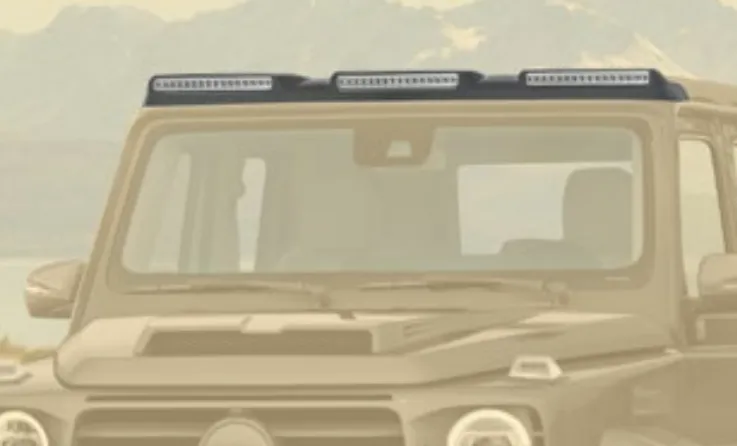
Roof panel with 3 position lights Hella


Mansory Gronos Roof Panel with 3 Hella Position Lights for Mercedes-Benz G-Class W465
The roof panel finished with three Hella-spec position lights is the mid-tier choice in the Mansory Gronos lighting hierarchy for the new W465 G-Class. Where the two-lamp configuration delivers a clean dual-beam stance and the six-lamp version pushes towards rally-grade saturation, the three-lamp layout introduces a deliberate beam-pattern logic: a narrow long-throw spotlight at the centre, flanked by two wide-flood units. The result is an asymmetric optical signature that reads as purposeful — neither minimalist nor maximalist — and a real-world performance profile that suits both expedition usage and night highway cruising. This page covers what the three-light Hella roof panel actually does, how it differs from its siblings on the same parent kit, and how the part is built into the wider Mansory Gronos visual program.
Beam-Pattern Logic: Centre Spot Flanked by Twin Floods
The defining technical story of this roof panel is not the count of lamps but the optical division of labour between them. The centre lamp is configured as a driving-beam spotlight — a tight, high-intensity cone designed to throw light far down the road, typically two to three hundred metres ahead at full output. The two outer lamps are flood units with a much wider horizontal spread, illuminating the verges, shoulders, and any peripheral movement in the lateral field. Together they create a T-shaped pool of light: deep along the centreline, broad across the foreground. Drivers who have run two-lamp arrays on previous G-Class generations will recognise immediately what the third lamp adds — not raw lumens, but optical reach into a band the flood pair cannot service.
Where Three Lamps Sit in the Hierarchy
Mansory offers the Gronos roof panel in three discrete lighting tiers. The two-lamp variant is the entry point, prized for its clean visual proportion and minimal aerodynamic intrusion. The six-lamp version is the saturation option, fitted to vehicles where total forward illumination and the rally-style aesthetic are the priorities. The three-lamp Hella build slots between them as a considered middle path — meaningful capability without over-styling the roofline. Buyers who hesitate between two and six lamps frequently land here once they have understood that the three-lamp configuration is not simply a half-measure but a distinct optical solution. Compare the alternatives on the two-position-lights Hella roof panel and the six-light Gronos roof panel to see the visual progression first-hand, or browse the standard two-lamp roof panel for the entry baseline.
Hella Lamp Specification Across All Three Positions
All three lamp positions are populated with Hella OEM-grade hardware. Hella supplies the same automotive-tier optics the unit-makers fit at the factory — sealed housings, polycarbonate lenses with hard coatings, and electronic ballasts where applicable. Beam patterns are homologated to the European ECE Regulations governing auxiliary forward lamps, meaning the panel is road-legal across the EU and most jurisdictions that recognise ECE markings. The centre spotlight typically carries an ECE Reference Number indicating its long-range driving-beam classification, while the flood units are marked for auxiliary use. Choosing Hella over generic LED bars is not cosmetic — it determines whether the vehicle can pass MOT/TÜV inspection with the lamps fitted and energised.
Twin-Relay Wiring Architecture
Three lamps require more than three wires. The Mansory wiring harness for the three-lamp roof panel routes the centre spot through one dedicated relay and the flood pair through a second, sharing power from a fused tap into the W465 light control circuit. The centre relay is high-current — driving a long-throw lamp at full output draws considerably more than a flood pair — and is sized accordingly. The dual-relay architecture also lets the driver activate the floods independently of the spot, useful when crawling in technical terrain where a long-throw beam would over-illuminate the foreground. Switching is handled through the panel start-button cluster on the headliner, integrated with the rest of the Gronos roof electronics.
Weight, Cantilever Load, and Roll-Axis Effects
Adding a third lamp to the roof is not optically free at the chassis level. Each Hella unit with its mount, harness section, and lens shield contributes around 1.2 to 1.6 kilograms; the three-lamp build adds approximately 3.5 to 5 kilograms over the bare panel. That mass sits high above the roll axis, increasing the polar moment slightly and making the vehicle marginally more reluctant to change direction quickly. On a G-Class — a high-CG ladder-frame SUV already biased towards stability over agility — the effect is barely perceptible at road speeds and is fully compensated by the standard W465 air-suspension calibration. Off-road at low crawl speeds, no rider-feedback change has been reported by long-term users.
ECE Compliance for Three Auxiliary Lamps
European homologation rules permit auxiliary forward lamps in pairs, and the centre spot is treated as a single auxiliary driving lamp under ECE R112 or equivalent. The three-lamp configuration is therefore compliant when each lamp carries valid markings and the wiring permits the spot to be deactivated independently of the dipped-beam circuit. Mansory supplies the panel with all necessary documentation, and the Hella lamps carry the type-approval markings inspectors look for. Owners planning international use should keep the homologation paperwork in the vehicle.
Three-Lamp vs Two-Lamp Hella vs Six-Lamp: Decision Notes
Against the two-lamp Hella roof panel, the three-lamp version trades a small amount of aerodynamic cleanliness and roughly 1.5 to 2 kg of additional mass for a usable centre spotlight. Against the six-lamp Gronos roof panel, it trades raw illumination output and the rally-look aesthetic for a much subtler roofline and lower wiring complexity. The three-lamp layout also reads as more deliberate visually — six lamps look uncompromising, two look minimalist, three look engineered. For owners considering the alternative wing-style roof furniture instead, the Gronos roof wing is the aerodynamic counterpart with no lighting at all.
Integration with the Wider Gronos Programme
This panel is one component of the full Mansory Gronos body kit for the Mercedes-Benz G-Class W465. The roof furniture sits visually on top of the wide front mask, performance bonnet, and carbon trimbars; ordering the panel on its own is supported, but most buyers specify it as part of a coordinated build. Browse the entire Mansory programme through the Mansory collection for context on how the parts cross-coordinate.
Ordering, Lead Time, and Production
The roof panel is produced to order in Mansory's Brand workshop. Standard lead time is ten to fourteen weeks from confirmed order to dispatch, reflecting the carbon-composite layup schedule, lamp procurement, harness fabrication, and final QC. Worldwide shipping is included, and pricing is quoted in EUR. To start an enquiry, contact the team via WhatsApp on +44 7488 818747 or by email to [email protected]. Full chassis-VIN confirmation is required before the order is committed to production.
Frequently Asked Questions
Q: Can the centre spotlight be switched separately from the two flood lamps?
Yes. The twin-relay harness is built specifically so the driver can activate the flood pair on its own — useful for low-speed off-road work — and bring the spot online only when long-distance reach is needed.
Q: Is the three-lamp roof panel road-legal in Europe?
The Hella lamps are ECE-homologated and the wiring is designed so the auxiliary driving beam deactivates with main-beam logic per ECE rules. The panel is supplied with documentation suitable for road registration in EU member states.
Q: How much weight does this add to the roof versus the two-lamp Hella version?
Approximately 1.5 to 2 kilograms more than the two-lamp Hella build, and roughly 3.5 to 5 kilograms over the bare panel without lamps. The increment is well within the W465 roof load envelope.
Q: Will the panel fit a non-Gronos W465 G-Class?
The mounting profile is matched to the Mansory Gronos roofline; on a stock W465 the fitment is mechanically possible but the panel was styled to coordinate with the Gronos wide front mask and trimbars. Most owners specify it alongside the full kit.
Q: Can the lamps be upgraded to LED conversion bulbs later?
The Hella housings are designed around their original light source and the ECE markings apply to the original assembly. Replacing the bulbs with non-homologated LED retrofits invalidates the road-legal status; full housing changes should be specified at order time.
Next Steps
Confirm chassis VIN, paint/finish preference, and any coordinated parts in the order alongside the roof panel, then reach out via WhatsApp or email. The Hodoor team will return a finalised quote in EUR with worldwide shipping and the ten-to-fourteen-week production window confirmed in writing.