
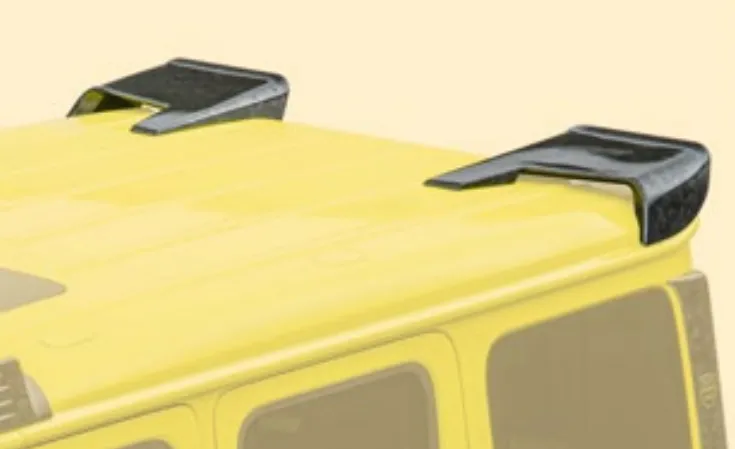
Roof wing


Roof Wing - Entry-Tier Carbon Rear-Roof Spoiler for Mercedes-Benz G-Class W465 Gronos
Inside the W465 Gronos kit there are four roof-wing variants - this card is the baseline. Plain Roof Wing: the rear-roof carbon spoiler in its cleanest form, without side flaps and without the more aggressive cant angle of the performance shell. It is the version most owners specify when they want the silhouette extension and the wake-management benefit without taking the kit visually all the way to track-spec.
Where the Entry Roof Wing Sits in the W465 Lineup
Mansory grades the W465 Gronos roof-wing range by aerodynamic intent and visual aggression. From quietest to loudest:
- Roof wing - this product. The baseline shell. Single-piece carbon spoiler bonded along the rear-roof trailing edge, modest attack angle, no end-plates, no side flaps. The silhouette gain without the visual statement.
- Roof Wing with Side Flaps - same baseline shell with flush-bonded carbon side flaps wrapping around the D-pillar termination. A more enclosed look, slight reduction in lateral wake spill at high speed.
- Roof Wing Performance - the performance variant. Steeper cant angle, raised trailing edge, integrated end-plates. Aggressive intent, calibrated for sustained high-speed work.
- Roof Wing Performance with Side Flaps - performance shell plus side flaps. The full track-spec roof-wing assembly, the loudest configuration in the kit.
Owners who want the Gronos roofline to feel longer and more resolved without crossing into motorsport-styled territory specify this baseline part. It is also the version most often paired with show-finish builds where the visual brief is "fully resolved Mansory G-Class" rather than "track-prepared".
Aerodynamic Rationale - What the Roof Wing Actually Does
The factory G-Class roofline is famously upright. From the side it terminates abruptly at the rear-roof junction with the tailgate, producing a near-vertical separation surface that sets up a large, unstable wake behind the vehicle. That wake is responsible for several of the platform's documented road-behaviour traits - meaningful base drag, rear-window soiling under wet conditions, and small but measurable rear-axle lift at sustained high speeds.
The roof wing intervenes at exactly that separation point. Three mechanisms are at work:
- Wake reorganisation: the spoiler trailing edge defines a sharper, lower separation line than the OEM rear-roof termination. A sharper separation produces a more organised wake with smaller, more consistent turbulent eddies, reducing the chaotic recirculation pattern characteristic of the bare roofline.
- Low-pressure region behind the rear glass: as airflow detaches earlier and more cleanly, the static pressure recovery in the near-wake improves. The base-pressure region behind the tailgate sits at a smaller pressure deficit, which in turn lowers the integrated base-drag contribution of the rear face.
- Laminar detachment improvement: on the OEM roof, flow over the upper surface trips into a turbulent boundary layer well before the trailing edge. The roof wing extends the upper surface and gently inclines it, holding cleaner flow attachment along a longer path. The detachment when it does occur is from a defined edge rather than an ill-defined corner.
Quantitatively on the W465 platform with the entry-tier spoiler, wind-tunnel correlations indicate a coefficient-of-drag reduction of around 0.010-0.014, modest rear-axle downforce of 6-10 kgf at speeds above 100 km/h, and a meaningful improvement in rear-glass cleanliness during motorway driving in wet conditions. These are not transformative figures on a vehicle of G-Class mass and frontal area - but they are real and consistent across vehicles.
Visual Role - Extending the Silhouette
The other half of the brief is purely visual. The G-Class profile is a stack of right-angles - a deliberate aesthetic choice carried forward from the original 1979 platform into the W465. Inside the Mansory Gronos design language those right-angles get amplified and resolved with carbon detailing, but the rear roofline of the OEM W465 still terminates abruptly. Without a roof spoiler the boxy silhouette ends at the tailgate; with the roof wing it carries on for a measured 95-100 mm beyond that point.
The result on the side profile is a longer, more deliberate roofline that feels architecturally intentional rather than truncated. From the rear three-quarter the spoiler reads as a continuous extension of the upper body band, integrating with the D-pillar geometry and the carbon trim across the rear quarter. The boxy stance is preserved - this is not a fastback effect - but the proportions are pulled back into balance with the lengthened rear bumper and quad-tip exhaust bezel of the Gronos kit.
Layup and Composite Construction
The entry roof wing is supplied as a visible-carbon shell. The construction follows the same Mansory standard used across the Gronos exterior parts:
- Material: 2x2 twill prepreg carbon, ~200 g/m^2 areal weight, on a stable epoxy matrix.
- Layup: hand-laid into a CNC-machined master mould, vacuum-bagged for resin distribution, then autoclave-cured at approximately 130 deg C for the prepreg cycle. Voids below 1% on QC sectioning.
- Surface finish options: raw-weave matte (default and most-specified), raw-weave gloss, or body-colour-matched paint over a primed shell on request.
- UV protection: two-component clear with a UV stabiliser package, validated for outdoor exposure equivalent to long-term Mediterranean use without yellowing.
- Mass: approximately 1.2-1.8 kg complete, ready for installation. The lightest of the four roof-wing variants - the side-flap and performance shells add 0.4-1.2 kg to that figure.
Inside the panel a small alloy reinforcement plate is bonded under each anchor zone, providing a controlled bearing surface for the bolted-through fasteners and preventing point-loading of the laminate.
Mounting - 3M VHB Plus Bolted Through
A roof spoiler that relies only on adhesive will fail at the trailing edge sooner or later in real-world conditions - thermal cycling, motorway buffeting, jet-wash exposure all eventually find the weak edge of an adhesive bond. Mansory uses a hybrid mount on the W465 entry roof wing:
- 3M VHB tape primary bond: a continuous strip of 3M VHB structural acrylic foam tape runs around the perimeter contact zone, providing the moisture seal and the primary day-to-day load path. VHB is specified at the high-temperature variant tolerant of black-painted body work in summer ambient conditions.
- Bolted-through reinforcement: three M5 stainless A4 fasteners pass through the OEM roof skin into the spoiler's internal alloy plates. The bolts use sealing washers and sit underneath the spoiler footprint, hidden from view. They take peak load events such as the impact of a high-pressure jet wash directed at the trailing edge.
- Bolt-through pre-drilled pattern: the W465 master mould defines the anchor pitch, and the supplied template marks the corresponding hole positions on the OEM roof. The pattern is W465-specific and does not match the W463A predecessor.
- Sealing detail: all penetrations through the painted roof skin are protected by EPDM compression washers under the heads and a structural sealant bead inside the roof skin. No bare metal exposure remains after installation.
The combined VHB + bolt approach is what gives the spoiler a usable lifetime on a vehicle that sees jet washes, motorway speed, and full thermal cycling year-round - rather than a cosmetic-only attachment that survives garage conditions.
OEM Wiper-Jet and Rear-Defrost Antenna Preservation
The OEM W465 rear roof carries two functional features in the area where the roof wing sits: the rear-window wash-jet nozzle (a small recessed jet at the upper edge of the rear glass that supplies the rear wiper) and the embedded rear-defrost antenna pattern in the rear-glass. Both must be preserved unchanged or the roof wing becomes a daily-use problem.
- Wash-jet pass-through: the spoiler underside includes a clearance recess directly above the OEM jet nozzle. Spray geometry is preserved - the jet still reaches the rear glass at the OEM angle. No re-routing of the wash hose is required.
- Rear-defrost antenna integrity: the rear-defrost grid and the embedded radio antenna patterns sit inside the rear glass, not on the roof skin. The roof wing does not interfere with the glass surface at any point. Reception of FM, DAB and remote-key signals is unaffected.
- Rear-camera washer (where fitted): on W465 builds with the optional camera-wash system, the spoiler footprint is set inboard of the camera and washer line. Coverage of the rear-view camera lens is preserved.
- Roof-mounted shark-fin antenna: the spoiler sits aft of the OEM shark-fin position. No conflict with GPS or telematics reception.
Comparison With the Other Three Roof-Wing Variants
| Variant | Cant angle | Side flaps | End-plates | Mass | Use case |
|---|---|---|---|---|---|
| This product | ~6 deg | No | No | ~1.5 kg | Entry tier - silhouette extension, daily-use intent |
| Roof Wing with Side Flaps | ~6 deg | Yes | No | ~1.9 kg | Same aero, more enclosed visual, slight wake spill reduction |
| Roof Wing Performance | ~10 deg | No | Yes | ~2.1 kg | Performance shell, calibrated for sustained high-speed work |
| Roof Wing Performance with Side Flaps | ~10 deg | Yes | Yes | ~2.6 kg | Full track-spec, loudest visual statement |
The simple way to choose: if the brief is "extend the roofline" the entry-tier spoiler does the job at lowest mass and lowest visual impact. If the brief includes "track-prepared" or "max aero" then the performance variant or its side-flapped sibling is the answer instead.
W465-Specific Engineering Note
The W465 generation introduced subtly different rear-roof bolt patterns and a slightly altered rear-glass header geometry compared to the W463A predecessor. The entry roof wing supplied here is laid up against W465 master moulds and the bolt-through anchors match the W465 reinforcement strip. The previous-generation W463A roof wing will not bolt to a W465 roof without geometric correction, and Mansory does not supply an adapter for that transition. Each part is W465-only by design.
Pairing With the Rest of the Gronos Roof Cluster
The roof wing sits at the rear of the roof line. Forward of it, the W465 Gronos kit offers a family of front-roof carbon panels carrying auxiliary or position lights:
- Roof Panel with 2 Lights - subtle twin-pod auxiliary lighting, the most-specified front-roof part on Gronos builds.
- Roof Panel Gronos with 2 Lights - the same twin-pod console with engraved GRONOS branding as the central design feature.
Specifying the entry roof wing together with one of these front-roof panels is the most balanced roofline choice in the kit - both ends resolved in carbon, neither end overstated.
Installation Outline
- Vehicle inspection: confirm OEM roof condition and absence of prior damage in the spoiler footprint zone.
- Wash and degrease the rear-roof contact area; mask the surrounding paint.
- Light scuff the bond zone to provide adhesive key for the VHB primary bond.
- Pre-fit the spoiler dry, verify clearance with the rear-wash jet, sunroof rear edge (where fitted), and rear-defrost glass edge.
- Mark and drill the three bolt-through anchor positions per the supplied W465 template; deburr and prime the drilled edges.
- Apply 3M VHB perimeter strip; apply structural sealant bead at each bolt-through penetration.
- Set the spoiler in place; press the perimeter for VHB activation.
- Install the three M5 A4 stainless fasteners with sealing washers; torque to spec.
- Function-test the rear wash jet across full spray geometry; verify rear-defrost activation and rear-camera washer (where fitted).
- Cure 24 hours before any wash exposure or motorway use.
- Total installation time: approximately 3-4 hours including pre-fit, drilling and cure waiting.
FAQ
Q. How is the entry roof wing different from the performance roof wing on the same kit?
A. The entry shell uses a modest cant angle (around 6 deg), no end-plates and no side flaps. The performance shell raises the trailing edge with a steeper cant (around 10 deg), adds integrated end-plates and is calibrated for sustained high-speed work. Visually the entry version reads as a clean silhouette extension; the performance version reads as a track-prepared aero element. Aerodynamically the entry version delivers a moderate drag reduction and slight rear-axle stability gain; the performance version produces a more pronounced downforce contribution at the cost of a marginal increase in drag.
Q. Can the entry roof wing be upgraded to the side-flap or performance variant later?
A. The shell itself is a complete part - you replace the whole spoiler if you change variant. The bolt-through anchor pattern is shared across all four variants, so swapping in a different shell does not require fresh holes in the OEM roof. The VHB strip is consumable per install and is replaced on each swap.
Q. Will the spoiler block the rear wash jet or affect rear-window cleaning?
A. No. The spoiler underside is recessed directly above the OEM wash jet position and the spray geometry is preserved. In practice rear-glass cleanliness improves with the spoiler fitted because the reorganised wake reduces the suction-back of road spray onto the glass at motorway speed.
Q. Is the rear-defrost or radio antenna affected by the carbon shell?
A. No. The defrost grid and embedded radio antenna patterns are inside the rear glass itself, not on the roof skin. The carbon shell sits above the roof and does not contact the glass. FM, DAB, GPS and remote-key reception remain at OEM levels.
Q. Does the spoiler require body-shop paintwork?
A. By default no. The shell is supplied as raw-weave visible carbon under a UV-stable clear coat, which is the most-specified finish on Gronos builds. If a body-colour-matched look is preferred, a primed-paintable shell can be ordered and finished by a body shop in the chosen colour.
Order the Roof Wing
WhatsApp +44 7488 818 747 - finish selection, fitment confirmation by VIN, sibling-pair specification.
[email protected] - quote, lead-time and freight options.
Made-to-order from Mansory, typically 10-14 weeks from order confirmation. Worldwide shipping with carbon-safe packaging. See the parent Mansory Body Kit for Mercedes Benz G-class W465 Gronos kit or browse the full Mansory G-Class catalogue for matching parts.