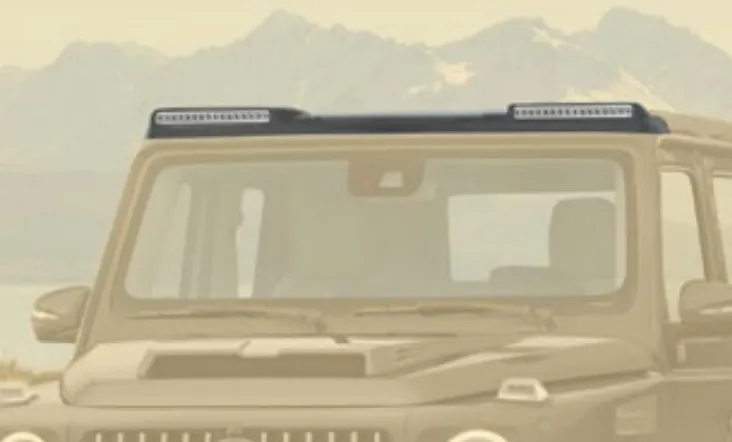
Roof panel with 2 position lights Hella


Roof Panel with 2 Position Lights Hella - OEM-Grade Carbon Roof Console for the Mercedes-Benz G-Class W465 Gronos
Hella is not a normal aftermarket lighting brand. The Lippstadt company is a tier-one original-equipment supplier to Mercedes-Benz, Porsche, BMW, Volkswagen and most of the European premium segment - the headlamps and rear clusters on a substantial portion of the cars in any German autobahn lane were engineered and manufactured by Hella. The Mansory Roof Panel with 2 Position Lights Hella for the W465 Gronos uses that engineering pedigree at the highest visible point of the vehicle. Two Hella-branded position lamps are integrated into a sculpted carbon roof console, replacing the generic LED hardware found on cheaper roof-bar setups with a lighting benchmark recognised by every workshop on the planet.
The W465 itself is the second-generation Mansory G-Class platform - sharper edge geometry, revised proportions and a more aggressive front overhang relative to the W463A predecessor. The roof zone above the windshield is the only place on the body where you can put auxiliary illumination without compromising the front-mask sculpting. This panel turns that real estate into refined lighting hardware.
Why Hella OEM-Grade Optics Actually Matter
The argument for Hella over generic LED bars is not vanity - it is measurable engineering substance. Three properties separate Hella position lamps from typical aftermarket alternatives:
- Beam-pattern integrity: Hella's free-form reflector geometry uses computational optics to shape the emission into a defined photometric envelope. Cut-off at the upper edge is sharp, foreground illumination is uniform, and there is no scattered glare into the eyes of oncoming traffic. Generic LED units lack this optical control, producing an uneven blob of light that fatigues the driver and irritates everybody else on the road.
- Lumen accuracy and stability: Hella publishes verified lumen output figures with thermal-derating curves. A Hella position lamp delivers its rated output across the operating temperature range; unbranded LED units typically lose 30-40% of nominal output once the driver chip warms up, and the figures on the box rarely match what reaches the road.
- Homologation pre-baked: the Hella position lamps fitted to this panel carry ECE R7 / R87 approval marks for position-light function, which means they are road-legal in EU, UK and most jurisdictions following ECE specifications. No retrofit certification, no inspection-station drama - the type-approval markings are stamped on the lamp body and visible during any roadworthiness check.
What "Position Lights" Means in This Configuration
Position lamps are not driving lamps and not work lamps - they are a specific homologated category. ECE R7 defines position lights as marker/parking lamps that signal vehicle presence and dimensions to other road users at low intensity, switched on with the vehicle's parking-light or low-beam function. The Hella units fitted to this panel sit in that ECE R7 envelope with optional R87 daytime running light authorisation, depending on configuration:
- Primary function: position-light operation - low-intensity emission for vehicle visibility, day or night, at parking-light or sidelight switch positions.
- Secondary function (configurable): daytime running light operation under ECE R87, automatic switching with ignition.
- Tertiary function (jurisdiction-dependent): auxiliary high-beam emission with the OEM main-beam circuit interlock, where local regulations permit roof-mounted auxiliary lighting.
This is fundamentally different from an unregulated off-road LED bar. The position-light specification means the panel can be active on public roads in EU/UK without any covering requirement, and the daytime-running variant gives the build a distinctive forward-light signature visible at a distance.
Hella was founded in 1899 and has been engineering automotive lighting for over a century. The company supplies original-equipment headlamp assemblies to Mercedes-Benz, Audi, Porsche, BMW, VW Group, Volvo, Jaguar Land Rover and most other European OEMs. Their engineering catalogue includes the matrix-LED systems on the latest S-Class, the laser high-beam modules on the BMW M5, and the LED tail clusters on the current Porsche 911. When Hella manufactures a position lamp for the auxiliary market, the design draws from the same optical engineering library used for those OEM programmes - the same simulation tools, the same photometric standards, the same long-term reliability targets. For a Gronos build at this price tier, fitting Hella optics rather than a generic LED bar is the correct decision; the optical performance is in a different league and the brand recognition is universal.
Position-Light vs Other Hella Variants in This Panel Family
Mansory offers the carbon roof panel with several Hella lamp permutations. The 2-position-lights specification is the entry point in the Hella tier:
- 2 Position Lights Hella (this panel): two Hella position lamps, refined low-intensity marker function with optional DRL and aux-beam. The cleanest aesthetic; the most road-legal across jurisdictions; the lowest power draw.
- 3 Position Lights Hella: three Hella lamps in an expanded console - a centre long-throw spot lamp flanked by two outboard driving lamps, combined long-throw and wide-spread coverage. More overt off-road posture and more declared visual presence.
- 2 Lights (non-Hella): two generic LED units in the same panel substrate. Lower price point; no Hella brand value, no OEM-grade beam-pattern engineering, no ECE pre-approval.
- Roof Panel "Gronos" with 2 Lights: the GRONOS-branded variant with prominent CNC-engraved nameplate and twin LED auxiliary units, optimised for show/identity rather than refined optics.
Buyers who care about lighting quality, road-legal operation across borders and long-term parts availability choose the Hella variants. Buyers who prioritise visual signature over optical engineering choose the GRONOS-branded panel.
Service-Part Availability and Carbon Substrate
Five years from now, the LED driver in the lamp will eventually fail - that is the nature of LED hardware, no matter the brand. The difference between Hella and a generic unit is what happens at that moment. Hella service parts are stocked at every authorised lighting workshop globally. Replacement modules, lenses, gasket kits and complete lamp units are referenced by part number and shipped within standard lead times. A failed unbranded LED unit cannot be repaired - the entire bar gets binned and replaced with whatever generic alternative is available that month, and the visual match to the original is approximate at best. For a build that owners keep five, ten, fifteen years, the parts-availability argument compounds with time.
The carbon console hosting the Hella lamps is engineered to match:
- Outer skin: 2x2 twill 200 g/m2 visible-carbon prepreg, autoclave-cured at 130 degrees C, finished with two-pack UV-stable clear coat in gloss or matte.
- Internal frame: aluminium structural skeleton bonded to the carbon shell for lamp-mount rigidity and impact stability.
- Mounting interface: high-modulus structural-adhesive perimeter bond plus four mechanical fasteners at OEM roof-rail anchor points.
- Mass: 2.9 to 3.3 kg complete with both Hella lamps and the integrated wiring harness.
- Sealing: EPDM-rubber perimeter gasket; harness exits through factory-rated grommet at the front roof edge.
- Lamp interface: standard 90 mm bezel mounting compatible with future Hella replacements or alternative ECE-approved units.
The supplied harness uses a sealed weatherproof Deutsch DT-series connector at the lamp end, transitioning to a cabin-routed loom that ties into the OEM electrical distribution at three points:
- Position-light circuit tap at the front-fuse-box marker-light feed - lamps follow OEM parking-light/sidelight switch behaviour.
- Optional DRL circuit tap with ignition-on signal for ECE R87 daytime running light operation.
- Optional high-beam interlock for auxiliary aux-beam function in jurisdictions where roof-mounted auxiliary lighting on public roads is permitted.
A dash-mounted three-position toggle (off / position-only / position+aux) is supplied for buyers who want manual override, with detachable harness allowing reversal to OEM-only operation if the panel is removed for resale. Voltage drop across the supplied harness at full load is under 0.3 V, ensuring the Hella lamps reach rated brightness regardless of vehicle electrical demand.
Comparison Against Adjacent Roof-Panel Options
The non-Hella 2-Lights roof panel uses the same carbon substrate and identical mounting geometry, but the sole technical difference - the lamp specification - is meaningful: Hella's sharp cut-off and uniform foreground illumination versus generic LED scatter and hot-spot inconsistency; Hella's thermally-derated rated output versus generic LED brightness sag once warm; Hella's ECE R7/R87 stamped homologation versus generic units typically uncertified for road use; globally-stocked parts versus orphaned in 5-10 years. The premium upcharge is roughly 25-35%, which on a Gronos build at this price tier is rounding-error money relative to the optical and resale benefit.
The 3-lamp Hella panel adds a third lamp - typically a centre long-throw spot - in a wider console. It is the right choice for buyers with genuine off-road, overlanding or expedition use, where the additional centre spot lamp delivers measurable far-field illumination at speed. For owners whose use case is predominantly urban, show or occasional touring, the 2-lamp variant is more proportionate; the 3-lamp panel reads as overt off-road declaration that may not match the build's overall posture. Both panels share the same substrate and Hella service-parts ecosystem - the 2-lamp can be retrofitted to 3-lamp if use cases evolve, with shell exchange and additional wiring.
Ordering and Configuration
Each panel is built to order against a specific VIN. Configuration choices made at order time:
- Carbon finish: gloss clear, matte clear or satin clear.
- Hella lamp specification: standard position / DRL-enabled / aux-beam-capable.
- Wiring harness routing for left-hand-drive or right-hand-drive markets.
- Dash-toggle position - centre console, lower fascia or A-pillar mount.
- Spare-parts pack - replacement gaskets, spare bezels, harness diagnostic plug.
Lead time is typically 10 to 14 weeks from confirmed order, encompassing autoclave production, lamp integration, beam-aim factory pre-set and packaged worldwide despatch.
FAQ - Hella 2 Position Lights Roof Panel
Q: Are the Hella position lamps actually different from the generic LEDs in the cheaper variant, or is this brand premium?
A: Genuinely different. The Hella optics are engineered to OEM-supplier standards used by Mercedes and Porsche - the cut-off, the lumen stability, the long-term reliability are at a different specification than typical aftermarket LED units. The Hella name on the lamp face also carries homologation paperwork and global service-parts coverage that generic units cannot match. The premium is technical, not cosmetic.
Q: Can I run the panel as daytime running lights instead of just parking lights?
A: Yes - configure DRL operation at order. The Hella position lamps are rated for ECE R87 daytime running light service when wired to the ignition signal rather than the parking-light circuit. Some jurisdictions require the OEM DRL to remain operational alongside, which is handled at install.
Q: How does this panel compare to fitting a separate Hella light bar on aftermarket roof rails?
A: The integrated panel preserves the carbon body language of the Gronos build, mounts at the structurally correct roof-edge geometry and uses a routed harness rather than an exposed cable run. A bolt-on bar on roof rails works mechanically but looks like an afterthought on a six-figure W465 build, and tends to develop wind noise and aerodynamic interference at autobahn speeds. The Mansory panel is the integrated answer.
Q: What if I want the cleanest possible front-roof aesthetic and no auxiliary lighting at all?
A: A blank carbon roof panel without lamp cutouts is available as a special order through Hodoor - same substrate, same mounting geometry, no optical hardware. The Hella variant is for buyers who want functional auxiliary illumination with OEM-grade brand value. The blank panel is for buyers who want only the visual carbon presence with no lighting function.
Q: Will the Hella lamps eventually need replacing, and will I be able to source identical replacements?
A: LED modules have finite operating life - typically 30,000 to 50,000 hours of usage at full brightness. Replacement Hella modules will remain available through the standard automotive parts network well past the point at which the original units fade. The 90 mm bezel mounting also accepts future-generation Hella units, so even decades from now the panel can be re-lamped without bespoke fabrication.
Order the Roof Panel with 2 Position Lights Hella
WhatsApp +44 7488 818 747 - Hella variant selection, finish, VIN-specific build slot
[email protected] - written quote, lead-time, freight, customs paperwork
Cross-reference with related Gronos roof family items: Roof Panel with 2 Lights (non-Hella) for the non-branded LED variant, Roof Panel with 3 Position Lights Hella for the triple-lamp configuration, Roof Panel "Gronos" with 2 Lights for the GRONOS-branded console, and Roof Wing for the rear-roof complement.