
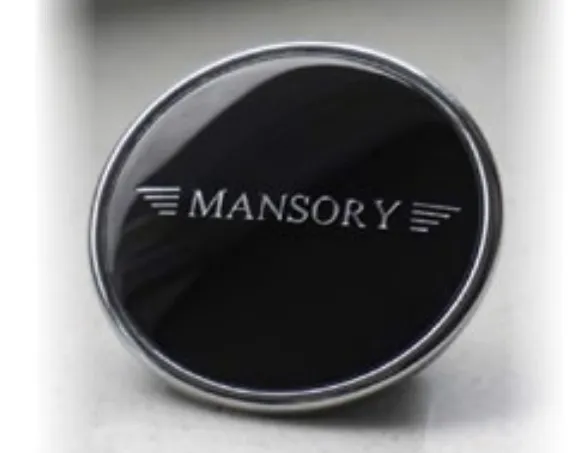
Logo emblem badge for engine bonnet


Mansory Logo Emblem Badge — Bonnet Jewellery for the Mercedes-Benz G-Class W465 Gronos
The Mansory Logo Emblem badge for the engine bonnet is the smallest detail in the W465 Gronos catalogue and, paradoxically, one of the most studied. It is the badge people see when they walk up to the car at standstill. It is the badge that registers in close-distance photography. It is the part of the kit that does the least to the silhouette and the most to the impression. Treat it as automotive jewellery: a discrete escutcheon, perfectly placed, perfectly finished, fitted to the centre-line of the bonnet pressing as Mansory engineered it for the W465 generation.
This page covers the materials, the surface protection, the adhesive science behind the mount, the placement geometry on the W465 bonnet, why the W463A version is not interchangeable, and the practical realities of installation, maintenance and removal. There is no aero substance to discuss here — and that is the point. Read the Bonnet IV product page for race-spec hood substance; read this page for what gets stuck to whichever bonnet you choose.
The Badge as an Identity Statement
A Gronos build is a layered statement. The body kit reframes the silhouette. The roof-wing and the wide front mask declare intent at distance. The exhaust declares intent on start-up. The badge declares intent at handshake distance — when somebody is leaning against the front quarter, looking at the bonnet, and reading the surface. At that range the eye notices weave direction, edge crispness, finish depth, and the gap between the badge and the bonnet pressing. Mansory's design brief for this part is simple: nothing on the badge should look bigger than it is, and nothing should look like it was added later. The escutcheon sits low to the bonnet surface, the perimeter is laser-cut not stamped, and the mount line is hidden under the badge body.
If you are buying a Gronos kit, this badge is what tells a passer-by which atelier the build came from before they read any other surface. It is also the cheapest way to tell that story, which is why it is often specified as an early-stage upgrade — fitted to an OEM bonnet on a car that will receive the rest of the kit later.
Material Options — Forged Carbon, 2×2 Twill, Anodised Aluminium, Gold-Plated
Mansory offers this badge in four production finishes. Each has a different optical signature and a different conversation context.
- Forged carbon (Mansory signature): chopped-strand visible composite with the marbled, no-two-identical pattern that has become a Mansory house style. Reads dark grey-to-black under most light, picks up bright streaks under direct sun. Thicker visual depth than woven carbon. Pairs with forged-carbon mirror caps and forged-carbon door pulls for a coherent close-distance reading.
- Visible 2×2 twill weave (gloss): classic high-gloss carbon with a clean, repeating diagonal weave. Reads as deeper black at distance and reveals weave geometry within arm's-length. The most conservative choice, and the most photogenic in studio lighting.
- Visible 2×2 twill weave (matte): identical weave structure under a matte clearcoat. Hides micro-scratches better than gloss, picks up less reflection from overhead light, and pairs naturally with matte-painted bodywork.
- Anodised aluminium: CNC-machined billet aluminium, then Type II anodised in black, dark grey or natural. The anodised surface is integral to the metal — it does not chip the way painted metal does. Edges are diamond-cut to a bright contrast line for added definition.
- Gold-plated metal (special order): 24k gold electroplated over a nickel-strike base on machined brass. Heaviest of the variants, deepest visual contrast against a dark bonnet, and the only finish that needs a dedicated cleaning routine. Special order with extended lead time.
The forged-carbon variant is the most-specified option on Gronos builds in 2026. The anodised aluminium variant is the second most popular and is often paired with the logo grill in the same finish for front-of-car coherence.
Surface Protection — UV, Chemical, Ceramic-Coat Compatibility
A bonnet badge lives in the harshest UV exposure on the car. Carbon-composite badges that lack proper surface protection chalk and yellow within 18–24 months. Mansory's production process addresses this at the resin level rather than relying on an aftermarket clearcoat alone.
- UV-stable resin matrix: the visible-side resin used on carbon variants is a UV-stabilised epoxy formulation tested to ASTM G154 cycles for accelerated weathering. The badge maintains colour and gloss specification through the equivalent of multi-year direct sun exposure.
- Top-coat clear: two-pack polyurethane clear over the cured composite, applied at 60–80 µm. This is the layer that takes UV, bird-droppings, insect splatter and the occasional bug-cleaner solvent.
- Chemical resistance: the cured top-coat is rated for typical detailing chemistry — pH-neutral shampoo, iron-fallout removers, mild solvent-based bug removers, isopropyl alcohol for surface preparation. It is not rated for aggressive paint-stripping solvents, acetone, or alkaline degreasers.
- Ceramic-coat compatible: the badge surface accepts standard SiO₂ and SiC ceramic coatings without primer issues. Most owners coat the badge as part of the same session as the bonnet itself.
- Anodised metal protection: the anodised layer on the aluminium variant is itself the protection — typical Type II anodise gives 15–25 µm of integral oxide. A wax or ceramic top-coat is optional and primarily cosmetic for the metal version.
Adhesive Science — The 3M VHB Mount
The badge mounts to the bonnet using 3M VHB 5952 acrylic foam tape in a die-cut pattern matched to the badge footprint. This is not generic double-sided tape and the install procedure is not casual. The bond is engineered to outlive the badge.
- Tape choice: 3M VHB 5952, 1.1 mm thickness, modified acrylic adhesive on both faces, black foam carrier. Rated for permanent bonding of metal-to-metal and metal-to-painted-substrate at automotive temperature ranges (-35°C to +90°C continuous).
- Surface energy: the bond requires a substrate surface energy above approximately 38 dyne/cm. Most automotive 2K clearcoats sit in the 38–42 dyne/cm range — at the lower edge of acceptable. Surface preparation is what brings the bond into the safe zone.
- Primer: 3M Primer 94 is applied to the bonnet contact zone before the tape is laid. The primer raises substrate surface energy and improves initial tack by a measured order of magnitude. Primer flash-off is 30–60 seconds before tape application.
- Surface preparation: isopropyl alcohol wipe, lint-free cloth, full evaporation before primer, ambient temperature 18–25°C and substrate dry. Cold or contaminated surfaces are the single largest cause of badge release in service.
- Cure window: 3M VHB reaches approximately 50% of ultimate bond strength at 20 minutes, 90% at 24 hours, and 100% at 72 hours. The badge must be left undisturbed for at least 24 hours before the car is pressure-washed or driven in heavy rain. Manual handwash from 72 hours.
- IP6X dust resistance at the bond line: the foam tape acts as a continuous gasket around the badge perimeter. Once cured, the bond line is dust-tight and water-tight — there is no path for ingress under the badge body to corrode the substrate or trap dirt.
An OEM-style stud-mount variant is available on request, where the badge backing carries M3 threaded studs that pass through pre-existing OEM emblem holes in the bonnet pressing. This option is preferred by owners who want a 100% reversible install with no clearcoat exposure to primer chemistry. Lead time is longer because the studs are bonded into the badge backing during composite cure.
Placement Geometry on the W465 Bonnet
The W465 generation introduced an updated bonnet pressing relative to W463A. The pressing crown is slightly different, the centre-rib runs to a different terminator point at the cowl, and the OEM emblem cut-out (where present) is dimensionally repositioned. Mansory's badge for the W465 is calibrated to that updated pressing.
- Centre-line position: the badge is placed on the bonnet's longitudinal centre-line, with its lateral axis perpendicular to that line.
- Forward offset: measured from the front edge of the bonnet, the badge centre sits at a fixed offset that corresponds to the visual sweet spot when viewed from approximately 1.6 m eye height — which is the natural viewing position for most adults at handshake distance.
- Surface curvature compensation: the badge backing is not flat. It is moulded to match the W465 bonnet crown radius at the placement point so the badge sits flush across its full footprint, with the foam tape evenly compressed and no edge lift.
- Installation alignment template: Mansory ships the badge with a die-cut alignment template that hooks onto the front edge of the bonnet and indexes the badge position. The template is single-use and is removed before final adhesion.
Why the W463A Version is Not Compatible
The W463A and W465 badges look similar at a glance and are dimensionally close at the perimeter. They are not interchangeable, and fitting a W463A badge to a W465 bonnet (or vice versa) produces an edge-lift problem that becomes visible within weeks.
- The bonnet crown radius differs between W463A and W465 at the badge placement point. A W463A-curved backing on a W465 bonnet leaves the badge perimeter slightly proud at the leading and trailing edges.
- The placement centre-line offset also differs because the W465 cowl line and bonnet front-edge geometry are revised.
- The backing geometry on the W465 variant is moulded specifically to the updated pressing — there is no shimming or hand-fitting that recovers the W463A part to a W465 surface without compromise.
If you are upgrading from a W463A Gronos build to a W465, the badge is one of the parts that must be re-ordered. Most other surface trim items are also re-cut for W465 — see the parent W465 Gronos kit page for the full updated catalogue and the door handle with logo for the matching close-distance trim piece.
Owner Installation versus Detailer Fitment
The badge is installable by a competent owner with patience and the right materials. It is also routinely fitted by detailers as part of a paint-protection-film and ceramic-coat session — which is the recommended route for owners who do not want to touch the alignment template themselves.
- Owner-fit: typical time 25–40 minutes including substrate clean, primer flash-off, template alignment, tape exposure, badge placement and edge-roll. Critical points are temperature, surface prep, and resisting the urge to reposition once the tape is in contact.
- Detailer-fit: usually 15–25 minutes within a larger session. Detailers will typically remove the bonnet's existing wax or ceramic coating from the bond zone, apply primer, fit the badge, and then re-apply ceramic over the badge surface (not over the bond line) once cure is complete.
- Common mistake: applying the badge over a freshly waxed or ceramic-coated bonnet without removing the surface treatment from the bond zone. The wax or coating dramatically lowers the substrate surface energy and the badge will release within months.
Maintenance and Long-Term Care
Once cured, the badge is essentially maintenance-free. Standard handwash with pH-neutral shampoo, the same drying technique as the rest of the bonnet, and the same ceramic-coat top-up cycle. A few specifics:
- Avoid high-pressure jet wash directly into the badge perimeter for the first 14 days post-install.
- Avoid stiff-bristle wheel brushes on the badge surface — the carbon clearcoat is hard, but it is not scratch-proof.
- Bird-droppings and tree sap should be removed promptly with pH-neutral cleaner — same as for the rest of the painted bodywork.
- For the gold-plated variant, use only a microfibre cloth with distilled water for routine cleaning. Avoid jewellery cleaners and ammonia-based glass cleaners.
FAQ
Q: Will it remove cleanly if I sell the car?
A: Yes, with care. The 3M VHB tape can be released using fishing line or specialist adhesive remover and gentle warming with a heat gun. Residual tape is removed with adhesive remover and the bonnet substrate is unaffected. Allow 30–60 minutes for a clean, panel-safe removal. The stud-mount variant is fully reversible by definition.
Q: Does it survive automatic car washes?
A: Yes — touchless and soft-cloth washes are both fine after the 72-hour cure period. The badge perimeter is sealed by the foam tape, so neither water nor brush bristle finds a path under the badge. Owners typically avoid the first 14 days post-install as a precaution.
Q: Can I powder-coat the metal version in a custom colour?
A: The anodised aluminium variant is not designed for powder-coat over-finishing — the anodise layer is the colour, and powder-coat over anodise is structurally workable but visually compromises the diamond-cut edge definition. If you want a custom colour on the metal variant, order the natural anodise finish and have it overpainted in 2K automotive paint instead. The gold-plated variant should never be over-coated.
Q: Why is the W463A version not compatible with my W465?
A: The W465 introduced a revised bonnet pressing — different crown radius and different placement geometry. Mansory moulds the badge backing specifically to the W465 surface, so a W463A badge sits proud at the perimeter on a W465 bonnet and lifts in service. The two parts share aesthetic language but not fitment.
Q: Can I fit it over an existing ceramic coating?
A: Not reliably. The ceramic layer lowers surface energy at the bond line below the safe threshold for VHB tape. The correct procedure is to mechanically polish back the ceramic from the bond zone (using a dedicated ceramic-removal compound or fine polish), apply primer, fit the badge, then re-apply ceramic over the badge body once cured. Any competent detailer will follow this sequence as a matter of course.
Order the Mansory Logo Emblem Badge
Hodoor ships the Mansory Logo Emblem badge for the W465 Gronos engine bonnet worldwide, made-to-order in your selected finish. Lead time is 10–14 weeks depending on finish — anodised metal is on the shorter end, gold-plated and forged carbon are on the longer end.
- WhatsApp +44 7488 818 747 — finish selection, mount type (VHB or stud), pairing with grill and door handle
- [email protected] — quotation, freight, kit-pairing advice
Cross-references: Parent W465 Gronos kit · Engine Bonnet (W465) · Bonnet IV (W465) · Logo Grill (W465) · Door Handle with Logo (W465) · Full Mansory catalogue.