
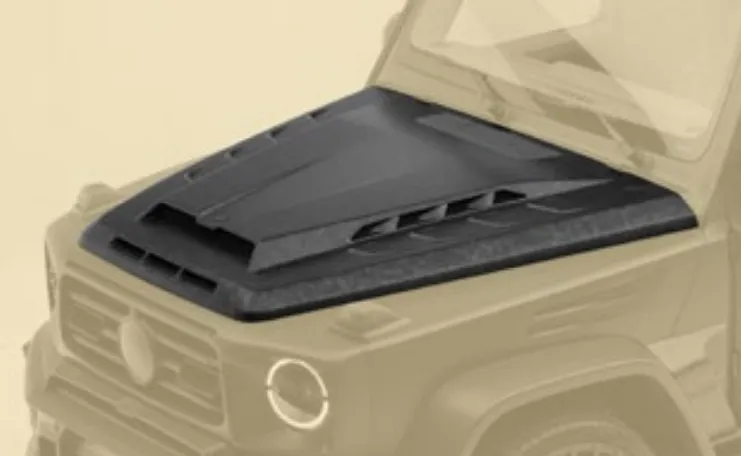
Engine bonnet IV


Bonnet IV — The Race-Brief Carbon Hood for the W465 Gronos Programme
Three hoods, three philosophies. The Performance engine bonnet is the entry pour into the W465 Gronos catalogue — visual carbon, modest weight saving, daily-driver friendly. Bonnet II turns the dial toward thermal management, with intake geometry that pulls bay heat at low speed. Bonnet IV is the third option, and it is unapologetically a race panel dropped into a road-legal aesthetic. Lightest layup. Thinnest skin. The most aggressive surface-flow treatment Mansory ships on this generation of G-Wagen. If you are reading this page because the lap-time matters or the front-axle pitch behaviour matters, IV is the one.
Sub-3.5 kg: What That Number Buys You at the Front Overhang
The OEM W465 aluminium hood lands somewhere between 12 and 16 kg as delivered, with production-year and trim variance accounting for most of the spread. Bonnet IV finishes at 3.2–3.5 kg — fully trimmed, with hinge-side reinforcements bonded in and the latch beam laid up. Net subtraction: 9 to 12 kilograms, lifted off the worst possible location for chassis dynamics. Every kilo ahead of the front axle is a kilo of pitch-axis inertia that the dampers fight on every brake input and every kerb. Removing it changes how the car feels in three measurable ways:
- Pitch inertia at the front: down roughly 4–6%, which a competent driver feels on turn-in and trail-brake transitions. The G-Class is not a sports car, but Gronos customers ask more of it than the factory engineers assumed.
- Front ride frequency: climbs a hair, helping the dampers control sharp inputs rather than chase a heavy mass on a long lever arm.
- Corner balance: shifts roughly 0.3% rearward — small on paper, real on a setup pad, and additive when other carbon panels are spec'd alongside.
How the Layup Hits the Target Without Sacrificing Service Life
Carbon panels can be light or they can be durable. Bonnet IV is engineered to be both, and the way Mansory threads that needle is in the layup schedule, not in the marketing copy. The recipe:
- Outer skin: 2×2 twill prepreg at ~200 g/m² on the visible surface, oriented for cosmetic weave continuity across the central panel and the strake bands.
- Primary load paths: unidirectional prepreg at ~250 g/m² along the centre rail, around the hinge-bolt pads, and across the latch beam — placed where the FE model says stiffness has to live.
- Core: Nomex honeycomb, 5 mm cell, 48 kg/m³ density, bonded between the inner and outer skins through the central span. Bending stiffness for almost no mass penalty.
- Cure: autoclave at 130 °C, 6 bar absolute, vacuum-bagged. Void content lands under 1.5%, which is what stops UV and heat cycling from wrecking the panel after a couple of summers.
- Edge protection: additional UD plies along the leading edge to absorb stone strikes and resist torsional flex when the hood is opened in the wind.
Vortex Strakes — Surface Aerodynamics, Not Decoration
Look closely at Bonnet IV and you will not see large open vents on the upper surface. What you see instead are two bands of low-profile vortex generator strakes, positioned either side of the centreline. They are borrowed almost directly from rally and DTM hood practice and they are doing real work. The geometry seeds small streamwise vortices that re-energise the boundary layer as it climbs the windshield and tracks over the roof. The downstream consequence is the interesting part:
- Flow attachment over the roof is more reliable at high speed, which means the rear roof-wing — whether you spec the standard Roof wing or the Roof wing performance — sees cleaner, less turbulent inflow and produces its design downforce more consistently.
- At cruise speeds in the 140–180 km/h band, CFD shows a small but reproducible drag reduction and a tightening of base-pressure variability behind the tailgate.
- Visually, the strake bands are the immediate giveaway that you are looking at IV and not the simpler hoods — they are the silhouette signature.
Heat Extraction: A Different Strategy Than Bonnet II
Bonnet II does its thermal job with visible intake openings on the upper surface — effective at idle and parade pace, where the bay needs help and there is not much ram-air to use. Bonnet IV takes the opposite route. Heat is pulled out via recessed slot vents integrated under the trailing edge of the hood, exhausting into the low-pressure zone directly ahead of the windshield base — the same region that feeds the OEM cabin-air intake. Two consequences worth understanding before you choose between hoods:
- At circuit speeds and sustained high-speed road work, the rear-slot strategy matches or beats Bonnet II — the low-pressure zone behind the hood lip is more stable at speed than the front intake area.
- At idle and crawl-pace urban driving, Bonnet II will pull more heat through natural convection. If the use case is showcase, valet circuits, and stop-go traffic, II is honestly the smarter pick.
W465 Hinge Geometry — Why the W463A Bonnet Will Not Bolt On
The W465 is the 2024+ G-Class platform and it shares visual DNA with the 2018-2023 W463A but it is not the same vehicle underneath. Bonnet IV for W465 is laid up to the new hinge geometry, the slightly relocated latch position, and the revised washer-jet routing on the underside. Underbonnet ECU and harness clearance is also different on the new car. If you are coming from a W463A Gronos build, do not assume parts cross over — order the W465-specific panel. Conversely, this hood is fitment-compatible with both the standard and Wide Kit body widths on W465; the hood-to-fender interface is identical across body widths.
Finish Options — Visible Carbon, Forged, or Painted
- Gloss 2×2 twill: the classic high-clarity weave that reads as "carbon" from across the showroom floor. Deepest visual depth.
- Matte 2×2 twill: a stealthier read, kinder to fingerprints and minor surface marks, increasingly the default request from the contemporary client.
- Forged carbon (Mansory signature marbled pattern): chopped-strand visible finish where each panel has a unique flow line — no two hoods identical.
- Body-colour paint: primed and finished to your factory code or a custom mix; the lightweight panel disappears under colour while keeping the weight saving intact.
Fitment Tolerances and Installation Window
Bonnet IV is a true OEM-replacement panel — same hinge bolt pattern, same latch mechanism interface, same gas-strut mounts as the factory hood. A competent technician fits the panel inside a typical morning, transferring the underbonnet thermal blanket (or substituting the Mansory IV-specific blanket) and verifying gap uniformity:
- Front edge to mask: 3.5–4.5 mm uniform across the panel width.
- Side edges to fender tops: 3–4 mm, no taper from front to rear.
- Trailing edge to cowl: 4–5 mm, with the strake band terminating cleanly at the cowl line so the slot vents flow into the low-pressure zone correctly.
- Bench time: 1.5–2.5 hours including blanket transfer and gap verification on a patient dealer or specialist.
Where Bonnet IV Lives in Your Gronos Build
Most Bonnet IV orders ship inside a wider Gronos build — at minimum the parent Mansory W465 Gronos kit, often with the Performance engine bonnet kept as a service-day spare or Bonnet II reserved for warm-climate or stop-go duty. The Bonnet IV upper surface pairs aerodynamically with the Roof wing performance — the strake-cleaned flow over the roof feeds the wing more consistently than the OEM hood surface does. If you want the upper-body story to read as one engineered set rather than a parts-bin pile, brief your account manager on the full upper-surface package up front. Browse the wider catalogue on the Mansory G-Class collection page.
FAQ — Choosing IV, Living With IV
Q: I already own the Performance engine bonnet — is it worth swapping to IV?
A: If your priority is visual carbon you are already covered. If your priority is measurable weight reduction at the front overhang and improved high-speed stability via the strake bands, IV is the upgrade. Honest answer: most Performance-bonnet owners do not need to swap. Track-day customers and serious driving customers do.
Q: Do the vortex strakes affect rain and snow behaviour on the windshield?
A: No detectable change in normal use. The strake bands are low-profile and they energise the boundary layer rather than redirect bulk flow. Wiper coverage and washer spray patterns are unaffected; the OEM jet routing is preserved.
Q: Is the hood hinge area reinforced enough to handle the Mansory gas strut load?
A: Yes. The hinge pads are laid up with extra UD plies and bonded into a local doubler. OEM gas struts and Mansory replacement struts both fit without modification. The panel is tested for repeated open/close cycling well beyond typical ownership demand.
Q: How does Bonnet IV behave under sustained sun exposure?
A: The autoclave cure produces void content under 1.5%, and the visible-carbon options ship with a UV-stable clearcoat. Painted variants behave like any high-quality painted panel. Avoid abrasive polishing on the strake bands — that is the only ownership caveat.
Q: Can I run IV without the rest of the Gronos kit, on an otherwise stock W465?
A: Mechanically yes — it bolts to the OEM hinges and latches normally. Aesthetically the strake bands and stripped silhouette will read as a deliberate intent without the matching front mask and roof wing, so most customers spec at least the front-end carbon group alongside. Your call.
Lead Time and Order Process
Bonnet IV is built to order. Standard lead time is 10 to 14 weeks from finish confirmation to ready-to-ship, with crating done in carbon-safe foam-lined boxes. We verify hood fitment by VIN before the layup is scheduled, so the W465 generation match is locked in before any composite work starts. Worldwide freight available.
Order, quote, or fitment check:
WhatsApp: +44 7488 818 747
Email: [email protected]