
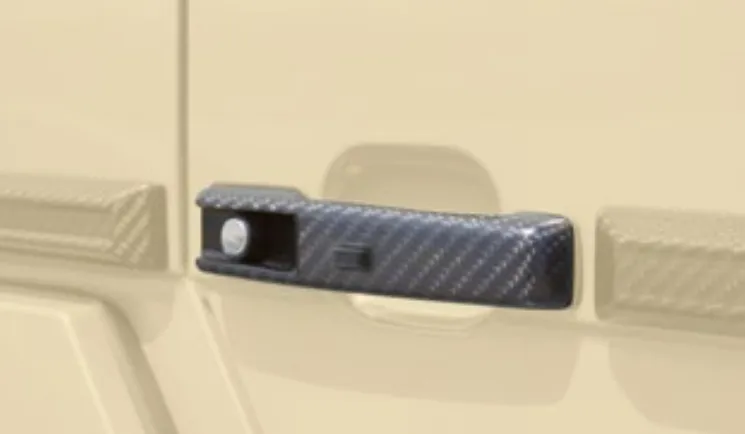
Carbon door handle with logo


Mansory Carbon Door Handle with Logo for Mercedes-Benz G-Class W465 Gronos — Touch-Point Carbon, Keyless-Go Engineered
The exterior door handle on the new W465 G-Class is the part of the car the owner physically meets first, every time. It is a chunky horizontal grip — proportioned to suit the squared body, hand-filling, with the OEM Mercedes-Benz unit machined and painted to match the door panel. Mansory replaces it with a full carbon body that carries the Mansory mark cast or applied into the upper face. The Mansory Carbon Door Handle with Logo for the W465 Gronos is engineered as a complete functional replacement, not a cosmetic shell — Keyless-Go capacitive sensor pass-through, driver-door lock cylinder pass-through, OEM-matched return spring tension, and a perimeter weather seal mean the door operates exactly as Mercedes engineered it, simply with the brand expression now executed in carbon at the touch point.
What the Set Includes
- Four exterior door handles: front-left (with lock cylinder pass-through), front-right, rear-left, rear-right. The driver-side handle is supplied with the lock-cylinder cut-out finished and trimmed; the other three handles are blank in that zone.
- Captive Keyless-Go sensor windows built into the back face of each front handle — the OEM capacitive pad transfers across without modification.
- Logo execution: choice at order time of cast-in raised Mansory wordmark integrated into the carbon laminate during layup, or applied stainless wordmark bonded to the cured surface for a stepped relief read.
- Stainless mounting hardware matched to the OEM bolt pattern at the inside face of the door skin — no door-skin drilling, no panel modification.
The four handles are supplied as a matched set with weave orientation aligned across all pieces — the carbon read is consistent at every door, which matters because the handles are the most-touched and most-photographed surfaces on the side of the vehicle.
Why a Door-Handle Replacement Earns the Engineering Investment
The exterior door handle is a deceptively complex component on a modern luxury vehicle. It carries the keyless-entry capacitive sensor, the lock cylinder on the driver door, the return-spring mechanism that pulls the handle back against the door skin after each pull, and a weather-seal interface that prevents water entry into the handle cavity behind the door skin. Replacing it is not a matter of swapping a plastic shell — every one of those functions has to transfer across cleanly, or the door fails in a way the owner notices every day. The Mansory carbon handle is engineered against each of those functions individually, with prototype testing at every step and verified compatibility with the Mercedes Keyless-Go control unit on the W465. The result is a touch-point part that reads as carbon, carries the brand mark, and operates indistinguishably from OEM.
Keyless-Go Capacitive Sensor Pass-Through
The W465 uses a capacitive-touch Keyless-Go system: a sensor pad inside the handle reads the dielectric change when a hand approaches, sends a wake-up signal to the keyfob via LF antenna, and unlocks the doors when the keyfob is authenticated. Two design constraints are non-negotiable for any handle replacement:
- The sensor pad cannot be moved. Its position is referenced to the LF antenna location and the keyfob detection envelope; relocating it produces inconsistent unlock behaviour at the edges of the detection zone.
- The material between the sensor pad and the user's hand must not block the capacitive field. Carbon fibre is electrically conductive — naively laying carbon over a capacitive sensor pad blocks the field entirely and disables the unlock function.
The Mansory handle solves this with a captive non-conductive sensor window: the OEM capacitive pad is housed in a moulded cavity inside the handle back face, and the carbon laminate above the pad is interrupted by a layer of dielectric glass-fibre composite that maintains the carbon visual read on the outer surface but allows the capacitive field to pass through to the user's hand. The transition between the carbon zone and the dielectric zone is bonded inside the handle and is invisible from the outside — the handle reads as a continuous carbon surface, but the capacitive function works across the entire grip area exactly as the OEM handle does. Keyless-Go unlock distance, hand-presence latency, and false-trigger rejection are all verified against OEM behaviour.
Driver-Door Lock Cylinder Pass-Through
The driver door retains a mechanical key cylinder for emergency access if the keyfob battery is depleted or the keyless system is otherwise unavailable. On the OEM handle this cylinder is housed in a precision-machined pocket with a chrome bezel; the key entry slot, the cylinder rotation envelope, and the lock-rod actuation must all be preserved. The Mansory driver-side handle is supplied with:
- Finished cylinder pass-through: the carbon body is moulded around a stainless cylinder housing that aligns to OEM tolerances, with a 0.2 mm clearance around the cylinder body for thermal expansion.
- Bezel options: matte stainless (default — visually quiet against the carbon read), gloss stainless (slightly more visible), or carbon-overlay (most discreet, hides the cylinder until the key is presented).
- Lock-rod alignment: the inside face of the handle includes a stainless lock-rod guide tooled to OEM dimension, so the mechanical lock-rod actuation transfers across without binding.
Functional verification: the driver door can be locked, unlocked, and opened with the mechanical key in the same number of cylinder rotations as OEM, with the same torque profile, and with no binding at any point in the rotation. The cylinder remains weather-sealed against the OEM seal ring.
OEM-Matched Return Spring Tension
The return spring inside the handle pulls the grip back against the door skin after each pull. Spring tension is calibrated by Mercedes to a specific feel: firm enough that the handle returns positively after a partial pull, light enough that the door pull is not fatiguing. A handle replacement with the wrong spring rate feels wrong every single time the door is operated — a defect the owner cannot ignore. The Mansory handle uses:
- OEM-spec stainless spring sourced from the Mercedes parts supply chain, identical wire gauge, identical coil count, identical preload geometry.
- OEM-tooled spring seat machined into the handle inner pivot, identical to the OEM mating geometry.
- Preload calibration verified at assembly: each handle is cycled 50 times against a calibrated test fixture and the return torque measured at three points across the pull arc; out-of-spec units are reworked or rejected.
The handle pull and return feels identical to OEM — the same initial breakaway force, the same return snap, the same final seat against the door skin. Owner perception of the door operation is unchanged from factory.
Perimeter Weather Seal
The handle mounts to the door skin through a perimeter cavity that must be sealed against water entry — rain runs down the door skin, washes across the handle, and any breach in the perimeter seal allows water into the door cavity behind the trim, where it can corrode the inner door structure and saturate the speaker and wiring loom. The Mansory handle is engineered with the seal as a primary input:
- EPDM perimeter gasket bonded to the inside face of the handle at the mounting flange, OEM-equivalent durometer, OEM-equivalent compression set.
- Compression depth verified at install: a 1.5 mm compression at the perimeter is the seal target, controlled by the stainless mounting hardware and a captive shoulder washer that limits over-tightening.
- Drain path preserved: the OEM drain slot at the bottom of the handle cavity is unobstructed by the carbon handle body — any water that does enter (e.g. high-pressure car wash) drains as the OEM design intends.
The functional result: the handle is sealed against rain, car-wash spray, and standing water at the door skin, exactly as the OEM handle is. There is no measurable change in handle-cavity moisture between OEM and the Mansory carbon replacement.
Logo Execution — Cast or Applied
Two logo executions are available, chosen at order time:
- Cast-in raised wordmark: the Mansory wordmark is integrated into the layup as a raised relief in the carbon outer skin, formed by a precision-machined mould tool. The wordmark reads as a tonal step in the carbon — the relief is visible in raking light, the weave is continuous across the letterforms, the surface is unbroken cured carbon. This is the most discreet execution — the brand mark is part of the part, not applied to it.
- Applied stainless wordmark: the Mansory wordmark is laser-cut from 0.6 mm stainless, brushed-finish, and bonded to the cured handle outer surface with structural adhesive. The wordmark reads as a contrasted relief — bright stainless against the dark carbon, more visible at distance, more confident as a brand statement.
The cast-in execution is preferred by owners specifying a fully-coordinated carbon build — the wordmark integrates with the visual quietness of the rest of the carbon parts. The applied stainless execution is preferred by owners who want the mark to read as a deliberate piece of jewellery on the touch-point. Both options are clear-coated; both options are warranted against fade and lift for the same horizon as the rest of the carbon programme.
Material — Visible Carbon, Engineered Layup
- Outer skin: 2x2 twill 200 g/m² book-matched cosmetic carbon, weave orientation matched between all four handles for set-wide visual consistency.
- Structural ply: 245 g/m² 0/90° carbon for stiffness and grip-load resistance — the handle is loaded in tension every time the door is pulled, and the laminate must carry that load through tens of thousands of cycles.
- Sensor-window dielectric zone: glass-fibre composite layered into the back face of the handle directly above the Keyless-Go capacitive pad, electrically transparent.
- Inner liner: 200 g/m² twill protective ply on the bond face.
- Mass per handle: 0.18-0.22 kg, comparable to OEM.
- Cure cycle: autoclave 130 °C / 6 bar / 6 hours, post-cure 80 °C / 4 hours.
- Finish: UV-stable two-pack clear coat in high gloss or full matte — the handle clear-coat horizon is matched to the rest of the carbon programme so that fade behaviour at 8-10 years is uniform across the vehicle.
Installation
The handles are installed from the inside of the door, with the door card removed for access. The sequence is straightforward but precise:
- Remove door card on each door requiring handle replacement, exposing the inside face of the door skin and the handle mounting plate.
- Disconnect Keyless-Go harness at the OEM connector (single connector per front door, no connector at rear doors).
- Remove OEM handle by loosening the two M5 stainless retaining bolts; transfer the OEM Keyless-Go capacitive pad to the carbon handle's captive cavity.
- Transfer driver-door lock cylinder (driver-side handle only): remove from OEM housing, transfer to carbon handle's stainless cylinder pocket, verify rotation and lock-rod alignment.
- Fit carbon handle with EPDM perimeter gasket, torque retaining bolts to 6 Nm against the captive shoulder washer (over-torque-limited).
- Reconnect Keyless-Go harness, verify capacitive sensor function with the Mercedes diagnostic tool — the W465 will report sensor presence and field strength; both should match pre-install values.
- Refit door card and operate the door 10 times to confirm spring return, latch engagement, and weather-seal compression.
- Total install time: 2.5-3 hours for the four-handle set at a competent workshop.
The install is fully reversible — the OEM handles can be refitted later without modification to the door skin. Owners selling the vehicle commonly refit OEM handles for the next owner and retain the carbon set for a future build.
Visual Pairings on a Gronos Build
- With carbon mirror housings: the handles and mirrors align as the two visible carbon touch-points on the side of the vehicle — the carbon language reads at door-card height across the full side elevation.
- With carbon trimbars: trimbars and handles share the carbon read along the door middle and lower edges, building the sense of a fully carbon-trimmed door.
- With logo emblem: the wordmark on the handles aligns with the logo emblem on the bodywork — the brand mark reads twice on every approach to the vehicle, once at distance, once at the touch.
- With logo grill: the front grill wordmark and the door-handle wordmark form a brand-mark conversation between the front of the car and the side — a deliberate visual rhythm at the two zones the owner and observers see most.
The full Gronos kit and the rest of the catalogue are available at the parent Mansory Gronos kit page and the Mansory collection.
Maintenance
The handle is the most-touched carbon surface on the vehicle — finger oils, sunscreen residue, leather glove transfer all reach it. Care is straightforward and matches the rest of the carbon programme:
- Hand wash with the rest of the bodywork using pH-neutral shampoo and soft microfibre — no abrasive pads, no solvent cleaners on the carbon outer surface.
- Quarterly ceramic-spray sealant top-up to resist finger-oil staining and UV fade.
- Annual visual inspection at the wordmark zone (cast-in or applied) for early signs of clear-coat compromise — both executions are warranted against fade and lift, but early detection extends the service horizon.
- Clear-coat refresh at the 8-10 year horizon for sustained visual integrity, matched to the rest of the carbon programme.
Compatibility — W465 Specific
This handle set is engineered for the 2024+ W465 generation only. Three platform-level changes make a W463A-spec handle inappropriate for the W465:
- Handle profile: the W465 handle is wider in section and slightly longer than the W463A — the OEM grip read changed with the new generation, and the carbon body is tooled to the new profile.
- Keyless-Go control unit: the W465 uses a revised LF antenna position and updated capacitive thresholds — sensor field tuning differs from the W463A and the carbon handle dielectric window is calibrated for the new system.
- Mounting bolt pattern: the W465 inside-face mounting bolt centres are repositioned versus the W463A — the carbon handle bolt pattern matches the new geometry.
Verify VIN at order time. The handle set fits all factory configurations of the W465 G-Class Gronos.
Ordering and Lead Time
The handles are built to order. Standard build window is 10-14 weeks from confirmed order to dispatch, including autoclave cycle time, clear-coat cure, and quality inspection. Worldwide freight is arranged at ex-works or DAP terms; the four-handle set ships in a foam-fitted hard case. Order specification at quote time:
- Vehicle VIN (W465 verification, driver-side configuration left-hand or right-hand drive).
- Logo execution — cast-in raised wordmark or applied stainless wordmark.
- Lock-cylinder bezel — matte stainless, gloss stainless, or carbon-overlay.
- Finish — visible carbon gloss or visible carbon matte.
- Pairing — handles only, full carbon touch-point set with mirror housings, or full Gronos build coordination.
Contact us to start a build:
WhatsApp +44 7488 818 747 — specification, finish, fitment by VIN
[email protected] — quote, lead-time, freight
FAQ — Carbon Door Handle with Logo for the W465 Gronos
Q: Will the carbon handle disable the Keyless-Go capacitive unlock function?
A: No. Naively, carbon fibre is electrically conductive and would block the capacitive field, but the Mansory handle includes a captive dielectric sensor window above the OEM capacitive pad — the carbon read is continuous across the visible outer surface, but the capacitive field passes through the dielectric zone to the user's hand exactly as it does on the OEM handle. Keyless-Go unlock distance, latency, and false-trigger rejection are verified against OEM behaviour.
Q: Can the driver-door mechanical key still be used?
A: Yes. The driver-side handle is supplied with a finished lock-cylinder pass-through tooled to OEM tolerances. The OEM cylinder transfers across, the cylinder rotation envelope is preserved, lock-rod alignment is preserved, and the door can be locked and unlocked with the mechanical key in the same number of rotations and the same torque profile as OEM.
Q: Will the door pull and return feel different from OEM?
A: No. The handle uses the same OEM-spec stainless return spring, the same spring-seat geometry, and the same preload calibration. Each handle is cycled and torque-tested at assembly to verify spec. Owner perception of the door operation — initial pull breakaway, return snap, final seat — is identical to factory.
Q: Cast-in logo or applied stainless logo — which is more durable?
A: Both are warranted against fade and lift for the same service horizon as the rest of the Mansory carbon programme. The cast-in execution is integral to the laminate and effectively cannot lift; clear-coat fade at the wordmark zone is uniform with the surrounding carbon. The applied stainless execution is bonded with structural adhesive that is service-rated for exterior application; it is the more confident brand statement and is preferred by buyers who want the wordmark to read at distance.
Q: Is the install reversible if I sell the vehicle later?
A: Yes. The OEM handle bolt pattern is preserved at the inside face of the door skin — no drilling, no panel modification. OEM handles can be refitted at any time without trace. Owners commonly refit OEM handles for resale and retain the carbon set as a removable upgrade for the next build.