
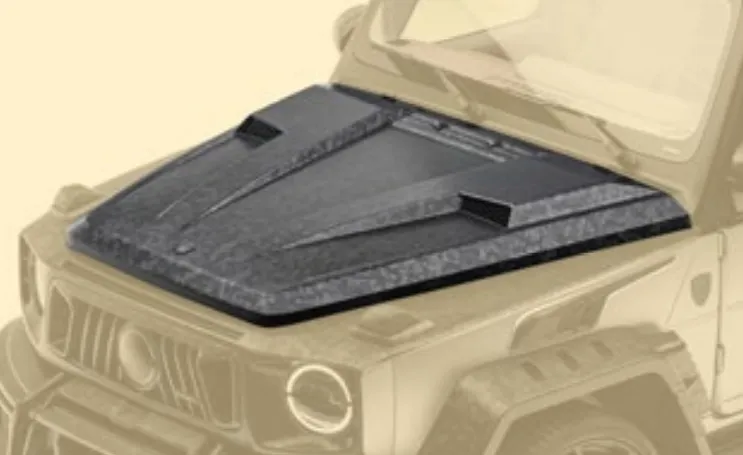
Performance engine bonnet


Mansory Performance Engine Bonnet — Daily-Driver Carbon Hood for Mercedes-Benz G-Class W465 Gronos
The Performance Engine Bonnet is the baseline performance hood in the new W465 Gronos kit — and the most usable one. It is the bonnet you fit when you want the visible carbon, the measurable weight saving, the cleaner pitch behaviour at the front overhang and the Mansory weave on the upper bodywork, but you do not want to strip your daily G-Class to a race-only specification. It sits below Engine Bonnet IV — the sub-3.5 kg vortex-straked race shell — and beside Engine Bonnet II with its high-flow thermal extraction. Three different philosophies, one shared platform, and the Performance bonnet is the one that lives with school runs, motorway cruising and gravel driveways without compromise.
Why a Performance Bonnet, Not a Race Bonnet
The W465 generation G-Class — launched on the updated 2024+ platform with revised electrical architecture, refreshed hinge fittings and slightly tweaked cowl-line geometry — ships with an aluminium factory hood that varies between roughly 12 and 16 kg depending on year, trim and the presence of acoustic or insulation packages. That mass sits ahead of the front axle, in the worst possible position for pitch inertia and turn-in feel. Mansory's response with the Performance bonnet is deliberate: retain the daily-use feature set of the OEM panel — gas struts, washer-jet routing, sound deadening provisions, full perimeter sealing — and rebuild the panel in autoclave-cured carbon, hitting a finished weight in the 5.5–7 kg range. That is a saving of 5–9 kg vs OEM, achieved without compromising winter usability, paint protection or the standard latching geometry.
Construction: Autoclave 2x2 Twill on a Daily-Driver Layup
The Performance bonnet is built on the same composite philosophy that Mansory uses across the Gronos hood family, with the layup tuned for road use rather than track-day weight extremism:
- Outer skin: 200 g/m² 2x2 twill prepreg, two-ply visible weave, carefully oriented so the pattern runs symmetrically across the centre crease and aligns with the front-edge radius.
- Primary load paths: 250 g/m² unidirectional carbon plies along the centre rail, hinge reinforcements and latch beam — the same UD strategy used on Bonnet IV, retained here for crash-pulse stiffness and long-term fatigue life.
- Inner shell: a structural inner skin bonded to the outer at perimeter and along the centre rail, forming a torsion-stiff hollow-section panel. Unlike Bonnet IV, the Performance bonnet retains a slightly thicker inner shell — this is where the durability difference lives.
- Cure cycle: 130 °C autoclave cure at approximately 6 bar absolute, vacuum-bag consolidation, void content held under 1.5%. The same process that produces the race-spec panels — but on a layup specified for road life, not race weekends.
The result is a bonnet that survives stone strikes, motorway debris, occasional bonnet leans, sealant adhesion for the OEM bonnet seal and a decade of UV exposure when finished correctly. It is not a delicate part. It is engineered to live on a working car.
Fitment, Hinges and OEM Pass-Throughs
Performance bonnet is a direct replacement for the OEM W465 hood. The mounting interface is preserved end to end:
- Hinge geometry: identical bolt pattern and stand-off heights to OEM. Factory hinges transfer across with no shimming on most cars; a small minority benefit from 0.5 mm shims on one side to perfect the fender gap.
- Gas strut mounts: retained at OEM positions, gas-strut load matched to the new lighter panel — strut effort is comfortable to lift, holds open reliably even at low temperatures.
- Washer-jet routing: OEM hose pass-throughs preserved, both jets serviceable from above without removing the inner shell.
- Sensor and cable pass-throughs: any bonnet-mounted sensors or cable runs that ship with your trim are accommodated through grommeted apertures pre-formed in the inner shell.
- Insulation pad interface: OEM insulation pad transfers across, or replace with a Mansory underbonnet thermal blanket sized for the Performance shell.
Installation by an experienced bodyshop technician runs about 1.5–2.5 hours including gap verification. Target gaps on the finished car: front edge to mask 3.5–4.5 mm uniform, side edges to fenders 3–4 mm uniform, rear edge to cowl 4–5 mm uniform. The Performance bonnet is fitment-compatible with the standard Gronos body and the wide-body variant, since the hood interface is identical between the two body widths on W465.
Performance Bonnet vs Bonnet II vs Bonnet IV — How To Choose
The W465 Gronos kit gives you three hood options, and the choice is not about prestige — it is about how you actually use the car:
- Performance Engine Bonnet (this part): 5.5–7 kg finished, clean upper surface, no large open intakes, full daily-driver feature set retained. Best for street cars, year-round use, owners who want visible carbon and meaningful weight reduction without a race-shop maintenance schedule.
- Engine Bonnet II: larger, openly visible thermal extraction openings on the upper surface — the choice when engine-bay heat soak under stop-start city driving is the dominant problem. Heavier than the Performance shell because of the additional vent assemblies, but the cooling benefit at idle is real.
- Engine Bonnet IV: sub-3.5 kg, vortex strakes, thinnest layup of the family, race-spec mass-saving. Maximum weight removed, lowest pitch inertia, most aggressive surface. This is the bonnet for circuit days, tarmac rallies and dedicated build cars.
If you are not certain which to specify, the default Mansory recommendation for an everyday W465 G63 build is the Performance bonnet. It is the most quietly competent of the three.
Visible Carbon Finishes and Custom Options
- Gloss 2x2 twill: classic deep-gloss carbon look, weave pattern visible at every angle. The most common specification on Gronos builds.
- Matte 2x2 twill: stealthy contemporary finish, hides minor surface marks better than gloss, pairs cleanly with satin paint codes.
- Forged carbon (Mansory signature): chopped-strand visible weave with marbled flow pattern, no two panels identical — an upgrade option specified ahead of layup.
- Body-colour painted: primed and painted to factory MB code or a custom Mansory colour, retaining all the weight and stiffness benefits of the carbon shell with no visible weave.
- Mixed finish: visible weave centre panel framed by body-colour edges — a popular treatment that highlights the bonnet centreline without committing to full visible carbon.
The bonnet pairs visually with the rest of the upper-body carbon programme — see the wide front mask directly downstream of the hood line, and the roof wing at the trailing end of the silhouette.
Real-World Weight Saving: What 5–9 kg Off The Nose Actually Does
The numbers are modest in absolute terms, but the location is what matters. Mass removed from the front overhang has an outsized effect on:
- Pitch-axis inertia: reduced by approximately 2–4% on a typical W465 build. You feel this as a slightly more eager turn-in and a calmer braking nose-dive — not a transformation, but a real change.
- Front-axle static load: drops by the full bonnet delta, meaningful at corner-balance level on lowered or coil-over builds.
- Suspension behaviour: the front shocks see lower static and dynamic load, ride frequency at the front rises slightly, sharp inputs settle more cleanly.
- Lift effort: bonnet is noticeably lighter to open and hold one-handed, and on cold mornings the gas struts have an easier life.
Ordering, Lead Time and Logistics
Performance bonnet is built to order. Standard production lead time runs 10–14 weeks from confirmed VIN and finish specification. The order workflow is straightforward: confirm VIN and trim level (acoustic pad presence, sensor count), select finish (gloss/matte/forged/painted/mixed), confirm any matching parts in the same order, and the panel enters the layup queue. Carbon-safe export crating is standard, with foam-supported edge protection and humidity-controlled enclosure for transit. Worldwide freight is arranged on confirmation of order. The bonnet is part of the wider parent kit page and the broader Mansory collection at Hodoor.
FAQ — Performance Engine Bonnet
Q: Is the Performance bonnet strong enough for daily use, or is it a fragile race part?
A: It is built for daily use. The layup keeps a thicker inner shell, retains the full perimeter seal, accommodates OEM insulation, and survives stone strikes and motorway debris. It is not a race-stripped panel — that is what Bonnet IV is for. The Performance shell will live happily on a working W465 for years.
Q: How much weight will I actually save vs the OEM hood?
A: The OEM W465 aluminium hood weighs roughly 12–16 kg depending on trim and acoustic package. The Performance bonnet finishes between 5.5 and 7 kg. Net saving is 5–9 kg, removed from ahead of the front axle where it has the biggest effect.
Q: Will the OEM hood release, gas struts and washer jets all still work?
A: Yes. The Performance bonnet is engineered as a direct OEM-interface replacement. Hinge bolt pattern, latch geometry, gas-strut mounts and washer-hose routing are all retained. Standard W465 release cable and electrical pass-throughs transfer across without modification.
Q: Can I retrofit the Performance bonnet later if I already have the rest of the Gronos kit?
A: Yes — the bonnet is sold as a standalone part within the Gronos programme. It does not require the wide-body conversion or any other specific kit element. Any W465 with OEM hood mounts will accept it, and it is visually consistent with the rest of the Gronos upper-body carbon set whether or not you fit the wide arches.
Q: What is the difference vs the W463A Gronos hood I see on older builds?
A: The W463A (2018–2023) and W465 (2024+) hoods share the same composite philosophy but the panels are not interchangeable. W465 has revised hinge fittings, an updated cowl line and a different bonnet geometry — the W465 Performance bonnet is engineered for the new platform specifically. Do not attempt to fit a W463A bonnet to a W465 car or vice versa.
Order the Mansory Performance Engine Bonnet
Specification, finish selection, VIN-based fitment confirmation, freight quotation and delivery scheduling are handled directly by Hodoor. Reach out by WhatsApp on +44 7488 818 747 or by email at [email protected] for current pricing, lead-time confirmation, and matching-part bundles inside the W465 Gronos programme.