
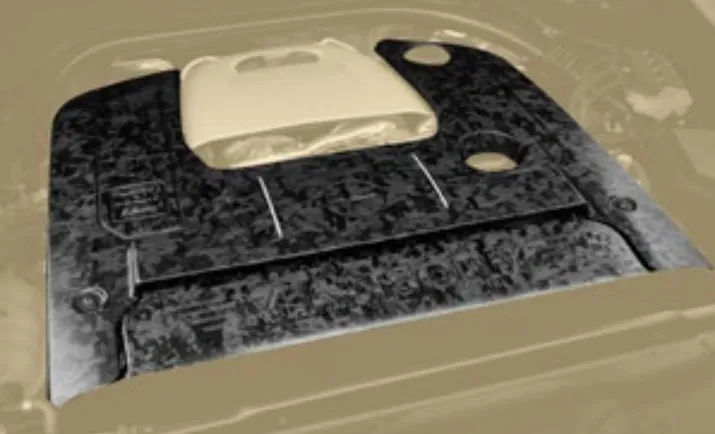
Engine cover for G63 AMG


Mansory Carbon Engine Cover for Mercedes-AMG G63 W465 Gronos
The first thing the eye lands on when the bonnet of a G63 AMG comes up is the engine cover. The OEM piece is moulded black plastic, embossed with the AMG handcrafted plaque on a contrasting trim strip, and it does its job perfectly well - it hides the harness, the intake plumbing and the cam covers, it dampens a little of the high-frequency mechanical noise, and it gives the under-bonnet view a finished surface to read. What it does not do is match the level of finish that the rest of the W465 Gronos build sits at. The body outside is hand-laid carbon. The interior is hand-stitched leather and visible weave. The bonnet itself, when specified in carbon, is a piece of structural composite. The plastic engine cover under it is the one surface that lets the underbonnet view down. The Mansory Engine Cover for the W465 Gronos is the part that fixes that.
This page covers what the cover actually has to survive under the bonnet of an M177-engined G63, the heat-resistant resin chemistry that lets a carbon-composite cover sit above a 4.0-litre biturbo V8 without delaminating, the OEM mounting and rubber-isolation work that keeps the cover quiet at idle and on motorway cruise, the machined access for oil and dipstick service, and the difference between the standard matte cover and the clear-coat sibling. The cover ships as part of a complete Mansory Body Kit for Mercedes Benz G-class W465 Gronos build or as a standalone retrofit on an existing W465 G63.
Under-bonnet thermal environment of the M177 V8 in the W465
The Mercedes-AMG M177 is a 4.0-litre V8 biturbo with a hot-vee architecture - both turbochargers sit in the inside-V valley between the cylinder banks rather than outboard on the exhaust manifolds. That layout shortens the gas path from exhaust port to turbine, which sharpens throttle response, but it also concentrates the hottest parts of the engine directly under the centre of the engine cover. In the G63 W465 the bonnet line sits relatively low above the cam covers, the engine bay is tightly packaged around a vertical bulkhead-and-firewall geometry typical of a body-on-frame off-roader, and there is comparatively little airflow across the top deck of the engine at low road speed. The result is an under-cover thermal environment that runs noticeably hotter than the equivalent zone on a saloon car using the same engine.
Field measurements during normal operation typically register 80 to 100 degrees Celsius continuous on the upper face of the OEM cover with the engine at operating temperature on a temperate day. Continuous towing in summer, alpine climbs at gradient or extended idle in traffic on a hot day push that figure into the 110 to 120 degrees Celsius continuous range. Heat soak after shutdown peaks higher again - because the airflow stops and the residual heat in the turbos and exhaust manifold radiates upward, the cover sees brief excursions into the 130 to 140 degrees Celsius range for the first few minutes after the engine stops. Any composite cover that goes here has to take all of that without softening, without warping, without losing surface gloss and without delaminating.
Heat-resistant resin chemistry: why standard epoxy is not enough
Most visible-carbon body panels in the wider Mansory range cure with a standard aerospace-grade epoxy resin in the 120 to 130 degrees Celsius autoclave window. That resin is rated for service temperatures up to roughly 90 to 100 degrees Celsius continuous - perfectly adequate for an exterior body panel, where the design case is solar load and ambient temperature, but marginal for an under-bonnet part on a turbocharged V8. A standard-epoxy cover left over the M177 would survive cool-weather running, but a hot summer towing trip or a long mountain climb would push the resin glass-transition temperature, soften the matrix, and the cover would start to lose its gloss surface, deform around the high-temperature zones above the turbos, and eventually delaminate at the resin-fibre interface.
The Mansory engine cover is therefore not laid up in the same resin as the rest of the body kit. It uses a phenolic-modified high-temperature epoxy with a glass-transition temperature in excess of 180 degrees Celsius, cured at a higher autoclave temperature than the body parts and post-cured at 150 degrees Celsius for a controlled period to drive the resin to its full design-case crosslink density. The end result is a cover that is qualified for 120 degrees Celsius continuous service with margin, that survives 140-degree heat-soak excursions without surface change, and that holds its gloss and weave clarity over the service life of the vehicle. The carbon fabric itself is the same 2x2 twill prepreg used on the visible-weave parts of the body kit, so the cover reads as part of the family rather than as a different generation of finish.
OEM mounting points and rubber-isolated bushings
The original M177 engine cover does not bolt directly to the engine. It sits on a set of rubber-isolated mounting bushings - small cylindrical rubber dampers pressed into receivers on the cam covers and on the intake plenum, and the cover snaps onto those bushings via plastic ball studs. The reason for that arrangement is acoustic. A V8 produces a substantial amount of high-frequency mechanical noise from valve gear, fuel injectors and the chain drive, and a hard-mounted cover would resonate sympathetically with that noise spectrum and turn into a loudspeaker, transmitting tappet click and injector tick straight up through the bonnet. The rubber bushings absorb the vibration before it reaches the cover, and the cover - which has its own bending stiffness and mass - then radiates very little of what does get through. The setup keeps the cabin quiet at idle and prevents a buzz at specific RPM bands.
The Mansory engine cover preserves that arrangement exactly. The carbon shell is moulded around the same OEM mounting receiver positions, the same ball-stud spacing, the same depth from cover face to bushing seat. The rubber bushings transfer over from the original cover or, more commonly, are supplied fresh as part of the kit so the new cover lands on new dampers rather than ten-year-old ones. The cover snaps on with the same hand pressure as the OEM piece and lifts off the same way for service. There is no glue, no clip retention, no body-side fastener that has to be drilled or threaded - the carbon piece sits on the same isolation system that Mercedes-AMG specified for the original.
That detail matters more than it first reads. A naive carbon engine cover that hard-mounts to the cam covers - of which several exist on the aftermarket - will buzz, will resonate, will telegraph the V8 mechanical noise into the bonnet panel above it, and will eventually fatigue-crack at the mount points where the engine vibration concentrates stress. The rubber-isolated approach is the only correct way to do this part. Mansory does it the correct way.
Oil-fill cap pass-through and dipstick access window
The OEM cover has two functional cut-outs that any replacement part has to reproduce exactly. The first is the oil-fill cap pass-through - a circular aperture, slightly larger than the OEM AMG-branded oil cap, positioned over the cam cover oil filler neck so the cap sits flush with the top face of the engine cover. The owner unscrews the cap, tops up oil, replaces the cap, and the cover never has to come off. The second is the dipstick access window - a smaller rectangular cut-out toward the rear of the cover that exposes the yellow dipstick handle for oil-level checks. Both apertures are profiled at the factory on the OEM cover and any replacement cover that does not reproduce them turns routine fluid checks into a five-minute cover-removal exercise.
The Mansory cover is CNC-machined post-cure to match the OEM aperture geometry within tight tolerance. The oil-fill aperture is sized to take the OEM AMG cap with a small clearance gap; the dipstick window is sized so the handle clears with no interference at any cam cover thermal expansion state. The aperture edges are sealed with the same UV-stable clear-coat as the rest of the cover surface to prevent moisture ingress at the laminate edge - polycarbonate-and-epoxy laminates that wick water at exposed edges eventually delaminate at those edges, so sealing the cuts is not optional. Owners can perform the same routine fluid checks on a Mansory cover that they would on an OEM cover, with the cover in place, in the same time.
Standard matte finish versus clear-coat sibling
The cover is offered in two surface finishes. The standard part - the one this page describes - is a matte or satin-finish 2x2 twill carbon, where the resin surface is sanded back after cure and finished with a non-glossy clear lacquer. The matte finish reads as understated under the bonnet, picks up less reflected light from the engine bay LED lamp, and tends to age more gracefully because surface micro-scratches from cleaning cloths are less visible on a matte surface than on a high-gloss one. Most Gronos owners specify the matte engine cover.
The engine cover clear-coat sibling is the same shell, with the same resin, the same mounting points, the same apertures - but finished with a high-gloss clear-coat that reads more dramatically under bonnet lighting and matches the high-gloss finish on certain optional carbon body parts. The trade-off is that the gloss surface shows fingerprints, dust and cleaning marks more readily, and it benefits from a microfibre wipe after every bonnet-up event at a show. Owners who specify the rest of the build in gloss-finish carbon - certain bonnet variants, certain mirror caps - tend to specify the clear-coat engine cover. Owners on the matte side of the spec tree stay matte. The two are functionally identical and the choice is purely visual.
Where the engine cover sits in the wider W465 spec
The engine cover is one of the under-bonnet upgrades that close the gap between exterior finish and underbonnet finish on a fully specified W465 Gronos. Lift the bonnet on an unspecified G63 and the OEM black plastic cover meets the eye against a backdrop of OEM chassis paint and OEM under-bonnet liner. Lift the carbon engine bonnet on a fully specified Mansory build and the eye meets a carbon engine cover, against a carbon underbonnet liner, against carbon strut tower covers - the whole compartment reads as a coherent composition rather than as a luxury body wrapped around a stock engine bay.
The engine cover pairs particularly closely with the bonnet IV variant, which is the most aggressive of the carbon bonnet options for the W465 - the underside of that bonnet has its own visible carbon liner, and the engine cover is the surface immediately below it that completes the look from above. At the rear of the engine bay, the aluminium tailpipe tips close the exhaust system in a finish that complements the engine cover from outside the truck. Spec these together and the M177 powertrain reads as integrated to the rest of the build.
Browse the wider Mansory collection to see the full set of W465 Gronos parts that can ride alongside the engine cover. Body kit, wheels, interior, exhaust, lighting and aero are all available in the same finish family.
Specification at a glance
Material: 2x2 twill carbon prepreg, hand-laid in autoclave-grade tooling. Resin: phenolic-modified high-temperature epoxy, glass-transition temperature greater than 180 degrees Celsius, post-cured at 150 degrees Celsius. Service rating: 120 degrees Celsius continuous, 140 degrees Celsius intermittent heat-soak. Finish: matte or satin clear-coat (this part); high-gloss clear-coat available as sibling SKU. Mounting: OEM rubber-isolated ball-stud bushings, supplied fresh in the kit. Apertures: CNC-machined oil-fill pass-through and dipstick access window, edges sealed against moisture ingress. Compatibility: Mercedes-AMG G63 W465 with M177 4.0-litre V8 biturbo only - not compatible with diesel or with W463A predecessor.
How to order
Send the VIN of the W465 G63, the chosen finish (matte or clear-coat), and a contact for build sign-off. We come back with a confirmed quote in EUR ex-works our European hub, a build slot, and a render of the under-bonnet view in the chosen finish. Lead time is 10 to 14 weeks from deposit, made-to-order in carbon, with worldwide shipping handled by our logistics partners. Reach a build advisor on WhatsApp or write to [email protected].
FAQ
Q: Will the cover survive the heat under the bonnet of a G63 AMG?
Yes. The cover is laid up in a phenolic-modified high-temperature epoxy with a glass-transition temperature greater than 180 degrees Celsius and post-cured at 150 degrees Celsius. It is qualified for 120 degrees Celsius continuous service and absorbs the brief 130 to 140 degrees Celsius heat-soak excursions that follow shutdown without losing gloss, weave clarity or laminate integrity. The under-cover environment in a hot-vee M177 V8 was the primary design case for this part.
Q: Does the cover need any modification to the engine to fit?
No. The cover lands on the OEM rubber-isolated ball-stud bushings that the original cover sits on. New bushings are supplied in the kit. There is no drilling, no glue, no body-side fastener and no engine-side modification. Removal of the OEM cover is hand-pull; fitment of the Mansory cover is hand-press. Time on the bench is well under five minutes.
Q: Why are the bushings rubber-isolated rather than hard-mounted?
Acoustic. A hard-mounted cover would resonate with valve-gear, injector and chain-drive noise from the V8 and turn into a loudspeaker for high-frequency engine noise, audible in the cabin at idle and on motorway cruise. The rubber dampers absorb that vibration before it reaches the cover. Mansory preserves that arrangement exactly because the rubber-isolated approach is the only correct way to mount this part.
Q: Can the owner still check oil and dipstick without removing the cover?
Yes. The cover is CNC-machined post-cure to reproduce the OEM oil-fill pass-through and dipstick access window. The OEM AMG oil cap sits flush in the aperture and the dipstick handle clears the access window at any cam cover thermal expansion state. Routine fluid checks are performed exactly as they would be on the OEM cover.
Q: How is this different from the engine cover clear-coat sibling?
Functionally identical - same shell, same resin, same mounting, same apertures. The difference is purely surface finish. This part has a matte or satin clear-coat that reads understated and ages gracefully. The clear-coat sibling has a high-gloss finish that reads more dramatically under bonnet lighting and pairs with high-gloss exterior carbon. Owners spec one or the other based on the rest of the build, not on performance.