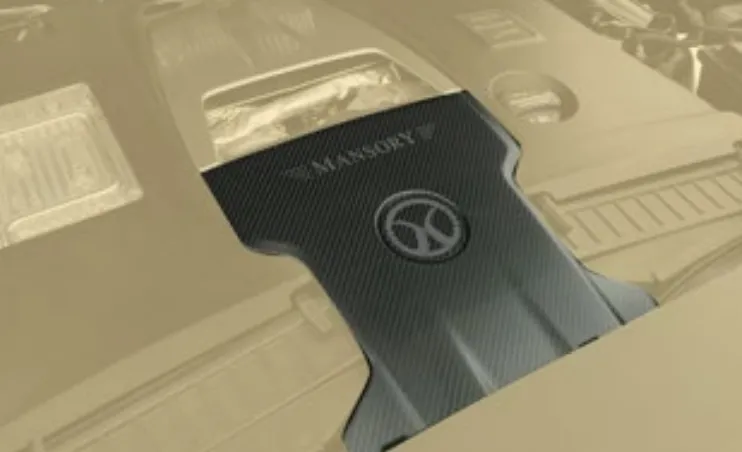
Engine cover for G63 AMG clear coat


Mansory Engine Cover Clear Coat for G63 AMG — W465 Gronos High-Gloss UV-Stable Multi-Coat Carbon Finish
The under-hood bay of the Mercedes-AMG G63 (W465) is one of the few cabins on a modern luxury vehicle that an owner regularly opens for an audience — at concours, at marina valet, at the workshop pickup. The carbon engine cover is the visual centrepiece of that bay; how it reflects light is the entire point. The Mansory Engine Cover for G63 AMG in Clear Coat takes the same autoclave-cured twill shell as the standard satin variant and finishes it with a multi-coat ultraviolet-stable 2K clear coat system, oven-baked to a high-gloss surface that reads as wet, mirror-like, and saturated rather than matte and businesslike. The shell construction is identical; the finish science is the differentiator. This page documents the clear-coat process, why it matters under engine-bay heat, and how the gloss reading compares against the satin baseline.
Multi-Coat Layup — The Five Layers Above the Carbon
The clear-coat finish on this engine cover is not a single spray pass. It is a five-layer wet-on-wet build, each layer with a defined purpose, applied in a controlled-temperature spray booth and cured in an industrial oven with a programmed temperature ramp. The visible result is a deep, glassy surface — the underlying engineering is what keeps that surface stable for the life of the vehicle:
- Layer 1 — Epoxy primer (40-60 µm): applied directly to the post-cured carbon laminate after a fine-grit abrade. The epoxy primer wets the woven twill, fills micro-pinholes from the resin film, and provides the chemical bond that the subsequent layers key into. Epoxy is preferred over polyester here because it is dimensionally stable across the engine-bay thermal range and does not shrink during cure.
- Layer 2 — Tinted base sealer (10-15 µm): a near-clear amber-tone sealer applied wet-on-wet, intended to deepen the carbon weave's perceived chroma without obscuring the pattern. The tint is calibrated against a reference panel; under direct light the carbon reads with a slightly warmer black than the satin variant.
- Layer 3 — First clear coat (60-80 µm): a two-pack isocyanate-cured (2K) urethane clear, hand-sprayed in two cross-coats. This layer is sacrificial in service — it is the layer that takes the early UV and oxidative load, sealing the weave under a continuous transparent film.
- Layer 4 — Wet-sand interlayer (after partial cure): the first clear is allowed to flash-cure to roughly 80% solvent-out, then wet-sanded with 1500-grit to remove orange peel and restore a perfectly flat optical reference. This is the step that distinguishes a true mirror finish from a "shiny" finish — the surface is mechanically flattened before the final coat goes down.
- Layer 5 — Final clear coat (50-70 µm) with UV stabiliser: a high-solids 2K urethane clear with HALS (hindered amine light stabiliser) and benzotriazole UV-absorber package. This is the layer that delivers gloss, that holds gloss across thermal cycling, and that resists the yellowing that affects unstabilised clears in elevated-temperature service.
Total film thickness above the carbon laminate is approximately 160-225 µm — measurably thicker than a standard automotive single-stage refinish, calibrated to permit the wet-sand interlayer step that delivers the final mirror reading.
Oven Cure Schedule
After the final clear is sprayed the panel is held flash-out for 10-15 minutes, then transferred to a programmable cure oven. The schedule is staged to drive solvent out at low temperature first, cross-link the urethane network at intermediate temperature, then post-cure at full target to lock the film:
- Stage 1 — solvent flash: 30 minutes at 40°C. Slow venting prevents trapped solvent that would later blister under engine-bay heat.
- Stage 2 — primary cure: 45 minutes at 60°C. The 2K isocyanate cross-link develops the urethane backbone; the film transitions from flexible to rigid.
- Stage 3 — post-cure: 30 minutes at 80°C. Final hardness develops, the HALS and UV-absorber packages disperse evenly through the film, residual stress is annealed.
The panel exits the oven, is allowed to cool slowly under controlled humidity, and is held 24 hours before final QC. The QC station gloss-meters every panel against the reference; rejections that fail the 90 GU minimum at 60° are returned to the wet-sand interlayer step and re-finished.
Gloss Measurement — Why 90+ GU at 60° Matters
Gloss is not a subjective parameter on this build. It is measured with a geometric gloss meter at three reference angles (20°, 60°, 85°) against a calibrated black-glass standard rated at 100 GU. The 60° reading is the industry reference for medium-to-high gloss surfaces; it is the angle at which both finishes are routinely specified on automotive class-A panels. The numbers tell the story directly:
- Satin standard variant: approximately 60-70 GU at 60°. Reads as soft, businesslike, low-glare under direct light. The weave pattern is visually present but not amplified.
- Clear-coat variant (this product): 90+ GU at 60° as a minimum spec, with reference panels routinely measuring 92-95 GU. Reads as wet, mirror, deep — direct light produces sharp specular highlights, the weave pattern reads with optical depth as if seen through clear glass.
- Reference — automotive class-A body paint: typically 88-92 GU. The clear-coat engine cover sits at or above the reading of a freshly polished body panel.
The 20° gloss reading is the more demanding test — it discriminates between high-gloss surfaces that look identical at 60°. At 20° the satin variant reads ~25-30 GU; the clear-coat variant reads 70-85 GU. That delta is what an observer perceives as "wet" versus "polished" under raking light, and it is the parameter that the wet-sand interlayer step and the high-solids final clear are engineered to deliver.
UV Stability Under Engine-Bay Heat — The Engineering Problem
Cosmetic clear coats face a specific challenge in the engine bay that body-mounted clears do not. The bay sits at elevated temperature continuously during operation — typically 80-110°C in steady cruise, peaking 120-130°C in heavy load conditions, holding 60-70°C as residual heat-soak after shutdown. At those temperatures, an unstabilised clear coat undergoes accelerated photo-oxidation: the polymer chains are scissioned by UV exposure, the chromophore population builds, and the film yellows visibly within 12-24 months of service. The pattern is well-documented — shiny, beautifully finished aftermarket carbon parts that arrive new and turn faintly amber within a single Mediterranean summer of garage-side photo-shoots and bay openings.
The Mansory clear specification responds to this with a deliberate stabiliser package in the final clear layer:
- HALS (hindered amine light stabiliser) — 1.5-2.0% by weight: intercepts the free radicals generated by UV photolysis before they propagate the chain-scission reaction that produces yellowing. HALS chemistry is regenerative — the stabiliser cycles between active and reduced forms and is not consumed quickly.
- Benzotriazole UV-absorber — 1.0-1.5% by weight: directly absorbs UV photons in the 290-380 nm band before they reach the polymer backbone. Reduces the photolysis rate by an order of magnitude relative to an unprotected film.
- Antioxidant package — 0.3-0.5% by weight: arrests the thermal-oxidative degradation pathway that runs parallel to the UV pathway, particularly relevant to clears that operate at elevated temperature continuously.
The cumulative result, validated against accelerated weathering test cycles correlated to Florida-equivalent natural exposure, is a clear coat that holds within 3 GU of its initial gloss reading and within a Δb* of 1.5 (yellowness index) across 5 years of continuous engine-bay service. In plain terms — the panel reads as new five summers later, not as a yellowing artefact of the first season.
Heat resistance — same as standard, verified against continuous service. The thermal envelope of the carbon laminate is identical on both variants — 80-120°C continuous service, peak 150°C transient, derived from the autoclave cure schedule and the epoxy resin glass-transition temperature. The clear-coat variant adds the requirement that the finish system above the laminate must hold the same envelope without softening, blistering, or losing gloss. The 2K urethane chemistry chosen here is rated for continuous service to 130°C with intermittent exposure to 160°C, comfortably above the engine-bay thermal range. The five-stage layup and the staged oven cure are what realise that rating in practice — solvent traps would blister, under-cured isocyanate would soften, and any one layer out of specification would compromise the system. The QC gloss check at exit is also a thermal stability check; a marginal cure schedule shows up as low gloss in the first week of service and is filtered out before dispatch.
Comparison Versus the Satin Standard — When to Choose Which
Both variants share the carbon shell, the OEM mounting hardware, the M177 V8 fitment, and the lead time. The differences are entirely in finish character and the buyer's intent for the bay:
- Satin standard: the businesslike option. Soft sheen, low glare under direct sun, weave pattern present but not amplified. Pairs naturally with bays that already include other satin or matte details — anodised dress covers, brushed-aluminium shrouds, matte-finished braided lines. The right call for buyers who want the bay to read coherent and understated.
- Clear coat (this variant): the cosmetic-premium option. High specular gloss, wet-look depth, weave pattern saturated and dramatic under raking light. Pairs naturally with bays that include polished or chrome details, mirror-finished hardware, and otherwise glossy presentation surfaces. The right call for buyers building toward concours-level bay presentation, or for owners whose bay is opened regularly for an audience and who want the engine cover to perform as a finish piece rather than a functional one.
The two variants are not mutually exclusive — a small subset of full-build owners specifies a clear-coat cover for show duty and a satin spare for daily service, swapping them across a 15-minute bench job. That is a niche order pattern; most buyers commit to one finish at order.
Compatibility and Pairings Across the Gronos Bay
The cover is engineered for the M177 4.0L bi-turbo V8 in the W465-generation G63 AMG, model years 2024 onward. It mounts to the OEM cover studs and uses the OEM rubber isolators and capnuts unchanged; the carbon shell replaces the OEM plastic cover one-for-one. Verify VIN at order time. The cover is not transferable to W463A G63 builds — the M177 packaging changed between generations and the mounting geometry differs. For W463A buyers, a generation-specific cover is offered separately; consult the parent kit page for the cross-platform catalogue.
The clear-coat engine cover reads at its full intent when the surrounding bay surfaces and the broader body kit are co-ordinated to its finish character. Common pairings on a build that includes this cover:
- The satin standard engine cover as the daily-service spare for owners who alternate between concours and routine duty.
- The aluminium exhaust tips with carbon housing at the rear, where the polished aluminium tips provide a visual companion to the high-gloss cover at the bay.
- The Mansory Performance Engine Bonnet above the bay, finished in matching clear coat for a continuous high-gloss read from the hood through to the cover beneath.
The full Gronos parts catalogue and the wider Mansory range are at the parent Mansory Gronos kit page and the Mansory collection.
Care and Long-Term Appearance
The clear-coat finish rewards the same maintenance discipline as a high-gloss body panel. Recommended schedule for owners committed to keeping the bay surface at concours condition:
- After every drive in adverse conditions: wipe the cover with a clean microfibre on opening the bonnet — dust and brake-bay fallout settle on horizontal surfaces and are abrasive if wiped off later when dry.
- Quarterly: a pH-neutral detail spray and a fresh microfibre, no heavy product build-up. The clear coat does not need polishing in normal service.
- Annually: visual inspection at the leading edge for any clear-coat micro-checking near sharp radii. A localised touch-up clear is supplied with the order; major refinish would only be required after a decade of heavy service or an impact event.
- Avoid: high-pressure spray directly on the cover at close range, ammonia-based glass cleaners, alkaline degreasers contacting the clear surface. None will fail the film immediately, all will accelerate gloss loss across years.
Ordering, Lead Time and Documentation
The cover is supplied to order. Standard delivery window is 10-14 weeks from confirmed order to dispatch. The lead time covers carbon layup, autoclave cure, the multi-coat finish process with the wet-sand interlayer, the staged oven cure, and final gloss QC. Ordering specification at quote:
- Vehicle VIN (W465 G63 verification, M177 engine confirmation).
- Finish reference confirmation — clear coat (this product) versus satin standard.
- Optional weave selection — book-matched 2x2 twill (default) or forged-composite face for a different visual character at the same finish level.
- Optional logo treatment — Mansory wordmark embedded under the clear, or omitted for a clean weave-only surface.
The cover ships in a foam-fitted hard case, oriented finish-up, with a microfibre over the surface to protect the clear during transit. Worldwide freight is arranged at ex-works or DAP terms.
Contact us to specify and order:
WhatsApp +44 7488 818 747 — finish, weave, fitment by VIN
[email protected] — quote, lead-time, freight
FAQ — Clear-Coat Engine Cover for G63 AMG W465
Q: Will the clear coat yellow over time under engine-bay heat?
A: Not within the design service envelope. The HALS plus benzotriazole UV-absorber package in the final clear layer holds yellowness index (Δb*) within 1.5 across five years of continuous service correlated to Florida-equivalent exposure. Yellowing in lesser clears is the result of unstabilised film chemistry running at elevated temperature; the system specified here is engineered specifically against that failure mode and validated against accelerated weathering test cycles before release.
Q: How does the clear coat measure against the satin standard in actual gloss numbers?
A: At a 60° gloss-meter angle the satin reads 60-70 GU and the clear coat reads 90+ GU as a minimum spec, with reference panels routinely measuring 92-95 GU. At a more demanding 20° angle the satin reads 25-30 GU and the clear coat reads 70-85 GU — that delta is what reads as wet versus polished under raking light. Both readings are referenced against a calibrated black-glass standard rated at 100 GU.
Q: Why does the clear-coat process need a wet-sand interlayer step?
A: Because a single-pass clear, however well sprayed, retains a fine orange-peel texture from solvent flash and gun atomisation. That texture scatters light at micro-scale and limits the achievable 20° gloss reading to the high 50s at best. The wet-sand interlayer step mechanically flattens the surface to a true optical plane, after which the final clear can be deposited as a thin uniform film that holds the flattened reference. The five-layer build with the wet-sand step is the difference between a shiny finish and a true mirror finish.
Q: Can I specify the clear coat finish on the satin variant after delivery, or vice versa?
A: No, finish is committed at order. The carbon shell is the same on both variants but the surface preparation, the layup count, the wet-sand interlayer, and the oven cure schedule are different processes — the part is finished as one or the other before it leaves the factory. An owner who has received a satin cover and wants a clear-coat cover orders a second part; the satin original can be retained as a daily-service spare or sold on.
Q: Is the high-gloss finish more fragile in service than the satin?
A: Functionally, no — the underlying film chemistry is the same 2K urethane and the cured hardness is identical. Cosmetically, yes in the sense that any swirl, scratch or wipe-mark reads more visibly on a high-gloss surface than on a satin one, simply because gloss surfaces show defects at lower contrast threshold. The maintenance discipline above (clean microfibre, neutral pH product, no aggressive detergents) is what keeps the surface reading at its initial spec; a clear-coat cover wiped with a dirty rag will show that abuse where a satin cover would conceal it.