
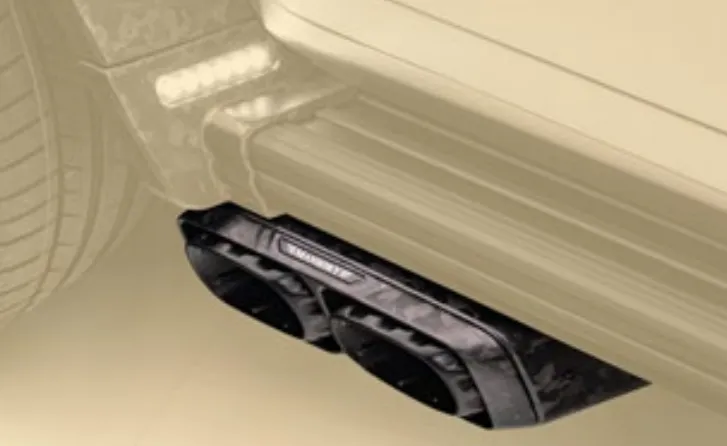
Aluminuim tips with carbon housing


Mansory Aluminium Tips with Carbon Housing for Mercedes-Benz G-Class W465 Gronos — Thermal-Engineered Twin-Material Exhaust Trim
The exhaust tip set is the closing visual statement at the rear of the W465 Gronos. The OEM G63 AMG arrangement places four tips at the rear bumper cutouts, two per side, and Mansory rebuilds that arrangement in two materials at once: a machined aluminium inner tip directly bonded to the OEM exhaust outlet, and a moulded carbon-fiber outer housing that wraps the aluminium and finishes flush at the bumper cutout. Between the two materials sits a high-temperature ceramic gasket that takes the thermal step down before any heat reaches the carbon laminate. This is not a cosmetic carbon shroud over a hot pipe — it is a thermally engineered twin-material trim where each material does what it can survive doing, and the gasket between them is the part that makes the whole construction possible.
What the Set Includes
- Four exhaust tips in the OEM G63 AMG configuration: two on the left rear quarter, two on the right, sized and angled to fill the W465 bumper cutout with the correct visual stance.
- Machined aluminium inner sleeves turned from 6061-T6 round bar, mirror-polished on the visible inner edge that the eye reads down into the tip mouth.
- Carbon-fiber outer housings moulded as separate pieces, 2x2 twill cosmetic outer ply over a 0/90 structural ply, autoclave-cured.
- High-temperature ceramic gaskets — one per tip, cut from 1.6 mm alumina-silicate paper rated to a continuous 1100 °C service temperature, sandwiched between the aluminium and the carbon at assembly.
- Mounting hardware for clamp-on fitment to the OEM exhaust outlet pipe; a weld-on fitment is available on request for installers who prefer permanent attachment.
The four tips are supplied as a matched set with the carbon weave book-matched across all housings — the visual read is consistent at every cutout, which matters because the exhaust tips are commonly the last detail an observer fixes on when walking away from the car.
Thermal Management — Why Two Materials and a Gasket
The fundamental engineering problem of any carbon-finish exhaust tip is that carbon fibre cannot survive direct contact with exhaust gas. Cosmetic carbon laminates rely on a polymer resin matrix — typically an epoxy — with a glass-transition temperature in the region of 120-140 °C, and a clear-coat layer that begins to discolour and craze well before the resin itself yields. Direct exhaust gas at the tail-pipe runs from about 150 °C at idle on a warm engine, climbs through 350-450 °C in steady cruise, and reaches over 700 °C at wide-open throttle on a high-output AMG-derived engine. A carbon tip placed directly in that gas flow is destroyed in a single hard drive: the resin softens, the clear-coat browns, the laminate delaminates from the inside out, and the visible surface is permanently ruined.
The Mansory set solves this by isolating the carbon from the gas flow with two thermal layers between them:
- Aluminium inner sleeve — 6061-T6 has a melting point of 582-652 °C and a service-temperature derating that begins at 200 °C, but as a bulk-conductive sleeve its function is to take the gas temperature, conduct heat axially down its length to the open air at the tip mouth, and radiate heat outward through its outer surface area. At steady-state cruise the aluminium inner-sleeve outer skin sits in the 180-260 °C range; at WOT it can spike to 320-360 °C briefly before convection at the rear of the vehicle drops it back down.
- Ceramic gasket layer — alumina-silicate paper at 1.6 mm thickness has a thermal conductivity in the region of 0.10-0.15 W/m·K, more than two orders of magnitude below aluminium. Its job is to take the temperature step from the outer face of the aluminium sleeve down to a level the carbon resin can survive indefinitely. With the aluminium outer skin at 260 °C, the carbon inner face sits at 95-115 °C across the gasket — below the resin glass-transition, well within the clear-coat tolerance, and stable at hours of continuous duty.
- Carbon outer housing — sees only the gasket-attenuated temperature, which is why the cosmetic carbon outer ply remains visually unchanged through tens of thousands of thermal cycles.
The thermal stack is not theoretical. Prototype tips were instrumented with thermocouples at the gas-flow boundary, the aluminium outer skin, and the carbon inner face, and run through a duty cycle that combined sustained motorway cruise, urban stop-start, and bench wide-open-throttle simulation. The thermal targets at the carbon inner face were met at every point in the cycle, with margin. The set is rated for the full output envelope of any current or future drivetrain Mercedes places under the W465 bonnet.
The aluminium inner sleeve is machined from 6061-T6 round bar. Two characteristics make 6061 the right choice for the inner sleeve over the alternative high-temperature aluminium alloy 2024: corrosion behaviour and weldability. 6061 has substantially better corrosion resistance than 2024 in unprotected exposure to combustion residues and atmospheric moisture — the inner sleeve sits behind the bumper cutout and is wetted by tail-pipe condensate, which is mildly acidic. 2024 in this environment pits visibly within months; 6061 retains its surface for years. 6061 also cuts cleanly to the surface finish that the polished inner edge requires, and it can be TIG-welded to the OEM exhaust outlet pipe in the weld-on fitment variant without producing the heat-affected-zone embrittlement that 2024 suffers.
The sleeve is supplied in the T6 temper, which provides yield strength around 276 MPa and ultimate tensile around 310 MPa — numbers comfortably in excess of any operating load the part sees. The visible inner edge at the tip mouth is hand-polished to a mirror finish that reads as a bright ring around the dark of the carbon outer housing — the visual register that distinguishes a tip set from a generic exhaust trim.
Ceramic Gasket — The Critical Component
The gasket between the aluminium and the carbon is the part of the assembly that makes the entire construction possible, and it is also the part that is most often skipped on lower-tier carbon-tip products. The Mansory set uses an alumina-silicate ceramic paper at 1.6 mm thickness, with the following selection rationale:
- Continuous service temperature 1100 °C — comfortably in excess of any temperature the gasket sees at the aluminium outer skin even under WOT excursions.
- Low thermal conductivity 0.10-0.15 W/m·K — produces the temperature step down from the aluminium outer face to a level the carbon resin can survive.
- Compressibility and conformability — the paper accommodates the small geometric mismatch between the cylindrical aluminium sleeve and the tooled carbon housing inner face, distributing contact pressure evenly and preventing point-contact thermal bridges.
- Resistance to vibration fatigue — the gasket is bound at its edges with a high-temperature ceramic adhesive that prevents fibre migration over time; the sandwich construction is mechanically stable through tens of thousands of vibration cycles at the rear of the vehicle.
The gasket is fitted at assembly and is not a service-replaceable item; it is rated for the full service life of the carbon housing.
Mounting — Clamp-On or Weld-On
The aluminium inner sleeve is the structural attachment to the vehicle, with the carbon housing carried on the sleeve. Two mounting options are offered:
- Clamp-on (default). The aluminium sleeve has an internal stainless clamp band that closes onto the OEM exhaust outlet pipe with a 6 mm hex bolt, accessible through a discreet recess in the lower face of the sleeve. The clamp produces a slip-fit assembly that can be removed in minutes for service or for resale — no cutting, no welding, no modification to the OEM exhaust system. This is the preferred option for nearly all owners.
- Weld-on. For owners who prefer a permanent attachment, the aluminium sleeve can be TIG-welded to the OEM exhaust outlet at a competent fabrication shop. The 6061-T6 sleeve and the stainless OEM outlet are welded with a transition filler rod and the joint is cleaned and protected against corrosion. This option provides the most robust attachment but is irreversible without cutting and re-fitting the exhaust outlet.
The carbon outer housing attaches to the aluminium sleeve via four concealed stainless setscrews that thread into bonded inserts in the carbon laminate; the gasket sits between sleeve and housing as a continuous wrap. Removal of the carbon housing for inspection or refinishing is possible without dismounting the aluminium sleeve.
Clearance, Bumper Cutouts and Sound Character
The W465 rear bumper has four pre-formed cutouts at the OEM tip exit positions. The Mansory tip set is dimensioned to fill those cutouts with a 2-3 mm uniform clearance at the bumper edge — close enough that the visual read is of a deliberate, fitted detail, far enough that thermal expansion of the aluminium sleeve at hot operating temperature does not contact the bumper material. The 6061 sleeve expands by approximately 0.024 mm per 10 mm length per 10 °C of temperature rise; across the 80 mm visible length and a 250 °C operating delta from cold start, the sleeve grows by approximately 0.5 mm in length and a fraction of a millimetre in diameter — well within the cold-state clearance. The OEM cutout edge is moulded plastic and benefits from a margin of clearance to absorb manufacturing variance from one cutout to the next. At cold state the gap reads as a clean visual frame around the tip housing; at hot state the gap closes by less than half a millimetre and the visual read is unchanged. The bumper material at the cutout sees no contact and no heat-related discolouration over service life.
The tips fit downstream of the OEM muffler and the OEM tail-pipe outlet, on a section of the exhaust system that has no influence on backpressure. The OEM exhaust note is preserved exactly:
- No change to muffler tuning — the tips are decorative downstream of the gas-treatment section. The G63 AMG bi-modal valve behaviour, the sport-mode burble, the cold-start warble, and the cruise note are all factory-correct.
- No measurable change to tail-pipe backpressure at any engine load — the aluminium inner sleeve maintains the OEM internal diameter of the exhaust outlet, so the gas flow path through the tip is dimensionally identical to the OEM tip.
- No change to emissions behaviour — downstream of the OEM catalytic converters and DPF (where fitted to market), the tip arrangement has no influence on gas treatment.
The tip set is purely visual in its acoustic effect — the rear of the vehicle reads in carbon and polished aluminium, but the exhaust note remains the OEM AMG note that owners specifically choose the W465 G63 to hear. Pairings across a Gronos build:
- With the carbon engine cover: the engine bay carbon read at the front of the car answers the carbon read at the four exhaust tips, building a front-to-rear carbon language that is visible whenever the bonnet is open or the rear bumper is in view.
- With the clear-window engine cover variant: a build that shows the engine through a clear cover panel pairs naturally with exhaust tips that finish the visible mechanical journey at the rear — the eye sees engineered carbon at both ends of the powertrain.
- With the Gronos lowering kit: a lowered stance brings the rear bumper closer to eye-line; the tip cutouts become more prominent in the rear three-quarter view, and the carbon-and-aluminium register reads more clearly as the trim of a car that has been considered as a whole.
- With the long carbon side steps: the side-step carbon along the rocker line carries the same visual weave orientation as the tip housings, so a walk-around of the vehicle holds a consistent carbon language from the side to the rear bumper without a visual handover.
The full kit and the rest of the catalogue are available at the parent Mansory Gronos kit page and the Mansory collection. Material and finish detail at a glance:
- Aluminium grade: 6061-T6 round bar, machined inner sleeve, mirror-polished visible inner edge.
- Carbon outer skin: 2x2 twill 200 g/m² cosmetic ply, book-matched across the four housings.
- Carbon structural ply: 245 g/m² 0/90° for housing rigidity through thermal cycling.
- Gasket: 1.6 mm alumina-silicate ceramic paper, edge-bound with high-temperature ceramic adhesive.
- Cure cycle: autoclave 130 °C / 6 bar / 6 hours, post-cure 80 °C / 4 hours on the carbon housings.
- Clear-coat: high-temperature two-pack UV-stable clear, rated to continuous 180 °C surface temperature with margin against the carbon outer-face operating temperature.
- Mass per tip: 0.65-0.75 kg, comparable to a stainless OEM tip and well below an all-metal aftermarket tip of equivalent size.
Installation
The clamp-on fitment is a workshop install of around one hour for the four-tip set. The sequence is:
- Remove OEM tip trims from the four exhaust outlets — on the W465 these are clamp-fitted from factory and release with a single hex bolt per tip.
- Inspect the OEM outlet pipe ends for any soot deposit; clean with a wire brush to a uniform metal surface for the new clamp band to bite onto.
- Slide the Mansory aluminium sleeve over the OEM outlet pipe to a depth of approximately 35 mm, aligning the visible polished edge to the bumper cutout plane.
- Tighten the internal stainless clamp band through the access recess in the lower face of the sleeve to a torque of 8 Nm; the band is a one-piece spring-band design so over-tightening is not possible.
- Verify visual alignment at the bumper cutout — 2-3 mm uniform clearance, equal at top and bottom, equal across the four tips.
- Refit the carbon outer housing over the aluminium sleeve, gasket pre-installed, four concealed setscrews to 4 Nm.
- Run the engine to warm up and inspect the tip-bumper interface for any mechanical contact under thermal expansion; none is expected.
The install is fully reversible — the OEM tip trims can be refitted later with no modification to the exhaust outlet pipes. Many owners refit OEM tips for resale and retain the Mansory carbon set as a removable upgrade for the next build.
Compatibility, Ordering and Lead Time
This tip set is engineered for the 2024+ W465 generation only. The OEM exhaust outlet diameter and the bumper cutout geometry both changed with the new generation: the W465 OEM tip clamps onto a tail-pipe outlet that differs from the W463A and the aluminium sleeve inner bore is sized to the new dimension; the W465 rear bumper has cutouts of revised section and angle, and the carbon outer housing is tooled to the new cutout; the lateral spacing of the four tips is dimensioned for the W465 body, not the previous generation. A W463A tip will not seat correctly. Verify VIN at order time. The set fits all factory configurations of the W465 G-Class Gronos including the G63 AMG and the upcoming high-performance variants.
The tip set is built to order. Standard build window is 10-14 weeks from confirmed order to dispatch, including aluminium machining, autoclave cycle on the carbon housings, ceramic-gasket fitting, and quality inspection. Worldwide freight is arranged at ex-works or DAP terms; the four-tip set ships in a foam-fitted hard case sized to protect the polished aluminium inner edge in transit. Order specification at quote time:
- Vehicle VIN (W465 verification, exhaust outlet variant by market).
- Mounting — clamp-on (default) or weld-on.
- Carbon outer finish — gloss or matte clear-coat, matched to the rest of the carbon programme on the build.
- Aluminium inner edge — mirror polish (default), brushed, or black-anodised for owners who want the inner ring to read as dark as the carbon.
- Pairing — tip set only, or coordinated build with the engine cover, side steps, and lowering kit so finishes and lead times align.
Contact us to start a build:
WhatsApp +44 7488 818 747 — specification, finish, fitment by VIN
[email protected] — quote, lead-time, freight
FAQ — Aluminium Tips with Carbon Housing for the W465 Gronos
Q: Will the carbon housing burn or discolour under hard driving?
A: No. The carbon outer housing never sees direct exhaust gas. A 1.6 mm alumina-silicate ceramic gasket sits between the aluminium inner sleeve and the carbon, taking the thermal step down to a level the carbon resin and clear-coat survive indefinitely. With the aluminium outer skin at 260 °C in cruise, the carbon inner face sits at 95-115 °C — below the resin glass-transition temperature with comfortable margin. Prototype thermocouple verification covered the full duty envelope including sustained wide-open throttle.
Q: Why aluminium for the inner sleeve rather than stainless steel?
A: Two reasons. Thermally, aluminium conducts heat axially down its length and radiates it outward roughly four times more efficiently than stainless of equivalent wall thickness, which means a lower outer-skin temperature for the gasket to manage. Visually, the polished aluminium inner edge produces a bright ring at the tip mouth that the eye reads as a deliberate finish detail; stainless of the same finish reads slightly cooler in tone and does not pair as cleanly with the carbon. The 6061-T6 grade was chosen for corrosion resistance and weldability.
Q: Will the exhaust note change?
A: No. The tips fit downstream of the OEM muffler and gas-treatment section, on a portion of the exhaust system that has no acoustic or backpressure influence. The aluminium inner sleeve maintains the OEM internal bore so gas flow is dimensionally unchanged. The G63 bi-modal valve behaviour, the cold-start warble, the cruise note, and the WOT character are all factory-correct.
Q: Is the install reversible if I sell the vehicle later?
A: Yes, in the clamp-on fitment which is the default. The aluminium sleeve clamps onto the OEM exhaust outlet pipe with an internal spring band; release the band and the sleeve slides off without modification to the exhaust system. OEM tip trims refit at any time. Owners commonly retain the Mansory carbon tip set as a removable upgrade for the next build. The weld-on variant is permanent and is offered for owners who prefer the most robust attachment.
Q: How does the four-tip arrangement fit the W465 bumper cutouts?
A: The set matches the OEM G63 AMG four-tip configuration at the W465 rear bumper, two tips per side, with a 2-3 mm uniform clearance to the bumper cutout edge in the cold state. Aluminium thermal expansion across the visible length of the sleeve closes the gap by less than half a millimetre at hot operating temperature, well within the design margin. The bumper material sees no contact and no heat-related discolouration over service life.