
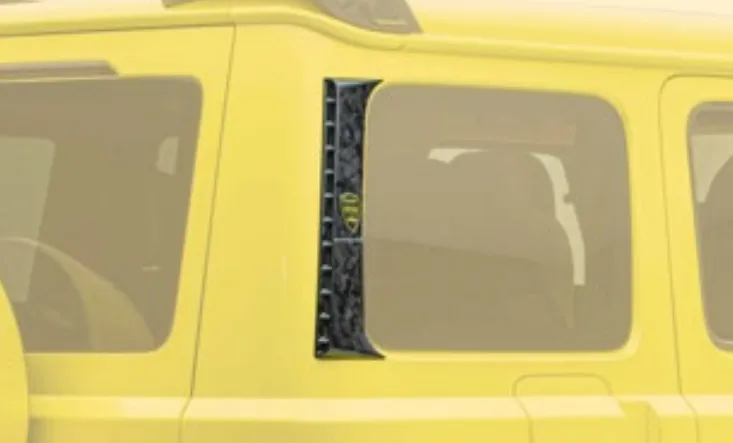
D-Pillar cover


Mansory D-Pillar Cover for Mercedes-Benz G-Class W465 Gronos — Carbon Rear Pillar Trim
Walk around a finished W465 G-Class build and look at the side profile from a low three-quarter angle. The car reads as a stack of vertical pillars — A, B, C and D — separated by glass and door cuts, with carbon details punctuating each transition. The D-pillar is the last upright before the rear door, the short vertical strip between the trailing edge of the rear side window and the rear-door shut line. On a stock G-Class that strip is finished in matte black injection-moulded plastic with a debossed Mercedes parts-mark on the inside face. On a Gronos build it is the single piece that, left untreated, breaks the carbon language travelling along the side of the vehicle. The Mansory D-Pillar Cover for the W465 closes that gap with a sculpted twill-carbon overlay tooled to the exact geometry of the new generation pillar.
Where the D-Pillar Sits — and Why It Reads
The W465 carries forward the classic G-Wagen architecture but with a slightly redrawn rear-quarter geometry. The rear side window is fractionally narrower and the rear door is repositioned a few millimetres further back compared with the W463A, which means the D-pillar — the vertical between the two — is a touch wider and carries a different curvature at its lower terminus near the belt line. From the side profile this strip occupies perhaps four percent of the visible body area but, because it sits at the eye line of an adult standing beside the car, it dominates close-range viewing. A black plastic pillar against an otherwise carbon-fluent build reads exactly as it is: a missing piece. Replace it with sculpted carbon and the entire side of the car composes correctly — the eye travels from A-pillar carbon, down the mirror housing, along the door-handle inserts, and finally lands on the rear pillar without a discontinuity.
Material and Layup
The cover is built as a thin, fully consolidated carbon panel — there is no need for core in a part this small and this curved — so the construction is simple, durable, and visually clean from any viewing angle:
- Cosmetic ply: 2x2 twill carbon, 200 g/m², book-matched left to right so the right-side cover and left-side cover read as a mirrored pair when photographed from the rear three-quarter.
- Structural ply: 200 g/m² 0/90° plain weave, oriented to stiffen the panel against gentle door-slam vibration.
- Cure: autoclave 130 °C / 6 bar / 6 hours, with an 80 °C / 4-hour post-cure to stabilise the resin against summer-sun heat soak inside a glass-house cabin.
- Mass per side: 0.22-0.30 kg — light enough that the OEM clip pattern is loaded well within its design margin.
- Clear coat: UV-stable LV-352 class two-pack, gloss or matte at order time. Painted-composite version available for body-colour-matched builds where the customer wants the pillar to disappear into the body shape rather than read as a carbon statement.
Visual Continuity Across the Side Profile
The D-pillar cover does not work alone. It earns its place on a build by joining a sequence of carbon details that resolve the entire flank of the car. The most successful pairings are:
- With the front A-Pillar / front and side roof cover: the front and rear pillars share a finish and a sheen, bracketing the side profile in matched carbon. The eye reads the car as having four upright accents — A, mirror, door-handle, D — rather than three carbon plus one black plastic.
- With the Carbon mirror housing: the mirror cap is the natural midpoint between A and D pillars; carbon at all three points lets the side profile compose without gap.
- With the Rear door panel: the inner-trim carbon of the rear door aligns with the pillar carbon at the door-shut line, so the join between door and pillar reads as a single carbon-to-carbon transition rather than a carbon-to-plastic one.
Water-Seal Interface — Critical Engineering Detail
The D-pillar sits directly against the rear-door weather-seal. Any cover that adds even a millimetre of unintended thickness in the wrong place will distort the seal contact and create a slow drip-path into the cabin during heavy rain or automatic-car-wash cycles. The Mansory cover is tooled with the OEM seal interface in mind:
- The inner edge of the cover sits 1 mm proud of the OEM pillar trim — exactly the offset required to keep the seal contact at the OEM-spec compression.
- The lower terminus of the cover is profiled to clear the door-rebate drainage channel, so water that runs down the inside of the door glass exits through the OEM drain hole as designed.
- A flexible polyurethane bead is applied along the cover-to-pillar perimeter at install, sealing the gap between the carbon overlay and the OEM trim against capillary moisture entry.
- The cover is dimensionally stable across the operating temperature range of the door cycle — there is no thermal-expansion creep that would alter seal contact between summer and winter.
The result, validated against repeated automatic-car-wash cycles, is that the cover does not change the cabin water-tightness behaviour at all. Drip tests after high-pressure wash show identical performance to the OEM pillar.
OEM Clip Retention — No Drilling, Fully Reversible
The OEM W465 D-pillar trim clips to the body with a pattern of integrated plastic christmas-tree clips along its inner perimeter. The Mansory cover is designed as an overlay rather than a replacement: it bonds to the OEM trim without removing it, so the clip pattern stays exactly as Mercedes engineered it.
- Surface preparation: wipe the OEM pillar trim with isopropyl alcohol and lightly scuff the contact zone with a Scotch-Brite pad to give the structural adhesive a key.
- Pre-fit: position the cover dry and confirm the gap to the door-seal at upper, middle, and lower contact points; verify the lower terminus aligns with the belt-line.
- Bond: apply Sika 252 or 3M Panel Bonding adhesive in a continuous bead around the perimeter contact zone.
- Clamp: position cover and hold with masking-tape tension ties for 60 minutes, then leave undisturbed for 24 hours before exposure to wash or wet driving.
- Hidden fasteners: two M4 stainless studs at the upper and lower edges, hidden under the seal lip, give a belt-and-braces mechanical hold for long-term reliability.
- Reversibility: the cover can be removed by a body shop with a fishing-line cut through the adhesive bead — the OEM pillar trim is undamaged and the car returns to factory if needed.
Total install time per side: 1.5-2 hours including dry fit, bond, and tension cure. Both sides in a half day of bench time.
Surface Protection — UV, Wash, and Real-World Behaviour
The D-pillar position is a relatively benign zone for a visible-carbon panel. Direct overhead sunlight reaches the pillar only in late morning and mid-afternoon at low latitudes, so total annual UV dose at this position is markedly less than on a roof wing or hood. That said, the cover lives outdoors and is washed regularly, so the surface system is engineered for long service life:
- Clear-coat UV system: hindered-amine light stabilisers in the LV-352 class two-pack block 95%+ of UV-A. Practical weave-yellowing horizon at this position is in the 10-12 year range under heavy sun, longer under garaged use.
- Automatic-car-wash survival: the cover is rated for unrestricted use in standard rotating-brush and touchless wash systems. The bonded perimeter and hidden fasteners hold the part securely against wash-jet pressure; the clear coat resists rotating-brush abrasion under normal cycle counts.
- Edge sealing: the perimeter polyurethane bead prevents capillary water entry behind the cover, the most common failure mode for poorly engineered carbon overlays.
- Maintenance: hand wash with pH-neutral shampoo, soft microfibre dry, quarterly ceramic-spray top-up. Annual edge inspection during routine service.
D-Pillar vs A-Pillar vs Carbon Trimbars — Which Pillar Carbon Does What
Buyers configuring a Gronos build often ask which pillar parts to specify and in what order. The three pieces that govern pillar-zone carbon — A-pillar cover, D-pillar cover, and the Carbon trimbars — each address a different zone and a different visual problem:
- A-Pillar / front and side roof cover: resolves the front pillar plus the side-roof channel above the doors. Highest visibility from a front three-quarter approach. Most often specified first.
- D-Pillar Cover: resolves the rearmost pillar between rear glass and rear door. Highest visibility from a rear three-quarter and at close-range standing height. Most often specified together with A-pillar.
- Carbon Trimbars: resolves the lower body trim along the door sills and rocker zone. Reads at low approach angles and in side-on photography. Specified to complete the side composition once both pillar parts are in place.
A build that has all three reads as a fully resolved side profile. A build with only the trimbars reads as carbon at the bottom of the doors with stock pillars above; the eye notices the absence. A build with both pillar parts plus trimbars is what most photography of finished Gronos cars shows.
Compatibility — W465 Specific
This cover is tooled for the 2024+ W465 generation only. The pillar geometry differs from the W463A in three measurable ways: the pillar width at mid-height is approximately 4 mm wider, the curvature at the lower terminus is more pronounced as the pillar joins the belt-line, and the OEM clip spacing pattern is revised at the lower edge. Fitting a W463A-spec D-pillar cover onto a W465 results in poor seating and an uneven gap to the door seal — a meaningful weather-tightness problem rather than a cosmetic one. Verify generation by VIN at order time. The Mansory W465 D-pillar cover is compatible with all factory trim levels — G500, G580, G63 AMG — and with both narrow-body and Wide Kit Gronos builds.
Ordering and Lead Time
The cover is built to order. Standard build window is 10-14 weeks from confirmed order to dispatch, including layup, autoclave cycle, post-cure, clear-coat application and inspection. Worldwide freight is arranged at ex-works or DAP terms; the part travels in a foam-fitted hard case to protect the clear coat in transit. Order specification at quote time:
- Vehicle VIN — for W465 generation verification.
- Side — left, right, or pair (most orders are a matched pair).
- Material — visible carbon (gloss or matte clear) or primed composite for body-colour paint at the installer.
- Pairing — alone, with A-pillar cover, with full pillar package (A-pillar plus mirror housings plus rear door panel).
Contact us to start a build:
WhatsApp +44 7488 818 747 — specification, finish, fitment by VIN
[email protected] — quote, lead-time, freight
FAQ — Mansory D-Pillar Cover for the W465 Gronos
Q: Will the cover affect the rear-door weather-seal contact and the cabin water-tightness?
A: No. The cover sits exactly 1 mm proud of the OEM pillar trim, which is the offset Mercedes engineers the seal contact to. Repeated automatic-car-wash and high-pressure-wash testing shows identical drip-test behaviour to the unmodified OEM pillar. The cover does not alter cabin water-tightness in any measurable way.
Q: Can a W463A D-pillar cover be fitted to a W465 if I am moving carbon parts between cars?
A: No. The W465 pillar is approximately 4 mm wider at mid-height with revised lower curvature and a different OEM clip pattern at the lower edge. A W463A cover seats poorly and creates an uneven gap to the door seal — a weather-tightness problem rather than a cosmetic one. Order a W465-tooled cover for any 2024+ build.
Q: How does the cover behave in a rotating-brush automatic car wash?
A: The cover is rated for unrestricted automatic-wash use. The bonded perimeter and hidden M4 stainless fasteners hold the part securely against wash-jet pressure, and the LV-352 clear coat resists rotating-brush abrasion under normal cycle counts. Touchless and high-pressure systems are also fine. The only wash practice we discourage is sustained close-range pressure-washer use directly along the cover perimeter, which is the same recommendation as for any bonded carbon overlay.
Q: Does the install require a body shop or can a competent fitter do it at the workshop bench?
A: A competent workshop fitter can install the cover at the bench. The job is surface preparation, structural-adhesive bond, masking-tape tension cure, and two hidden M4 fasteners — no body-shop paint work, no panel cutting. Total bench time per side is 1.5-2 hours, both sides in a half day. Body-shop work is only needed if the customer specifies the primed-composite version for body-colour paint.
Q: Can the cover be removed cleanly later if I sell the car back to a stock-spec buyer?
A: Yes. The bonded perimeter is cut with a fishing-line tool along the adhesive bead — a standard body-shop technique — and the cover lifts away. The OEM pillar trim underneath is not modified, so the car returns to factory cosmetic spec. Plan a half day at a body shop for clean removal of both sides.
The full Gronos kit and the rest of the catalogue are available at the parent Mansory Gronos kit page and the Mansory collection.