
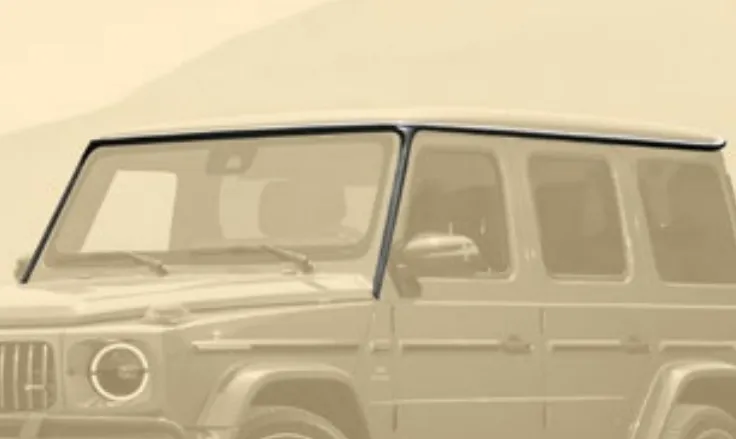
A-Pillar / front and side roof cover


Mansory A-Pillar / Front and Side Roof Cover for Mercedes-Benz G-Class W465 Gronos — Upper Cabin Carbon System
The G-Class roofline is the most architectural element on the vehicle: vertical windshield, hard-cornered A-pillars, a flat roof bracketed by clearly defined side rails, and a squared-off rear with the D-pillar capping the cabin. On the new W465 generation Mercedes have refined the upper cabin geometry — slightly different A-pillar section, a revised side rail to suit the updated sunroof envelope, repositioned roof-rack threaded inserts, and a redesigned rain channel that runs the full length of the side rail. The Mansory A-Pillar / Front and Side Roof Cover for the W465 Gronos answers that geometry with a multi-piece carbon set tooled specifically for the new platform — a system that turns the upper cabin frame into a continuous carbon expression while leaving every functional surface (rain channel, sunroof seal, weather strip, roof-rack mount) exactly as Mercedes designed it.
What the System Includes
- Two A-pillar covers: left and right, mirror-image pair, each running the full length of the windshield pillar from the cowl seal at the base to the front roof corner.
- Two side roof rail covers: left and right, running from the front roof corner along the full side rail toward the D-pillar transition.
- Optional front roof-edge connector (separate part): bridges across the top of the windshield between the two A-pillar caps for buyers who want an unbroken loop at the front.
The four primary panels are supplied as a matched set with weave orientation aligned across all pieces — A-pillar to side rail — so the carbon read is continuous when the eye sweeps from windshield to roof to rear quarter.
Visual Continuity from Front to Rear
On a finished Gronos build the upper cabin is the part of the car that stays in view from the longest distance — visible from oncoming traffic, from cars in adjacent lanes, and at eye level when standing next to the vehicle. The OEM A-pillar and side rail are painted body colour, which reads cleanly in isolation but breaks the carbon language the moment a buyer fits visible-carbon hood, mirror housings, and D-pillar covers. The A-pillar and side rail covers close that loop. When fitted alongside the front mask, hood, mirror housings and the rear roof wing or D-pillar carbon, the eye traces an unbroken material line from the cowl, up the windshield pillar, along the side rail, around the rear corner, and back down the D-pillar. The roofline reads as a single carbon frame around the cabin glass — the same visual logic high-end motorsport-derived road cars use to express their carbon architecture.
Multi-Piece Bonded Layup — Why Not One Big Cover
An obvious question is why the system is multi-piece rather than a single wraparound cover. There are three engineering reasons:
- Mould geometry: the A-pillar section turns through nearly 90° at the front roof corner. Tooling a single piece around that corner produces draft-angle problems and uneven cure pressure, which compromises both surface quality and laminate density.
- Thermal expansion: a single panel running the full A-pillar-plus-side-rail length would have a temperature-driven length change of several millimetres between a 40 °C summer roof and a -20 °C winter morning. Splitting the system at the front corner places the expansion joint at a hidden seam rather than along a visible edge.
- Service and shipping: separate panels can be replaced individually if damaged, and freight is dramatically simpler — no oversized single panel that requires palletised shipping.
The seam between the A-pillar cover and the side rail cover sits at the front roof corner, hidden under a precision-trimmed butt joint sealed during installation. The eye does not register a transition.
Material — Visible Carbon, Engineered Layup
- Outer skin: 2x2 twill 200 g/m² book-matched cosmetic carbon, weave orientation matched between A-pillar and side rail panels for visual continuity at the corner seam.
- Structural ply: 245 g/m² 0/90° carbon for stiffness and impact resistance.
- Inner liner: 200 g/m² twill protective ply on the bond face.
- Core strategy: solid laminate throughout — the panels are slim, curved sections where additional core mass is unnecessary and would add visible thickness at edges.
- System mass: 2.0-2.4 kg total across all four primary panels; the optional front connector adds approximately 0.6 kg.
- Cure cycle: autoclave 130 °C / 6 bar / 6 hours, post-cure 80 °C / 4 hours for full laminate stabilisation.
- Finish: UV-stable two-pack clear coat in high gloss or full matte; both finishes use the same hindered-amine UV stabiliser package.
Each panel is finished on both sides — the inside-facing surface is laminated to a clean inner ply rather than left as raw bond face, because a portion of the A-pillar inside surface is visible from the driver's seat through the windshield (more on that below).
Rain Channel Preservation
The W465 rain channel runs along the inboard edge of the side roof rail, where it collects water shed off the roof and routes it forward to the cowl drain. Any cover that intrudes on the rain channel — narrows it, raises its floor, or interrupts its drainage path — produces water tracking onto the side glass during heavy rain, and in the worst case, water seepage into the A-pillar interior. The Mansory side rail cover is engineered with this constraint as the primary geometric input:
- The cover sits on the outboard half of the rail surface only — the inboard rain channel surface is fully preserved at OEM dimension.
- The cover edge stops 6 mm from the rain channel inner wall, with a sealed perimeter bead preventing capillary water entry behind the cover.
- The forward end of the cover ramps down to meet the cowl drain entry point exactly — no step, no dam, no flow restriction.
The functional result: rain shedding behaviour is unchanged from OEM. Water that hits the roof tracks across the cover surface, drops into the OEM channel at the inboard edge, runs forward, and exits through the cowl drain.
Weather-Strip Interface
The OEM weather strip seals the door frame top edge to the side rail underside; it is one of the most service-sensitive sealing surfaces on the vehicle, because any change to its mating geometry can produce wind noise at highway speed or water entry during washing. The cover is engineered to leave the weather strip mating surface untouched:
- The cover wraps the outer face and the upper face of the side rail, but stops at the upper-inner radius — it does not extend down to the weather-strip groove.
- The OEM weather strip remains in its OEM groove, sealing against the OEM door frame, with OEM clamp-load.
- The cover adds approximately 1.8 mm of standoff at the upper-outer corner of the side rail; this is below the 3 mm threshold at which door-glass-to-rail clearance becomes an issue, and well within the OEM tolerance band for the door drop adjustment.
Buyers fitting the system to a vehicle still under factory warranty can do so without affecting the door seal warranty — the weather strip is not removed, modified, or repositioned during installation.
Sunroof Clearance
The W465 panoramic sunroof is wider than the W463A unit and uses a revised guide rail that sits slightly outboard of the previous-generation rail. That change is the single largest reason a W463A-spec A-pillar cover does not fit the W465 — the side rail clearance envelope around the sunroof rail is different. The Mansory W465 cover is tooled with the new guide rail position and includes:
- A 4 mm clearance envelope between the cover inboard edge and the sunroof guide rail at the closest point.
- An undercut at the sunroof front-edge rubber seal to allow seal compression during sunroof closing without cover contact.
- Verified clearance with the sunroof tilt-and-slide actuator at full travel — no contact, no rub, no noise.
If the vehicle is specified without the sunroof option, the cover sits over the closed sheet-metal roof with the same outer geometry, simply without the inboard clearance constraint.
Interior-Side Appearance
One detail separates a properly engineered A-pillar cover from a generic aftermarket trim part: the inside surface. From the driver's seat, the inboard face of the A-pillar is visible through the windshield, framed by the windshield glass and the dash top. A cover that is finished only on the outside reads, from inside the cabin, as a raw composite back-face — visible weave on the outside, glassy resin or rough fibre on the inside. The Mansory cover is laminated to a finished clean inner ply across the entire visible inside zone, with the same UV-stable clear coat as the outer face. The result: from the driver's seat the A-pillar reads as a finished carbon frame on both sides, not as a part with a hidden back face. Buyers who specify the matching carbon mirror housings get the full front-of-cabin carbon expression: pillars and mirrors aligned, all surfaces finished.
Roof-Rack Mounting Point Compatibility
The W465 retains threaded roof-rack inserts at the same approximate longitudinal positions as the previous generation, but the inserts are repositioned approximately 8 mm outboard to suit the wider sunroof. The Mansory side rail cover is engineered to clear the new insert positions:
- The cover does not occlude any roof-rack threaded insert.
- Factory roof rails (sliding bars or fixed crossbars) bolt directly to the OEM inserts without spacers.
- Aftermarket cross-bar systems that clamp to the door frame top edge will need to clear the carbon cover — verify with the bar manufacturer; standoff at the outer edge is approximately 1.8 mm.
If the vehicle is fitted with factory-option roof rails at delivery, the rails can remain mounted during cover installation — the cover slides under the rail mount foot at the relevant point, with no need to remove the rail.
Installation
The system is installed in a defined sequence to control alignment between adjacent panels:
- Surface preparation: wash and degrease the OEM A-pillar and side rail surfaces, light scuff sand for adhesive key, isopropyl alcohol wipe.
- Pre-fit each panel: verify gap targets at the cowl base, the front roof corner seam, the rear-quarter transition, and the sunroof clearance envelope.
- Install the A-pillar covers first: structural adhesive (Sika 252 polyurethane) at the perimeter contact zones, hidden M4 stainless studs at the panel base into bonded captive nuts on the inside face for mechanical security.
- Install the side rail covers second: same adhesive system, with the front edge butt-joined to the A-pillar cap, sealed with a thin polyurethane bead at the seam.
- Apply EPDM weather seal at all glass-to-cover interfaces (windshield perimeter, sunroof front edge).
- Cure undisturbed for 24 hours before exposure to washing or wet driving.
- Total install time: 5-7 hours for the four-panel system at a competent workshop.
The install is fully reversible — adhesive can be cut and the panels removed without damage to the OEM body. Buyers selling the vehicle later commonly remove the carbon set and refit the OEM-painted finish for the next owner.
Visual Pairings on a Gronos Build
- With the visible-carbon hood and front mask: the carbon language flows from the front bumper up through the hood, around the windshield, and along the roof — an unbroken material expression at the front of the vehicle.
- With carbon mirror housings: mirrors and A-pillar covers visually align at the front-of-cabin zone, creating a cohesive carbon expression from the driver's perspective looking out and from any observer's perspective looking at the front quarter.
- With D-Pillar Cover: closes the upper cabin carbon loop completely from windshield to rear quarter — pillars, side rails, and rear pillars all reading in carbon.
- With Roof Panel "Gronos" with 2 Lights: the pillar-and-rail carbon frames the roof panel as the centrepiece of the upper cabin reading — frame in carbon, panel as the focused volumetric statement.
- With Roof Wing: the side rail carbon flows naturally into the roof wing carbon at the rear roof corner, completing the rear roofline expression.
The full Gronos kit and the rest of the catalogue are available at the parent Mansory Gronos kit page and the Mansory collection.
Maintenance
The upper cabin zone receives heavy UV exposure (especially in sun-belt climates) and is exposed to rain runoff from the windshield. Long-term care is straightforward:
- Hand wash with the rest of the upper bodywork using pH-neutral shampoo and soft microfibre.
- Quarterly ceramic-spray sealant top-up — particularly important for these high-UV-exposure panels.
- Annual visual inspection at the leading edges (front A-pillar tops, where stone impact and rain runoff are concentrated).
- Clear-coat refresh at the 8-10 year horizon for sustained visual integrity, the same maintenance horizon as any visible-carbon bodywork part.
Compatibility — W465 Specific
This system is engineered for the 2024+ W465 generation only. Three platform-level changes make a W463A-spec cover inappropriate for the W465:
- A-pillar section: the W465 A-pillar is approximately 4 mm wider at the upper-third zone, to suit the revised glass curvature.
- Side rail rain channel: the W465 channel runs the full rail length and exits at a revised cowl drain position; W463A tooling produces a step at the channel exit.
- Sunroof guide rail: repositioned outboard, requiring a different inboard edge profile on the side rail cover.
Verify VIN at order time. The system fits all factory configurations of the W465 G-Class Gronos, including narrow-body and Wide Kit variants, with or without sunroof, with or without factory roof rails.
Ordering and Lead Time
The system is built to order. Standard build window is 10-14 weeks from confirmed order to dispatch, including autoclave cycle time, clear-coat cure, and quality inspection. Worldwide freight is arranged at ex-works or DAP terms; the panels travel in foam-fitted hard cases sized for the longest dimension. Order specification at quote time:
- Vehicle VIN (W465 verification, sunroof yes/no, roof-rack yes/no).
- Finish — visible carbon gloss or visible carbon matte.
- Front roof-edge connector — yes / no.
- Pairing — pillars only, full upper-cabin carbon set with mirror housings and D-pillar covers, or full Gronos build coordination.
Contact us to start a build:
WhatsApp +44 7488 818 747 — specification, finish, fitment by VIN
[email protected] — quote, lead-time, freight
FAQ — A-Pillar / Front and Side Roof Cover for the W465 Gronos
Q: Will a Mansory A-pillar cover from the previous-generation W463A fit my new W465?
A: No. The W465 A-pillar section, side rail rain channel layout, and sunroof guide rail position have all changed versus the W463A. A W463A-spec cover seats poorly at the upper A-pillar, produces a step at the rain channel exit, and contacts the sunroof guide rail at full travel. The W465 system is tooled to the new geometry — confirm generation by VIN at order.
Q: Does the cover affect windshield seal integrity, sunroof operation, or the cabin rain noise level?
A: No. The covers overlay the OEM frame without disturbing the windshield seal, the sunroof seal, or the OEM weather strip. The rain channel is preserved at OEM dimension. Sunroof tilt-and-slide function, windshield wiper sweep, and cabin rain noise are unchanged. Several customers have remarked the cabin reads slightly quieter at highway speed because the carbon cover damps high-frequency wind buffeting at the A-pillar leading edge — a small but measurable effect on long-distance comfort.
Q: Can I install only the A-pillars, only the side rails, or do I need the full set?
A: The system can be installed in stages. A-pillars alone are a valid configuration and read cleanly with carbon mirror housings. Side rails alone create a visual discontinuity at the front roof corner because the painted A-pillar reads against the carbon rail — best avoided. Recommended order: A-pillars first, then side rails, then optionally the front roof-edge connector for an unbroken loop at the front.
Q: Is the system compatible with factory roof rails or aftermarket roof racks?
A: Factory roof rails on the W465 bolt to threaded inserts in the roof itself, which the side rail cover does not occlude — factory rails fit without spacers. Aftermarket cross-bar systems that clamp to the door frame top edge clear the cover (1.8 mm standoff at the upper-outer corner) but verify with the bar manufacturer for the specific clamp geometry.
Q: How visible is the inside face of the A-pillar from the driver's seat, and is it finished?
A: The inboard face of the upper A-pillar is clearly visible through the windshield from the driver's seat, framed by the dashboard top and the windshield glass. The Mansory cover is laminated with a finished clean inner ply across the entire interior-visible zone and clear-coated to match the outer face — both sides read as finished carbon, not as a part with a raw bond face on the back.