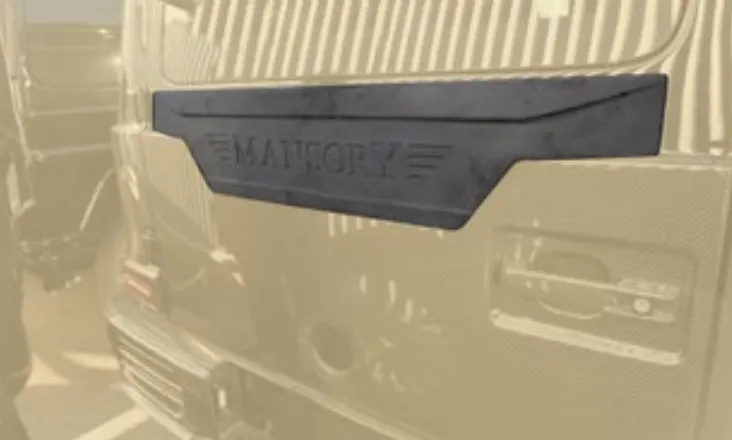
Rear door panel


Mansory Carbon Rear Door Panel for Mercedes-Benz G-Class W465 Gronos
The rear of a G-Class is the surface owners see every time they walk up to their car, and on the W465 the swing-out tailgate is the largest single panel on the vehicle. The Mansory Rear Door Panel in carbon fibre rebuilds that panel from scratch using the same pre-preg laminate, autoclave cure, and finish quality used across the rest of the Gronos kit. It is not a stick-on overlay - it is a structural composite panel that takes the place of the OEM steel pressing, integrates the spare-wheel mount cutouts, and changes the visual identity of the back of the truck completely.
This page covers the engineering case for moving the rear door surface to carbon, the layup spec, weight savings versus the factory panel, the alignment work needed to keep the door closing cleanly against the body, and how the panel fits with the rest of the rear assembly - the Spare wheel cover, the Spare wheel cover frame, the D-Pillar cover, and the Carbon mirror housings. Order it as part of a complete Mansory Body Kit for Mercedes Benz G-class W465 Gronos build, or as a standalone retrofit on an existing W465.
Why the rear door panel matters more than any other panel
Every G-Class generation has carried its spare wheel on the rear door, and the W465 keeps that signature feature. What that means in practice is that the rear door is not a small hatch hidden under glass - it is a full vertical sheet of metal almost two metres tall, with the spare-wheel cover sitting proud of it as the focal point. From any angle that includes the rear of the car, this panel dominates the view. Leaving it as a painted steel pressing while the bonnet, the wide front mask, the roof wing and the wide arches all carry visible carbon weave creates a visual disconnect that careful Mansory customers tend to fix as soon as they notice it.
The carbon rear door panel resolves that disconnect. The same 2x2 twill weave used on the engine bonnet and the wide front fenders now wraps the back of the car as well, and the rear three-quarter view gains a coherence that no amount of paint can match. In raw weave finish the panel reads as a deliberate engineering statement; in body-matched paint with a clear-coated weave inlay around the spare wheel it reads as understated luxury. Either way, the rear is no longer the unfinished side of the truck.
Hand-laid 2x2 twill carbon, autoclave-cured
The panel is built up by hand from pre-impregnated carbon fibre cloth in 2x2 twill, the same architecture Mansory uses across the visible-carbon range. The layup is laid into a heated tool that mirrors the OEM rear door geometry exactly - same character lines, same crease where the panel meets the spare-wheel housing, same draft angle around the rear glass aperture. Layer count is built up to match the bending and torsional stiffness of the steel pressing it replaces, with localised reinforcement around the bolt holes and the spare-wheel mount cutouts where load transfers into the door structure.
The cure happens in an autoclave at 130 degrees Celsius under pressure - the same process used for aerospace structural panels. Autoclave cure removes air voids, locks the resin matrix into a fully crosslinked state, and produces a panel that holds its dimensions in the heat of a parked car in summer or the cold of a Scandinavian winter. The resulting laminate is dimensionally stable to a tolerance well under one millimetre across the full panel height, which matters because the rear door has to close cleanly against a long sealing line on the body.
Finish goes on after cure. Standard delivery is the OEM Mansory raw 2x2 twill weave under UV-stable clear coat in either gloss or matte. Body-matched paint is offered, as is a hybrid finish where the central spare-wheel surround is left as visible weave and the rest of the panel is painted - the customer choice depends on whether the rear door is meant to read as a statement piece or to integrate quietly with the rest of the bodywork.
Weight savings - around 4 kg versus 7 to 9 kg of OEM steel
The OEM steel rear door pressing on the W465 weighs in the region of 7 to 9 kilograms once the spare-wheel mount reinforcements and internal stiffening ribs are accounted for. The Mansory carbon replacement comes in at roughly 3.5 to 5 kilograms depending on finish and reinforcement options. That is a saving of around 3 to 5 kilograms hung off the rear of the door at the furthest point from the hinges - mechanically the most useful place on a swing-out door to remove mass.
The owner notices that saving in two places. First, the door itself is easier to swing on its hinges, particularly when the truck is parked nose-up on a slope. Second, and more importantly, the load on the rear door hinges and the gas struts is reduced, which extends hinge life and keeps the door sitting square in its aperture for longer. G-Class owners who keep their truck for a decade tend to chase down the rattles and sag that develop in heavy steel rear doors over time - moving to a lighter carbon panel from the start sidesteps that wear curve entirely.
Spare-wheel mount integration
The W465 carries its spare on the rear door through a robust steel bracket that bolts through the door skin to internal reinforcement. The Mansory carbon panel preserves that mounting completely - the cutouts for the bracket are moulded into the panel, and bonded reinforcement plates inside the laminate distribute the load from the spare into the panel structure rather than concentrating it at the bolt holes. The OEM spare-wheel bracket bolts directly to the new panel using the factory bolt pattern.
If the build is also receiving the matching Spare wheel cover and the Spare wheel cover frame, the three components are produced as a matched set. The cover bezel sits flush against the panel face with a controlled gap of around 1.5 millimetres for thermal expansion, and the frame profile lines up with the rear door panel character lines without visible offset. Order all three together and the assembly arrives pre-fitted in our shop before shipping, which removes the trim work from the installer.
Mounting and alignment tolerances
Installation uses the original rear door bolt holes - no new holes are drilled into the door frame or the body. Bonded reinforcement plates inside the laminate accept the OEM bolts at full torque without crushing the carbon. The panel is fitted to the existing hinge plate using the factory hinge bolt pattern, and the door latch carries over from the donor vehicle.
The alignment work is where this part rewards a careful body shop. The W465 rear door has to close against the body cant rail along its top edge, against the rear bumper line along its bottom edge, and against the rear quarter panels along both vertical edges. Any twist in the door, any misalignment of the hinge plate, or any mismatch in the seal land will show up as a door that whistles at speed, leaks water in heavy rain, or rattles on rough surfaces. We supply the panel with shim packs for both hinges and a written alignment procedure, and we recommend a body shop that has worked on G-Class doors before. Allow a full working day for the install plus alignment - it is not a back-of-the-driveway job.
Once aligned correctly, the door closes with the same satisfying click as the OEM steel panel, the seal lands evenly all the way round, and the gap to the surrounding panels is consistent within factory tolerance. The carbon panel does not flex or oil-can in the way thin steel can, so once it is set up correctly it stays set up.
How the rear door panel ties into the rest of the rear assembly
This panel is the foundation piece of the W465 Gronos rear redesign. Specified on its own it transforms the largest single surface on the back of the truck. Specified together with the Spare wheel cover and the Spare wheel cover frame, the entire spare-wheel zone moves to carbon as a matched assembly. Add the D-Pillar cover and the rear pillar surface alongside the door joins the same finish family, so the rear three-quarter view reads as a single carbon composition rather than a series of trims.
From the side of the car, the Carbon mirror housings echo the same weave at the front of the door line, which closes the visual loop from front fender to rear door. The rear door panel is, in effect, the part that justifies the rest of the carbon spec on the back half of the car - without it, the spare-wheel cover ends up sitting on a painted steel pressing and the visual logic of a Gronos build breaks at the rear.
Finish options at a glance
Three finish families are offered. Raw weave clear-coated, in either gloss or matte, is the default - it is also the option that photographs best and reads most clearly as carbon at distance. Full body colour paint matches the panel to the rest of the bodywork and turns the carbon into a structural choice rather than a visual one. Hybrid finish keeps a central weave window around the spare-wheel housing and paints the rest of the panel - this is the option chosen most often on darker body colours where a full weave panel can read as too busy.
All three finishes use UV-stable clear coat over the carbon, which is what stops weave from yellowing under sun exposure over the years. Without a UV-stable top coat, even the best autoclave-cured carbon turns visibly yellow in three to five years of outdoor parking - the clear coat is not optional and it is not a cost-saving area.
How to order
The rear door panel ships as a single SKU. To order, send the VIN, the current build spec (so we know whether the spare-wheel cover and frame are already on the truck or coming together with this panel), and the chosen finish - raw weave gloss or matte, body paint code, or hybrid with weave window. We come back with a confirmed quote, an EUR price ex-works our European hub, and a build slot.
Lead time is 10 to 14 weeks from deposit, made-to-order in carbon, with worldwide shipping handled through our logistics partners. While the panel is being scheduled, browse the rest of the W465 Gronos catalogue and the wider Mansory collection to see what else can join the build.
Reach a build advisor on WhatsApp or write to [email protected] with your VIN and finish preference. We come back with a quote, a confirmed lead-time slot, and a render of the rear three-quarter view in your chosen finish so you can see the panel in context before signing off.
FAQ
Q: Does the carbon panel need any modification to the rear door frame?
No. The panel uses the OEM bolt pattern, the OEM hinge plate, and the OEM latch. No new holes are drilled into the door frame or the body. The only fitting work is alignment with shims, which the install procedure covers.
Q: How much weight does it save versus the OEM steel pressing?
Roughly 3 to 5 kilograms depending on finish and reinforcement options. The carbon panel weighs about 3.5 to 5 kilograms; the steel pressing it replaces weighs around 7 to 9 kilograms with all its internal stiffening accounted for.
Q: Will the panel hold the spare wheel safely?
Yes. The spare-wheel mount cutouts are moulded into the panel, and bonded reinforcement plates inside the laminate carry the load from the bracket bolts into the panel structure. The OEM spare-wheel bracket bolts directly to the panel at full torque.
Q: How long does installation take?
Allow a full working day at a body shop that has worked on G-Class rear doors before. Most of that time is alignment with the hinge shims to make sure the door closes cleanly against the body cant rails along all four edges. Rushed alignment is the most common cause of wind noise on swap-in panels, so the time is well spent.
Q: Can I order it with the spare-wheel cover and frame as a matched set?
Yes - we recommend it. When the panel, the cover and the frame ship together they are pre-fitted in our shop before crating, which removes the trim work from your installer and guarantees the gap between the cover and the panel face is correct. Specify the matched-set option when ordering.