
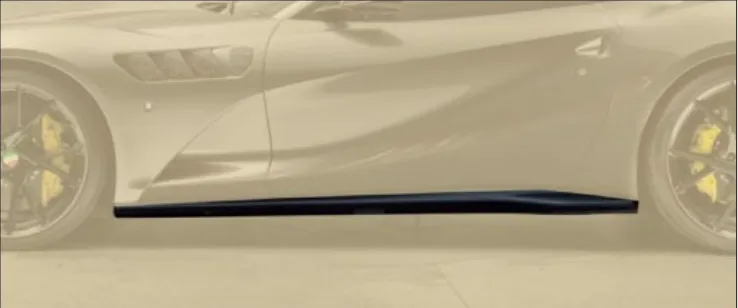
Side skirts Mansory Carbon for Ferrari 812 Stallone V2


Side skirts Mansory Carbon for Ferrari 812 Stallone V2
The Mansory carbon side skirts redraw the lower flank of the Ferrari 812 Superfast and 812 GTS Spider with a pair of sculpted rocker panels that travel the full length between the front wheel arch trailing edge and the rear arch leading edge. They are a signature element of the Stallone V2 carbon programme, sitting under the doors where the eye registers them at standing height, and they lengthen the long-bonnet front-mid-engine GT silhouette without altering ride height or interfering with the F1 transaxle's underbody airflow. This part lives within the wider Mansory Carbon Fiber Body kit set for Ferrari 812 Stallone V2 as a flank-defining piece that unites the front and rear bumper carbon visually, while keeping the OEM bonnet prancing horse and fender Scudetto entirely untouched. Owners specify them when they want the 6.5-litre F140 GA naturally aspirated V12 to look as planted as it sounds at 8900 rpm.
Construction & Materials
Each skirt is a single autoclave-cured carbon shell laid up over a CAD-derived plug taken directly off the 812's OEM rocker rail. The shape is hollow on the inboard face, ribbed internally for stiffness, and trimmed on a five-axis fixture so the upper edge tucks under the door sill cleanly and the lower edge runs parallel to the underbody pan rather than dipping below it. The visible surface is finished either as deep-gloss lacquered weave or as raw exposed weave under a UV-stable matte clear, depending on what the rest of the Stallone V2 programme on the car has been specified in.
- 3K twill weave aligned diagonally to the rocker line so the eye sweeps front-to-rear along the flank.
- Pre-preg layup with autoclave cure under controlled ramp for full resin conversion and panel flatness.
- Wall thickness 1.8-2.4 mm with localised reinforcement around bolt bosses and the central lap joint.
- Per-side weight in the order of 2.6-3.2 kg depending on weave and finish.
- Stainless captive nuts bonded into the inboard face for repeatable torque on the bolted mounts.
- OEM-spec rubber gasket strip retained along the upper sill interface to keep grit out.
- UV-stable 2K clear in deep-gloss lacquered finish or matte raw-weave finish, both flatted by hand.
- Optional contrasting tracer line at the lower lip or a forged-look insert at the rear kick.
Design & Visual Function
From the side the 812 reads as a classical front-engined Ferrari grand tourer: long bonnet, set-back cabin, short rear deck, with a rocker line that the OEM treats as a quiet shadow. Mansory's skirts take that quiet shadow and turn it into a sculpted ledge. The upper crease tucks under the door cut, the body of the skirt steps outward to catch light along the lower half of the flank, and a discreet trailing kick rises behind the rear arch so the skirt resolves into the rear bumper rather than dying flat into the wheel arch. The result is visual lengthening: the car looks lower without being lowered, and the bonnet feels longer because the flank is reading as a continuous horizontal band.
The weave direction is chosen to pull the eye along that band. A diagonal 3K twill catches highlights as the car moves past the observer, which suits the 812's GT character better than a vertical weave would. When the car is also wearing the Mansory front bumper or splitter, the skirt acts as the connecting tissue between front and rear carbon — without it, those endpoints feel detached. With it, the lower body reads as one piece treated end to end.
Importantly the skirts do not interrupt the OEM signature elements above them. The bonnet still carries the prancing horse, the fender Scudetto badge stays in place on the front quarter, and the door handles, mirror feet and side glass surround are all untouched. The carbon plays a supporting role beneath those cues rather than competing with them, which is what the Stallone V2 language was set up to do across the whole programme.
Compatibility & Fitment
These skirts fit the Ferrari 812 Superfast Coupé from 2017-2022 and the Ferrari 812 GTS Spider from 2019-2022. Both bodies share the OEM rocker rail and sill geometry that the skirt is engineered around, so a single part covers both variants. They are NOT compatible with the 488 GTB, 488 Pista or 488 Spider, NOT compatible with the F8 Tributo or F8 Spider, and NOT compatible with the 296 GTB or 296 GTS — all of those cars are mid-engine with different rocker geometry and door cut shapes. Ride height is not altered by the skirt; OEM ride height should be retained, the skirt is engineered around the standard pan height with no need for lowering the car. The F1 dual-clutch transaxle, magnetorheological SCM-E dampers and CCM brakes are all untouched. The OEM bonnet prancing-horse emblem and the fender Scudetto are retained in their factory positions. If the car has had any prior repair on the rocker or sill area, the installer should confirm panel flatness before fitting because the bonded mounts depend on a clean substrate.
Installation & Reversibility
Installation runs four to six hours per side at a competent body shop, slightly more if the lower edge of the door requires masking and the OEM rocker trim has any age-related grit underneath that needs to be cleaned out first. The mounting strategy is hybrid: bolted along the upper run via the OEM rocker rail captive points, and bonded along the lower run with a structural adhesive bead that distributes load and seals the joint against grit ingress. The combination gives the skirt mechanical retention where the OEM hardware is strongest and a continuous seal where the road throws debris hardest. The bolted mounts use stainless captive nuts in the carbon so the skirt can be removed in the future if the car returns to factory specification, with the bonded line releasing through controlled heat work in a body shop. We recommend either a Ferrari-certified body shop or a Mansory-trained installer for the work, because the alignment of the upper edge under the door cut is unforgiving on a first attempt and a misaligned skirt will telegraph along the entire flank.
Pairing within the Mansory Stallone V2 programme
Side skirts work hardest when they are not the only carbon on the lower body. The most direct flank companions are the side panels Mansory Carbon for Ferrari 812 Stallone V2 immediately above them along the door and quarter, and the front fenders Mansory Carbon for Ferrari 812 Stallone V2 just ahead of the front rocker termination. With those three pieces the entire flank reads as a treated surface from the leading edge of the front wheel through the door and into the rear quarter. To bookend the flank front-to-rear, the splitter for front bumper Mansory Carbon for Ferrari 812 Stallone V2 and the rear kit 812 GTS Mansory Carbon for Ferrari 812 Stallone V2 close the loop so the carbon at the rocker resolves into carbon at the front and rear corners rather than fading into painted bodywork.
Maintenance & Durability
Side skirts on a low-slung GT live in the dirtiest envelope of the car. Gravel kicked up by the front tyre, road rash on motorway joints and the occasional kerb rash on tight underground ramps all hit the lower edge first. The lacquered finish is more forgiving of stone-strike marks because the clear takes the hit and can be flatted and re-cleared without touching the weave; the raw matte weave shows fewer marks day to day but is harder to polish back if a deep chip lands in the substrate, so owners who do regular track-day driving on mixed surfaces tend to specify the lacquered version and add a clear PPF strip along the lower 80 mm of the leading edge. Cleaning is pH-neutral shampoo, soft microfibre and lukewarm water. Avoid alkaline wheel cleaners, ammonia and abrasive sponges — those are what kills lacquered carbon over time. A ceramic coating or a carbon-safe sealant restores depth twice a year and slows micro-marring from washing. If a panel chips, a competent carbon workshop can repair localised damage by flatting, re-laying clear and polishing without panel replacement; full skirt replacement is only required for severe structural damage from a kerb strike, not for cosmetic chipping.
Lead Time & Warranty
Skirts are produced to order rather than held as stock, so lead time is typically four to eight weeks from confirmed deposit, depending on production queue and the chosen finish. Lacquered gloss runs through a faster cycle than matte raw-weave because the matte cure schedule includes additional flash and flatting time. Each pair carries a twelve-month manufacturer warranty against delamination and clear-coat defects under normal use, supported through our channel for owners who buy via Hodoor.
FAQ
Q: Will the skirts lower the car or change ride height?
A: No. The skirts are engineered around the standard 812 ride height. They do not require lowering the car and they do not lower it themselves; the lower edge runs parallel to the OEM underbody pan.
Q: Will they fit my 812 GTS Spider as well as a Superfast Coupé?
A: Yes. Both share the same rocker rail and sill geometry, so a single skirt fits the 2017-2022 Superfast and the 2019-2022 GTS Spider.
Q: How are they mounted — bolted or bonded?
A: Both. The upper run uses bolted captive points along the OEM rocker rail; the lower run uses a structural adhesive bead. The hybrid mount gives mechanical retention where the OEM hardware is strongest and a continuous seal where road grit hits hardest.
Q: Raw weave or lacquered finish — which lasts longer on a track-day car?
A: Lacquered. The clear takes stone-strike marks and can be flatted and re-cleared. Raw matte weave looks subtler but is harder to repair if a deep chip lands. Track-day owners usually go lacquered with a PPF strip along the leading edge.
Q: Can I retrofit these to a 488, F8 or 296?
A: No. Those cars are mid-engine with different rocker geometry and door cuts; the 812 skirt will not fit any of them. This part is 812 Superfast and 812 GTS Spider only.
Pair the skirts with the side panels, front fenders and the front splitter or rear kit so the carbon reads as a continuous flank-and-corner treatment rather than a single ledge. To configure finish, weave or contrast tracer, contact us on WhatsApp +44 7488 818 747 or by email at [email protected].