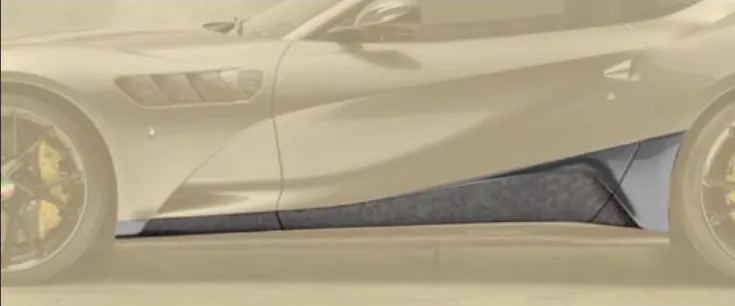
Side panels Mansory Carbon for Ferrari 812 Stallone V2


Side panels Mansory Carbon for Ferrari 812 Stallone V2
The Mansory carbon side panels for the Ferrari 812 Stallone V2 are body-side overlay panels engineered for the door and quarter region of the long Ferrari GT flank — distinct from the lower side-skirts and from the front-fender carbon, sitting in the visual middle band where the eye reads the car's length. They turn the otherwise uninterrupted painted side of the 812 into a layered carbon-on-paint section, breaking the slab of colour with an aligned weave panel that runs in dialogue with the door handle and mirror cover. This piece sits within the broader Mansory Carbon Fiber Body kit set for Ferrari 812 Stallone V2 programme as the connective body-side detail, applied to a chassis whose 6.5-litre F140 GA NA V12, front-mid layout, F1 transaxle and 8900 rpm redline define a classical front-engine grand-touring silhouette that benefits from a carefully measured carbon break rather than full coverage.
Construction & Materials
Each side panel is laid up from aerospace-grade pre-preg carbon fibre, autoclave-cured under a controlled ramp profile so resin conversion is complete and the substrate dimensionally stable across temperature swings. Because these are overlay panels rather than load-bearing structure, the engineering priority is shape fidelity and bond integrity: the panel must follow the 812's body curvature within tight panel-gap tolerances and stay there for the life of the car without lifting at edges or creeping in hot months. Mansory shapes the panels over CAD bucks taken from the OEM body, edge-finishes them on a five-axis trim, and applies a UV-stable 2K clear topcoat that holds weave depth without yellowing.
- Twill 2x2 weave with the warp aligned to the body waistline so the cadence reads horizontally along the flank.
- Mirror-matched weave at any seam between front and rear panel halves where the part is two-piece per side.
- Autoclave cure for full void elimination and class-A surface clarity.
- Wall thickness 1.4-2.0 mm with localised reinforcement at clip-into-paint anchor zones.
- Edge profile chamfered and lacquered so the panel-to-paint transition reads as a deliberate break, not an applied sticker.
- Bonded clip-into-OEM-paint mounting using primer-prepped automotive structural adhesive plus discrete OEM-friendly clip locators.
- UV-stable 2K clear, gloss as standard; satin and matte options available at order, with optional raw-weave (no clear) finishing on request.
- Optional contrast tracer thread or coloured weave at a defined band for owners who specify the panel as a signature detail.
Design & Visual Function
The 812 carries one of the longest, most classical bodies in the modern Ferrari range — long bonnet, cabin set rearward over the F1 transaxle, and a generous painted flank between front fender and rear quarter. Without intervention that expanse can read as plain on a car wearing aggressive front and rear Stallone V2 carbon: carbon at the nose, paint in the middle, carbon at the tail, and the middle reads quiet. The side panels solve that. They drop a measured carbon band into the door/quarter zone so the carbon programme feels continuous from front bumper to rear deck.
Weave alignment is the single most important visual decision on this part. Mansory aligns the panel weave to the door handle and the mirror housing carbon so that, viewed from the side, the cadence of the twill reads as one horizontal flow rather than three separate carbon islands. A car running the new mirror housing for 2020+ build years, the carbon outer door handle and the side panels arrives at a unified body-side language; specifying the panels alone, without the matching mirror or handle, leaves the panel looking dropped in. Order them as a set with the handle and the mirror in the same finish for the cleanest result.
Two finishing logics exist for the panel-to-paint transition. The first is a paint-break: the panel edge is masked and clear-coated tightly, so the transition reads as a hard, intentional architectural break. The second is a raw-weave finish where the carbon is exposed (no clear) for a more matte, textile-like surface that contrasts with surrounding gloss paint. Choice depends on whether the rest of the kit is gloss or satin, and on body colour.
Compatibility & Fitment
The side panels fit the Ferrari 812 Superfast Coupe (2017-2022) and the 812 GTS Spider (2019-2022). Both Coupe and Spider share the door and quarter geometry that this overlay is shaped to, so a single set covers either bodystyle within the Stallone V2 programme. The part is NOT compatible with the 488 GTB, 488 Pista, F8 Tributo or 296 GTB/GTS — those cars are mid-engine with substantially different door and quarter contours, and the overlay shaping will not sit. The OEM front-bonnet prancing horse and fender Scudetto are unaffected by this part because the panel does not encroach on either; both remain on the car alongside the Mansory programme. F1 transaxle clearance, magnetorheological SCM-E damper geometry and CCM brake routing are equally untouched — this is a body-side surface part with no interaction with mechanical systems. Cars that have undergone prior side-impact repair or aftermarket repaint should be evaluated by the installer before order, because the panel is shaped to factory body contour and significant deviation can affect fit at edges.
Installation & Reversibility
Installation runs three to five hours per side for a competent body shop, performed at bay temperature on a clean, decontaminated surface. Workflow: the body side is washed, clay-barred and IPA-wiped to remove silicones; the panel is offered up dry, locator clips are checked into OEM trim paths, panel-gap tolerances are verified with feeler and tape; the bonded perimeter is masked, primer prep is applied to the painted substrate per the structural-adhesive manufacturer's spec, the panel is bonded with even bead pressure and held with low-residue tape until cure; the masking is removed, edges are inspected and final clear-flash polished if needed. The job is reversible with thermal release of the adhesive and a respray of the affected paint band, but reversal is non-trivial and best treated as a permanent specification decision. We recommend a Ferrari-certified body shop or a Mansory-trained installer; first-attempt installs by general aftermarket shops have produced lift at the trailing edge during heat cycling and should be avoided.
Pairing within the Mansory Stallone V2 programme
The side panels are designed to live with the rest of the body-side carbon. Their natural partners are the side skirts Mansory Carbon for Ferrari 812 Stallone V2 directly below them, which take the carbon from the door waistline down to the lower body, and the outer door handle Mansory Carbon for Ferrari 812 Stallone V2 which sits within the panel zone and dictates the weave alignment for the whole side. For the mirror, choose either the NEW Mirror LHD housing for GTS Mansory Carbon for Ferrari 812 Stallone V2 on 2020+ cars or the front fenders Mansory Carbon for Ferrari 812 Stallone V2 if the carbon programme is to extend forward into the wheel-arch zone for a continuous nose-to-door carbon flank. Specifying the side panels with skirts and handle in the same finish is the cleanest path to a unified body-side; adding the mirror and front fenders extends the language across the full lateral body.
Maintenance & Durability
Care for the side panels is similar to any premium lacquered carbon, with a few considerations specific to body-side overlay. The panels sit in the zone most exposed to door dings in car parks, brushed clothing and bag straps when entering the car, and stone chips thrown by the rear tyres on wet roads, so the most useful preventative measure is paint protection film (PPF) over the leading edge of the panel and over the area immediately aft of the front wheel where chip frequency peaks. Wash with pH-neutral shampoo, soft microfibre and lukewarm water; never use alkaline cleaners, ammonia-based glass products on the carbon, or abrasive sponges. A ceramic coating applied over the lacquer adds chemical resistance and slows micro-marring. Avoid automatic car washes with rotating brushes — they are the single most common cause of weave-clear scuffing on body-side carbon. Repair workflow for a chipped panel is straightforward in a competent carbon workshop: localised flatting, fill where structural, fresh clear, polish; full panel replacement is rarely required for cosmetic damage. Panel resonance, which can occasionally be reported on adhesive-bonded body-side carbon parts, is engineered out here by the bonded-clip-into-paint mounting which constrains the panel against the OEM body across its full footprint rather than at point fixings only.
Lead Time & Warranty
Lead time is typically four to eight weeks from confirmed deposit, varying with the current Mansory production queue and any optional finishes specified (satin, matte, raw-weave, contrast tracer). The panels ship with a twelve-month manufacturer warranty against delamination, clear-coat defects and bond-line failure under normal use, supported through our channel for owners who buy via Hodoor.
FAQ
Q: How tolerant is the install to factory paint condition? Does the existing paint need to be perfect?
A: The bonded mounting uses primer-prepped automotive structural adhesive, so the underlying paint must be sound — well-adhered, free of bubbles, no failing clear. Light swirl marks or polishing residue are not an issue and are removed during the IPA-wipe step. Cars with documented prior side-panel repaints should be evaluated by the installer before order, because residual cracking or under-cured aftermarket clear can compromise the bond.
Q: Can the car be repainted after the side panels are bonded on?
A: A full panel respray with the side panel in place is not recommended; the panel should be removed first by thermal release of the adhesive, the paint work completed, and the panel re-bonded onto the fresh, fully cured paint. Spot-paint blending around the panel edge is possible without removal but is more difficult and best done by a body shop with carbon overlay experience.
Q: Is there any panel resonance or buzzing at high revs?
A: No. The bonded-clip-into-paint mounting constrains the panel across its full footprint, not at point fixings, so there is no air gap behind the carbon to resonate. Owners running the 812 hard to the 8900 rpm redline and feeling the unfiltered NA V12 induction note through the body have reported no buzz from the side-panel carbon.
Q: Will this fit my F8 Tributo or 296 GTB?
A: No. The side panels are shaped to the 812 body geometry only. The F8 and 296 are mid-engine cars with different door and quarter contours, and the overlay will not sit correctly. The 488 is also incompatible.
Q: Can I run the side panels without specifying the carbon door handle and mirror?
A: You can, but the visual result is weaker. The side-panel weave is aligned to the handle and mirror cadence; with paint where those parts should be carbon, the panel reads as dropped in rather than part of a continuous body-side language. Specify all three together for the cleanest finish.
Pair the side panels with the side skirts, outer door handle and the appropriate mirror housing for a unified body-side carbon language across the Stallone V2 programme. To configure finish, confirm production year for mirror selection, or request raw-weave or contrast tracer options, contact us on WhatsApp +44 7488 818 747 or by email at [email protected].