Front fenders Mansory Carbon for Ferrari 812 Stallone V2


Front fenders Mansory Carbon for Ferrari 812 Stallone V2
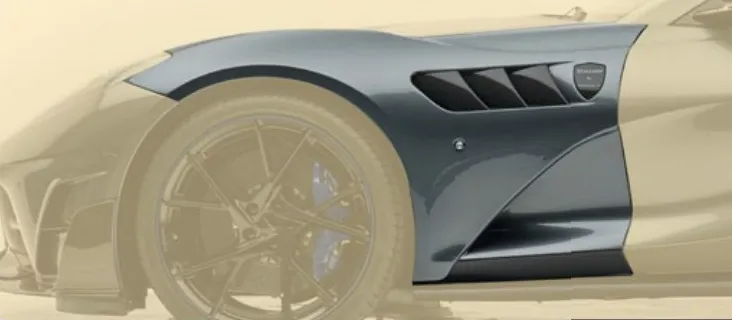
The Mansory carbon front fenders for the Ferrari 812 Superfast and 812 GTS replace the steel wheel-arch panels with a symmetrical pair of pre-preg laminate skins engineered specifically for the Stallone V2 programme. They sit in the long shoulder-line ahead of the doors, the visual gateway between the long bonnet and the cabin, and they host the most heritage-laden detail on the whole car: the OEM Scudetto badge. That badge is non-negotiable, and these fenders are recessed, machined and trimmed around it so the prancing-horse Scudetto remains exactly where Maranello put it, only now framed by autoclaved twill instead of stamped steel. The part belongs to the wider Mansory Carbon Fiber Body kit set for Ferrari 812 Stallone V2 and pairs naturally with the front bumper and front kit ahead of it. The 812 is a front-mid-engine GT carrying the 6.5L F140 GA naturally aspirated V12 with its 8900 rpm redline directly behind these fenders, and the panels were drawn so the long bonnet, the prancing-horse bonnet badge and the fender Scudetto all read as a single coherent surface from any three-quarter angle.
Construction & Materials
Each fender is laid up from aerospace-grade pre-preg twill carbon, oriented so the weave centreline tracks the upper body crease that runs from the headlamp shut-line back into the door cut. Lay-up sequence is balanced front-to-rear so the panel cures flat without any built-in twist, and the autoclave cycle uses a controlled ramp profile to drive full resin conversion before the de-mould step. The Scudetto pocket and the side-marker housing aperture are routed on a five-axis cell after cure, with witness marks taken from the OEM steel fender so the badge sits on its original axis to within fractions of a millimetre.
- 2x2 twill outer ply with the weave centreline aligned to the bonnet shut and front-bumper crease so the three panels read as one continuous surface.
- Autoclave cure under pressure and heat for void-free laminate and consistent surface clarity across the pair.
- Wall thickness 1.5-2.0 mm with localised reinforcement at the headlamp tab, the door-pillar return and the wheel-lip flange.
- Weight saving versus the OEM steel fender pair in the order of 35-50 percent depending on configuration and finish.
- Stainless threaded inserts bonded into mounting tabs so OEM bolt torque values can be reused without compressing the laminate.
- Scudetto badge pocket machined post-cure with rebate depth matched to the OEM badge backing plate so the badge sits flush.
- UV-stable 2K clear, hand-flatted between flash layers; gloss as standard, satin or exposed-weave matte available.
- OEM side-marker / repeater housing aperture preserved with the original gasket channel so the lens seats and seals as factory.
Design & Visual Function
Front fenders on a long-bonnet GT do most of their visual work above the wheel, in the shoulder-line that connects the headlamp to the A-pillar. On the OEM 812 that shoulder is restrained, almost classical; the Stallone V2 fender keeps the silhouette but adds a subtle carbon emphasis that makes the front shoulder feel slightly more sculpted under raking light, without altering the actual track or wheel offset. These are aesthetic carbon overlays, not widebody arches: the OEM front track is preserved end-to-end, the wheel sits exactly where it sat, and the existing alignment, suspension geometry and tyre clearance numbers all carry over unchanged.
The single most important design detail is the Scudetto. The OEM yellow shield with the prancing horse is the visual anchor of the front quarter, and the Stallone V2 fender is built around it rather than over it. The badge cut-out is rebated so the metal Scudetto sits flush with the carbon surface, the weave runs cleanly around its border, and the eye reads steel-and-enamel against twill rather than carbon swallowing the heritage. Combined with the OEM prancing horse retained on the front bonnet, the car keeps both of its Ferrari signatures in their original positions while the rest of the front shoulder shifts into Mansory's carbon idiom.
Weave alignment is the other point that separates a tooled fender from a generic carbon skin. The centreline of the twill is set parallel to the bonnet shut so when the bonnet sits closed the weave appears to flow uninterrupted from the bonnet panel into the fender, then forward into the front-bumper crease. If the car wears the matching carbon front bumper alongside the fenders, the entire forward third of the body reads as a single carbon surface broken only by the headlamp graphic and the Scudetto. That continuity is what owners specify these fenders for.
Compatibility & Fitment
The fenders fit the Ferrari 812 Superfast Coupé (2017-2022) and the 812 GTS Spider (2019-2022), both LHD and RHD. They are NOT compatible with the 488, F8 or 296; those are mid-engine layouts with different fender architecture. The 812 is a front-mid-engine grand tourer with the 6.5L F140 GA naturally aspirated V12 sitting behind the front axle and ahead of the cabin, driving a rear-mounted 7-speed F1 dual-clutch transaxle, and the fender skins were drawn around that exact bay. OEM hardware retained without modification: the prancing-horse bonnet badge, the Scudetto fender badge, the side-marker / repeater housing, the front-bumper mounting tabs, the headlamp shut-line geometry and the front active aerodynamics under the bumper. The OEM front track is unchanged because the fenders are aesthetic skins rather than widebody arches, so factory alignment specs, OEM wheel offsets and tyre clearance carry across without recalibration.
Installation & Reversibility
Installation is a precision body-shop job rather than a workshop bolt-on. Per side, expect five to seven hours of bench time; for a paired install, eight to twelve hours covering both fenders, paint-break inspection and final swing-test of the bonnet. The OEM steel fender is unbolted, the Scudetto badge transferred onto its original adhesive pad with fresh primer prep, the carbon panel offered up dry to verify shut-lines against the bonnet, the door cut and the front-bumper crease, then bonded and bolted using the OEM hardware paths. The side-marker housing is reseated with a fresh gasket so the lens seals as factory. Painted finish, where specified, is laid before final fitment so the colour-break with the bonnet and door is judged on the bench rather than on the car. Work is fully reversible: the OEM steel fenders store flat, the carbon panels unfasten cleanly, and a future owner can revert to factory steel without any sign of intermediate work. We recommend a Ferrari-certified body shop or a Mansory-trained installer because the Scudetto rebate depth, the bonnet shut-line tolerance and the door cut-line gap are easy to misjudge on a first attempt.
Pairing within the Mansory Stallone V2 programme
The fenders sit at the visual hinge between the front bumper and the doors, so they pair most usefully with the parts that touch them. The natural front-end set is the front bumper Mansory Carbon for Ferrari 812 Stallone V2 with which they share the bonnet-line crease, the splitter for front bumper Mansory Carbon for Ferrari 812 Stallone V2 beneath them, and the side panels Mansory Carbon for Ferrari 812 Stallone V2 immediately rearward where the door cut hands the carbon language back to the rocker. With those three panels in place the fenders stop being a stand-alone trim item and become the keystone of the front shoulder, with the Scudetto framed by carbon front, rear and below.
Maintenance & Durability
Carbon fenders on a long-bonnet GT face a particular mix of stresses: stone strike from the front wheels, washer-fluid overspray from the bonnet jets, sun load on the upper shoulder, and finger-contact wear around the Scudetto when an enthusiast crouches to inspect the badge. Cleaning is pH-neutral shampoo, soft microfibre, lukewarm water, two-bucket method; no alkaline cleaners, no ammonia, no abrasive sponges, all of which etch lacquered carbon and dull weave depth. Ceramic coating or carnauba over the lacquer slows micro-marring; a self-healing PPF strip across the leading edge of each fender is a sensible defence against gravel pickup. If a panel chips, repair is straightforward in a competent carbon workshop: localised flatting, fresh clear, polish, and the fender returns to as-new without replacement. Repaint matching with neighbouring carbon is the detail to brief carefully if the body wears mixed gloss-and-satin; the painter should pull a sample against the bonnet and the front bumper before final clear so the three surfaces hold the same depth under hard daylight.
Lead Time & Warranty
Mansory builds these fenders on order rather than holding stock, so lead time is typically four to eight weeks from confirmed deposit, depending on the current production queue and any optional finishes such as satin, matte, exposed weave or contrast tracer. The pair ships with a twelve-month manufacturer warranty against delamination, clear-coat defects and laminate flaws under normal use, supported through our channel for owners who buy via Hodoor.
FAQ
Q: Is the Ferrari Scudetto badge retained on these fenders?
A: Yes, and this is the single point we will not negotiate. The carbon fender is recessed and trimmed around the OEM Scudetto so the prancing-horse shield stays exactly where Maranello placed it, sitting flush in a machined rebate. The fender frames the badge; it never replaces it.
Q: Do these fenders widen the car or change the track?
A: No. They are aesthetic carbon overlays, not widebody arches. The OEM front track, wheel offset, tyre clearance and alignment specs all carry over unchanged because the panel geometry mirrors the steel fender it replaces.
Q: Will the weave line up with the carbon bonnet and front bumper?
A: Yes. The twill centreline is set parallel to the bonnet shut, so when the bonnet is closed the weave reads as a single surface flowing into the fender and forward into the front-bumper crease. Pairing the matching carbon front bumper and front light air vents top extends that continuity across the whole forward third.
Q: How do you handle repaint matching with the rest of the carbon?
A: We recommend the painter pulls a clear-coat sample against the bonnet and the front bumper before final cure on the fenders, so the three surfaces hold the same gloss depth under daylight. This matters most on cars that mix gloss and satin finishes across the body.
Q: Will these fit my F8 Tributo or 296 GTB?
A: No. The 488, F8 and 296 are mid-engine cars with different fender architecture, shoulder geometry and badge positioning. These fenders are 812 Superfast and 812 GTS Spider only, 2017-2022 Coupé and 2019-2022 Spider.
Order the fenders alongside the front bumper, splitter and side panels to build a continuous carbon surface from the front shoulder back into the rocker line. To configure finish, brief repaint matching against your existing carbon, or coordinate installation with a Ferrari-certified body shop, contact us on WhatsApp +44 7488 818 747 or by email at [email protected].