Roof cover Mansory Carbon for Lamborghini Aventador


Roof Cover Mansory Carbon for Lamborghini Aventador
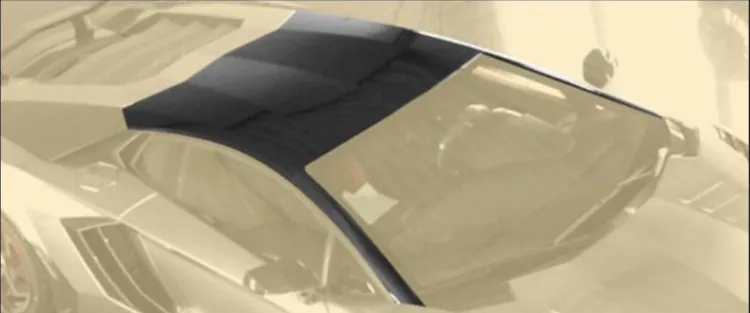
The coupé Lamborghini Aventador's fixed roof is one of the car's most aerodynamically active surfaces: the flow that separates from the windscreen's upper edge must negotiate the roof's shallow curvature and arrive at the engine lid's leading edge with as much attached-flow energy as possible to feed the engine bonnet's louvres efficiently. The factory roof panel — a formed composite in the LP 700-4 — is adequate for this function but presents a large, flat, painted surface that adds both visual mass and unnecessary weight to the highest point of the car's body structure. Mansory's carbon roof cover, a component of the Mansory Carbon Fiber Body kit set for Lamborghini Aventador, reduces both: the autoclave carbon skin cuts approximately 4 kg from the roof section, lowering the car's centre of gravity — the single most impactful mass-location change available from an exterior panel swap on any car — while delivering the programme's signature 3K twill surface to the Aventador's most visually prominent horizontal plane.
Construction & Materials
The Aventador's roof panel spans a relatively shallow, wide surface — long in the car's longitudinal direction, wide transversely, and only moderately curved in either axis. This geometry is the most demanding for maintaining weave registration: across a large, near-flat surface, any deviation in cloth draping angle is immediately visible as a diagonal "ghost line" where the weave diamonds misalign slightly. Mansory's production specification for the roof cover is the most strictly controlled draping tolerance in the Aventador programme — the 45 ° weave orientation is verified at six measurement points across the panel during layup, and any measurement outside ±1 ° at any point triggers a rework of the affected cloth section before cure.
| Property | Roof Cover Specification |
|---|---|
| Outer skin weave | 3K twill, 45 ° ±1° at all draping verification points |
| Inner skin weave | 2K plain — bending stiffness across the unsupported span |
| Core | Nomex honeycomb, 8 mm, centre section — prevents panel drumming at speed |
| Cure | Autoclave, 120 °C / 6 bar |
| Surface lacquer | UV-stabilised urethane, polished to 20 GU gloss (ultra-high gloss) |
| Weight | approx. 7.5 kg (vs factory roof composite ~11.5 kg) |
| Roof-rail seals | Factory rubber profiles transferred — waterproofing unaffected |
| Draping tolerance | 45 ° ±1° verified at 6 points — strictest in the programme |
The Nomex honeycomb core at the centre section serves a specific functional purpose: the large flat roof span, if unsupported, acts as a tunable Helmholtz resonator at certain vehicle speeds — a panel drumming mode that is both audible inside the cabin and measurable as increased drag from surface normal oscillation. The 8 mm Nomex core raises the panel's first natural frequency above the excitation bandwidth encountered in normal driving, eliminating both phenomena. This core is omitted from the edge sections — the car's windscreen and rear screen frames provide adequate edge support — concentrating material where the acoustic and aerodynamic benefit is greatest.
Design & Visual Function
The roof panel is the largest single carbon surface visible from above — relevant to drone photography and multi-storey car park viewing, both increasingly common contexts for supercar presentation. From this elevated angle, the 3K twill weave's diamond pattern reads at its largest scale: each individual diamond is approximately 5 × 5 mm, and across the roof's surface area of approximately 0.85 m², the pattern creates a rhythmic grid that has an architectural quality — more graphic than a painted surface, more systematic than a forged-carbon random pattern. Owners who display their cars at concours events consistently report that the roof cover attracts detailed inspection from a broader audience than almost any other single component.
The ultra-high gloss lacquer (20 GU) is specified specifically for the roof — a higher gloss level than the body panels below, because the roof's orientation means it reflects the sky rather than the ground and surrounding environment, and the sky's diffuse illumination benefits from maximum reflectivity to translate the diffuse light source into visible shimmer across the weave surface. On an overcast day, a gloss-lacquered roof panel reads as dynamic and material-rich in a way that a satin lacquer at the same position would not achieve.
Compatibility & Fitment
This is the coupé roof cover, designed for the Lamborghini Aventador LP 700-4 (2011–2016) and LP 720-4 50° Anniversario coupé. The Roadster has a different roof geometry — the dedicated roof cover cabrio is the correct item for open-top cars. Aventador S (MY2017+) uses a different roofline — the Mansory S programme covers that model. The roof cover is LHD/RHD symmetric.
Installation & Reversibility
Roof panel replacement requires a professional workshop with a vehicle-height lift and overhead clearance for the panel during removal and installation. Time estimate: 4–5 hours including windscreen and engine lid partial removal access, factory roof unbolt, Mansory panel installation, factory rubber profile transfer, and alignment verification. The factory roof panel reinstalls on the same mounting sequence — full reversibility with storage of the original panel. Roof replacement is one of the more ambitious single-panel installations in the programme and should be booked as a dedicated half-day workshop event.
Pairing within the Mansory Aventador programme
The roof cover pairs naturally with the A-pillar cover at the windscreen forward edge — together they wrap the entire upper surface from the A-pillar root to the engine lid lip in a continuous carbon plane. The carbon windshield panel addresses the surface immediately below the windscreen, completing the transition from the A-pillar carbon to the painted front bonnet. For the full upper-body specification, add the trunk carbon cover at the rear to continue the carbon theme from the engine lid's rearmost edge to the tail of the car.
Maintenance & Durability
The roof's horizontal orientation makes it the programme's highest UV-exposure surface — it receives direct overhead UV-B for many hours daily on a car parked or driven regularly in summer conditions. The ultra-high gloss lacquer's UV stabiliser package is formulated for continuous-exposure rooftop applications, but additional protection is strongly recommended: a ceramic coating applied at installation and refreshed annually provides a sacrificial UV-absorbing layer above the lacquer that maintains optical clarity across multi-year outdoor service. Avoid parking under trees where sap and bird deposits can concentrate on the roof surface — these acidic contaminants attack the lacquer's UV stabiliser system faster than UV radiation alone, and they are most damaging when heat-cycled by the roof's direct sun exposure between deposits.
Lead Time & Warranty
The roof cover's tight draping tolerance specification and large panel size require careful production scheduling. Mansory allocates 4–6 weeks from order to delivery. The panel is covered by a 12-month warranty against delamination, panel drumming attributable to honeycomb debonding, lacquer voids, and weave misregistration beyond the ±1 ° production tolerance. The ultra-high gloss lacquer is the most optically demanding surface in the programme — any manufacturing haze or micro-orange-peel above 3 µm Ra is covered as a defect under warranty.
FAQ
Q: Does the roof panel affect the Aventador's structural stiffness?
A: The LP 700-4 coupé's structural stiffness is derived from the carbon monocoque tub, not the roof panel. The factory roof panel and the Mansory replacement are both non-structural outer skins — the torsional rigidity of the coupé body is unaffected by the panel swap.
Q: Will the weave on the roof cover match the direction of the front bonnet?
A: Both panels are produced at 45 ° weave orientation from the car's centreline. Because the roof is viewed from above and the bonnet from the front or side, the weave angle appears different from each perspective — but in terms of manufacturing consistency, both are at the same angular specification.
Q: Does the honeycomb core make the roof cover louder or more resonant than the factory panel?
A: No — the Nomex honeycomb core specifically suppresses the drumming resonance that a flat carbon panel without core would exhibit. The honeycomb-cored panel is acoustically quieter than either a pure carbon skin or the factory composite roof in the 50–200 Hz range relevant to road-speed panel excitation.
Q: Is fitting the roof cover compatible with fitting a roof wing or spoiler?
A: The Mansory programme does not include a roof wing for the base Aventador coupé. Third-party roof wings that mount to the coupé roof panel should be assessed for mount-point compatibility with the Mansory panel's specific edge structure before ordering. Consult the fitting workshop with the proposed wing specification.
Enquire via WhatsApp +44 7488 818 747 or [email protected] for order placement and lead time confirmation.