
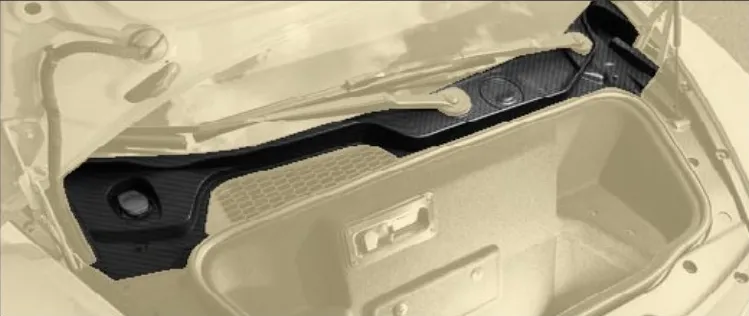
Carbon windshield panel Mansory for Lamborghini Aventador


Carbon Windshield Panel Mansory for Lamborghini Aventador
Between the Lamborghini Aventador's front bumper and the base of its steeply raked windscreen, a narrow but visually prominent horizontal zone connects the aerodynamic nose to the glazed cabin — a panel section that includes the windscreen's lower framing trim, the A-pillar roots, and the transition from painted body to glass. On the LP 700-4, this surface carries the factory's characteristic satin-black trim which, while adequate in isolation, creates a visible material break when the adjacent front bonnet is replaced with Mansory's 3K twill carbon. Mansory's carbon windshield panel addresses this transition as a dedicated component within the Mansory Carbon Fiber Body kit set for Lamborghini Aventador — a precisely formed carbon section that bridges the bonnet's trailing carbon edge and the windscreen's lower frame, eliminating the material discontinuity and completing the car's forward upper surface in a single coherent material statement.
Construction & Materials
The windshield panel's geometry is constrained at three independent boundaries simultaneously — the rear edge of the front bonnet at the top, the windscreen's lower rubber seal at the rear, and the A-pillar root panels at either side. Meeting all three constraints in a single carbon piece requires a mould that captures the LP 700-4's actual installed geometry at this junction, which Mansory derives from a direct three-dimensional scan of the relevant panel interfaces on a reference vehicle. The resulting mould produces a panel that fits the seal channels within ±0.3 mm — tight enough that no gap-filling sealant or shimming is required at the windscreen rubber, which must remain waterproof after the factory panel is replaced.
- Outer face weave: 3K twill, 45 ° — single-drop drape on the narrow visible face, no cloth joints
- Edge flanges: 2K plain biaxial — dimensional accuracy at the three constrained boundary edges
- Cure: Autoclave — required for zero porosity at the three-boundary constrained geometry
- Wall thickness: 1.8 mm face, 2.5 mm flanges
- Finish: high-gloss UV-clear lacquer; matte available on request
- Mounting: OEM trim clip system plus windscreen-seal channel contact — no adhesive required
- Waterproofing: windscreen lower seal transfer maintains factory waterproof integrity
- Weight: approximately 0.45 kg (vs factory satin trim ~0.75 kg)
The ±0.3 mm boundary fit at the windscreen seal is a critical specification for waterproofing: the LP 700-4's windscreen seal is a co-extruded rubber profile whose compression zone is calibrated for the factory panel's exact edge profile and height. A replacement panel that sits higher by 0.5 mm at the seal would under-compress the seal and risk water ingress at the windscreen perimeter under pressure-wash conditions; one that sits lower would over-compress and risk seal cracking at low temperature. The ±0.3 mm tolerance keeps the Mansory panel within the seal's designed compression range across the full operating temperature cycle of the car.
Design & Visual Function
The visual function of the carbon windshield panel is transitional rather than dominant — its purpose is to prevent a visual break between the carbon bonnet and the car's glass-and-A-pillar zone rather than to draw attention to itself as a statement component. In this role it succeeds precisely by being unremarkable: a viewer scanning from the front bonnet's trailing edge toward the windscreen encounters the same 3K twill weave continuing uninterrupted across the windshield panel's narrow face, and the material transition to glass occurs at the windscreen seal without any painted-surface interruption.
The component's significance becomes apparent in its absence: on a Mansory-bonneted Aventador without the windshield panel, the satin-black factory trim reads as an abrupt visual boundary between the carbon programme and the rest of the car — a boundary that signals an incomplete specification. With the windshield panel in place, the entire forward surface of the car, from bumper to windscreen, speaks in a single material language. This completeness is what concours judges and experienced carbon enthusiasts recognise as a "through-built" specification versus an add-on programme.
The panel also eliminates one of the LP 700-4's weaker styling points: the factory satin-black trim at the windscreen base has a visual mass in certain lighting conditions that makes the Aventador's nose appear heavier than its actual dimensions. The carbon replacement's lower visual mass — lighter in colour in indirect light, darker in direct light — reduces this effect, making the front end read as more aerodynamically slender from the front quarter view angle.
Compatibility & Fitment
Designed for the Lamborghini Aventador LP 700-4 (2011–2016) and LP 720-4 50° Anniversario. The windscreen lower panel geometry is consistent between coupé and Roadster — both body styles share the same windscreen lower frame profile. Aventador S (MY2017+) uses a different windscreen frame geometry at this position — the Mansory S programme covers that model. LHD and RHD cars use identical windscreen lower frame geometry.
Installation & Reversibility
The windshield panel installs via OEM trim clips and the windscreen seal channel, accessible without front bonnet removal on the standard LP 700-4. Installation time: 45–60 minutes including factory panel removal, windscreen seal inspection (replace if any cracking from UV exposure), and Mansory panel clip engagement plus seal channel seating. Full reversibility — factory panel reinstalls on the same clips. The windscreen seal should always be inspected before reinstalling any panel in the seal channel — a compromised seal is best replaced opportunistically during this access rather than waiting for a water ingress event to prompt it.
Pairing within the Mansory Aventador programme
The windshield panel pairs with the carbon windshield wipers cover at the immediately adjacent wiper channel — together they create a complete carbon zone at the windscreen's lower boundary from A-pillar to A-pillar. The front bonnet above and the A-pillar cover at either side complete the forward upper-body carbon wrap. These four components — windshield panel, wipers cover, front bonnet, and A-pillar covers — are typically specified and installed in the same session for owners building the complete forward carbon specification.
Maintenance & Durability
The windshield panel's location in the windscreen base channel means it is perpetually in a water-drainage and debris-accumulation zone — leaves, grit, and fine road dust that wash off the bonnet collect in the base channel and rest against the panel's upper face. Clean the channel at every wash with a soft brush and directed rinse; accumulated organic matter (leaf decomposition) in direct contact with the lacquer surface over extended periods can stain the clear coat through organic acid transfer. The windscreen seal's condition at the panel contact edge should be inspected annually — UV degradation of the seal's upper lip is a gradual process that accelerates after year 5 in direct-sun climates and, if left unaddressed, can allow water to migrate under the panel's channel flange.
Lead Time & Warranty
Lead time from order is 2–3 weeks. Mansory covers the panel with a 12-month warranty against delamination, lacquer voids, and boundary-fit deviation outside the ±0.3 mm specification causing visible gaps at the windscreen seal or A-pillar root. Waterproofing failure attributable to manufacturing boundary-fit error — confirmed by flood-test prior to use — is a manufacturing defect covered under warranty.
FAQ
Q: Will fitting the carbon windshield panel affect the Aventador's rain-sensor operation?
A: The LP 700-4's rain sensor (where fitted) is integrated into the windscreen inner face at the top of the glass — not at the lower panel boundary. The Mansory windshield panel does not affect rain sensor operation at any position.
Q: Can I fit the windshield panel without replacing the front bonnet?
A: Yes. The windshield panel is a self-contained installation. However, its visual benefit is most significant when the adjacent front bonnet is also in carbon — fitting the panel against a painted factory bonnet creates a material transition at the bonnet-to-panel boundary that most owners find aesthetically inconclusive. Consider both components together for the best result.
Q: Is the windscreen seal typically reused or replaced during installation?
A: The factory seal should be inspected at installation. If it is under 5 years old and shows no cracking, it can be reused. Older seals or those showing UV cracking should be replaced to maintain waterproofing performance — a Lamborghini OEM or equivalent aftermarket profile is the correct replacement specification.
Q: What is the visual difference between the matte and gloss finish options?
A: The gloss finish (20 GU) matches the front bonnet's lacquer for a visually continuous surface. The matte finish (5–10 GU) provides contrast against a gloss bonnet, which some owners prefer for visual variety at the bonnet base transition. Specify the finish to match or contrast your adjacent bonnet finish.
Contact the team via WhatsApp +44 7488 818 747 or [email protected] for orders and specification advice.