
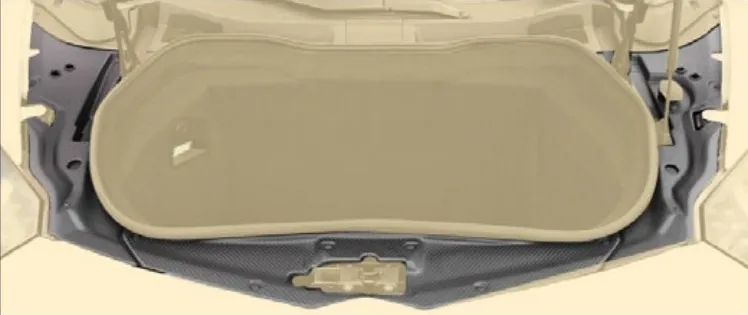
Trunk carbon cover Mansory for Lamborghini Aventador


Trunk Carbon Cover Mansory for Lamborghini Aventador
At the very rearmost point of the Lamborghini Aventador's visible exterior — the horizontal panel that closes the tail section between the rear windscreen and the trailing bumper edge — the trunk carbon cover sits as the final surface element in Mansory's comprehensive exterior programme. Often the panel least visible to the driver and most visible to every other road user behind the car, the trunk cover is the surface that follows the Aventador at all times in traffic and is scrutinised by pursuing photographers and following drivers at the moments of highest drama: hard acceleration exit, slowing for traffic, parking in a confined space. Mansory's carbon trunk cover, part of the Mansory Carbon Fiber Body kit set for Lamborghini Aventador, delivers the programme's material quality to this pivotal rear surface — completing the car's exterior carbon specification with the panel that every following observer sees first and remembers longest.
Construction & Materials
The trunk panel's form factor — large plan area, shallow curvature, constrained access at the perimeter seal channels — makes it one of the programme's more production-intensive panels. The rear screen's lower seal channel and the rear bumper's upper mounting rail define the panel's boundary geometry precisely, and any deviation propagates into visible gap inconsistency at the seal interface. Mansory's manufacturing process uses the same contour-measurement approach as the roof cover — a direct measurement of the LP 700-4's installed rear panel geometry forms the basis for the Mansory tool, ensuring that the replacement panel's perimeter fits the factory seal channels without modification.
- Outer skin weave: 3K twill, 45 ° diagonal — matched to roof cover and engine bonnet for upper-surface weave continuity
- Inner skin weave: 2K plain biaxial for out-of-plane stiffness across the span
- Core: Nomex honeycomb, 8 mm at centre section — suppresses panel drumming from exhaust and tyre noise excitation
- Cure: Autoclave, 120 °C / 6 bar
- Finish: high-gloss UV-clear lacquer, matched to roof cover gloss level
- Weight: approximately 4.2 kg (vs factory trunk composite ~7.5 kg)
- Rear screen seal: factory rubber profile transferred — no waterproofing modification
- Licence plate recess: maintained — factory recess geometry preserved in the Mansory panel
The Nomex honeycomb core at the trunk cover's centre serves a different acoustic function than at the roof: the trunk is directly above the rear exhaust system and the wheel arch acoustic environment. Without core, the thin carbon skin would act as a sounding board for the exhaust's mid-frequency harmonic content — a resonance mode that, on a naturally aspirated V12, occurs in the 80–200 Hz range that is most audibly intrusive inside the cabin. The Nomex core shifts the panel's first bending frequency above this range, converting what would otherwise be an acoustically exciting panel into a well-damped flat plate — contributing to the Aventador's cabin refinement at motorway cruise, where the V12 exhaust note is the dominant in-cabin sound source.
Design & Visual Function
The trunk cover is the most photographed carbon panel on the Aventador from the pursuing road user's viewpoint — which is also the viewpoint of the following press car during a test drive, the race organiser's camera vehicle during a sprint event, and the social-media photographer capturing the car from a distance. From this perspective — rear three-quarter, elevated slightly above road level — the trunk cover occupies the car's entire visual centre between the rear wing (if fitted) and the rear bumper. The 3K twill weave at this scale reads as a rich, structured surface that contrasts with the Aventador's typically bold body colour and provides the visual depth that explains why carbon-covered supercars photograph more dramatically than painted ones.
The panel's contribution to the car's upper-surface visual narrative is the completion of the upper carbon deck: from the front bonnet's leading edge, across the roof cover, through the engine bonnet's louvred surface, and finally across the trunk cover to the rear bumper — the entire upper surface of the Aventador reads as a continuous carbon plane when all four elements are in Mansory carbon. This totality is what owners describe as the car feeling "resolved" — no painted surfaces interrupting the weave, no material inconsistency breaking the visual flow from nose to tail.
Compatibility & Fitment
Designed for the Lamborghini Aventador LP 700-4 (2011–2016) and LP 720-4 50° Anniversario. Both coupé and Roadster share the same trunk panel geometry. Aventador S (MY2017+) has a slightly different trunk panel boundary geometry — the Mansory S programme covers that model. The trunk cover is LHD/RHD symmetric — no steering-side variants are required. The factory licence plate recess is preserved in the Mansory panel, maintaining regulatory compliance for all markets.
Installation & Reversibility
Trunk cover replacement follows the same access and tooling requirements as the roof cover. A vehicle-height lift, overhead clearance, and two technicians are required. Installation time: 3–4 hours including panel removal, factory rear screen lower seal transfer, Mansory panel installation, and gap verification at all perimeter seals. The factory panel reinstalls on the same mounting sequence — full reversibility with panel storage. Scheduling trunk cover installation during the same workshop session as roof cover and engine bonnet replacement minimises total access time and reduces overall installation cost per panel.
Pairing within the Mansory Aventador programme
The trunk carbon cover is the natural companion to the roof cover for owners building a complete upper-surface carbon specification. Pair it with the engine bonnet to complete the rearmost two panels of the upper carbon deck in a single workshop session — the engine bonnet and trunk cover share the same installation access sequence (both require engine lid and rear screen frame access). For the rear wing programmes, the trunk cover provides the base surface from which the rear spoiler mounts — a natural pairing that presents the complete rear upper carbon system.
Maintenance & Durability
The trunk cover's rear-facing orientation makes it the programme's highest-velocity road-wash impact surface — water, grit, and debris projected from the rear tyres impact the trunk cover directly from below and behind in wet-road driving. This directional wash is more aggressive than the front bonnet's impact environment, and protective measures should reflect this: paint-protection film on the entire lower half of the trunk cover (the half facing toward the rear tyres) is the most effective single investment for maintaining the lacquer's pristine condition across multi-year high-mileage use. The honeycomb core's acoustic benefit also depends on the core maintaining its adhesive bond to both skin faces — inspect for any hollow-spot sound (indicating local core delamination) at each service interval by gentle fingertip tapping across the panel surface.
Lead Time & Warranty
The trunk cover's Nomex core construction and precision perimeter fit requirement schedule it for 4–5 weeks production lead time from order confirmation. The panel carries a 12-month warranty against delamination, honeycomb core adhesive failure, lacquer voids, and perimeter seal-channel dimensional non-conformance. Panel drumming attributable to manufacturing honeycomb debonding — identifiable by a hollow sound on percussion rather than solid resonance — is a manufacturing defect covered under warranty.
FAQ
Q: Is the licence plate recess maintained in the Mansory trunk cover?
A: Yes — the factory licence plate recess geometry is replicated precisely in the Mansory panel. Licence plate mounting holes are in their factory positions, and the recess depth maintains the required plate-to-bumper clearance for standard licence plate formats in most markets.
Q: Does the trunk cover affect the Aventador's rear-facing camera?
A: The rear camera (where fitted as a factory option on the LP 700-4) is typically integrated into the rear bumper, not the trunk cover. The Mansory trunk cover does not affect camera positioning or field of view. Confirm your camera location with your chassis number if uncertain.
Q: Can the trunk cover be fitted without removing the engine bonnet in the same session?
A: Yes. The trunk cover installation sequence is independent of the engine bonnet — both panels can be fitted separately. Combining them in one session saves time but is not required.
Q: Is the weave on the trunk cover aligned with the roof and engine bonnet?
A: All three panels are produced at 45 ° weave orientation. When all are installed, the weave diamonds will read at the same diagonal angle across the upper surface of the car — the primary visual continuity that owners describe as the "resolved" full-carbon upper deck.
Contact the Mansory team via WhatsApp +44 7488 818 747 or [email protected] to order or confirm availability.