A-pillar cover Mansory Carbon for Lamborghini Aventador


A-Pillar Cover Mansory Carbon for Lamborghini Aventador
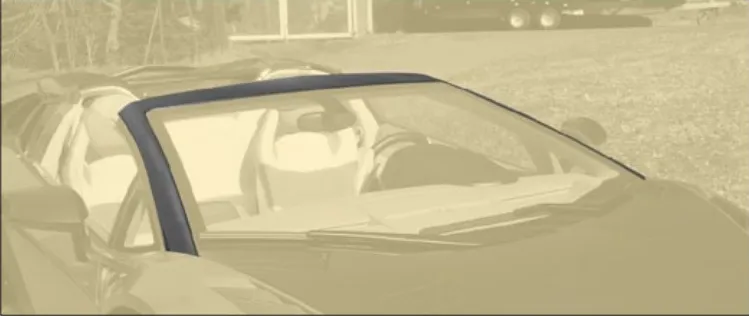
The A-pillar of the Lamborghini Aventador occupies a uniquely prominent position in the car's visual architecture. Unlike the A-pillars of conventional sports cars, which blend into the roofline at modest angles, the Aventador's near-vertical pillar face is a forward-facing element visible from any angle of approach. Its painted surface is one of the largest body-coloured expanses in the frontal three-quarter view — a zone that Mansory's programme addresses directly with this precision carbon cover, forming part of the comprehensive exterior transformation offered by the Mansory Carbon Fiber Body kit set for Lamborghini Aventador.
Construction & Materials
The A-pillar cover is produced by autoclave compression of prepreg 3K twill carbon, with the ply stack oriented to position the twill's 45° diagonal bias parallel to the pillar's vertical axis — a weave direction that creates a dynamic, eye-following pattern as the observer moves around the car. The structural laminate beneath uses 2K plain biaxial reinforcement for dimensional stability across the pillar's curved cross-section, which requires the carbon to maintain its geometry under a combination of lateral and tensile loading at the mounting edges.
- Outer face weave: 3K twill, 45° diagonal
- Internal structure: 2K plain biaxial reinforcement
- Cure: Autoclave full prepreg consolidation
- Resin system: toughened epoxy, UV-stable at up to 120 °C continuous
- Wall thickness: 2.0 mm face, 3.0 mm at mounting flanges
- Finish: high-gloss UV-stable clear lacquer
- Mounting: OEM clip retention, no drilling
- Weight: approximately 0.30 kg per unit
The high-gloss UV-stable lacquer is critical for the A-pillar cover because its forward-facing orientation means it receives significantly more UV flux than rear-facing components. Standard carbon lacquers yellowing within three to five years of installation is a well-documented failure mode for aftermarket carbon on sun-exposed panels. Mansory's UV-stable formulation is specified to maintain optical clarity over a ten-year service horizon in temperate climates — a specification that applies to a daily-driven car rather than a show car in a controlled environment.
Design & Visual Function
The A-pillar cover's primary visual function is to complete the programme's structural carbon language at the car's most prominent frontal element. When the roof cover, windshield panel, and A-pillar cover are all specified in 3K twill, the Aventador's entire greenhouse surround reads as a single carbon frame enclosing the glass — the greenhouse becomes a structural carbon arch rather than a painted surround interrupted by glass panels.
The secondary visual function is subtler: by replacing the painted A-pillar with a textured carbon face, the cover eliminates the specular reflection from the pillar's painted surface at shallow viewing angles. A painted A-pillar catches light from a wide hemisphere of incidence angles and can read as a bright glare stripe in backlit conditions. The carbon face's texture scatters specular reflection across the weave geometry, eliminating the glare stripe and giving the pillar a more neutral visual weight that does not compete with the glass and body panels.
At close range, the 3K twill's fibre bundle density — 3000 filaments per tow, producing a weave count of approximately 5 tows per centimetre — creates a surface texture that rewards close inspection. Each tow crossing is individually visible in directional light, giving the pillar a depth and visual complexity absent from any painted finish.
Compatibility & Fitment
Designed for the Lamborghini Aventador LP 700-4 (2011–2016) and LP 720-4 50° Anniversario. The A-pillar geometry is shared between coupé and Roadster. Aventador S (MY2017+) revised the pillar surround — the Mansory S programme covers that model. Supplied as a pair (LH and RH).
Installation & Reversibility
Installation requires removal of the factory A-pillar trim panel and replacement with the carbon cover using OEM clip retention positions. No drilling, no adhesive bonding. Installation time is approximately 45–60 minutes for both pillars at a workshop familiar with the Aventador's interior surround architecture. Full reversibility — factory panels reinstall on the same clips.
Pairing within the Mansory Aventador programme
The A-pillar cover pairs logically with the carbon windshield panel to complete the greenhouse surround system. Adding the roof cover (coupé) or the roof cover cabrio (Roadster) completes the carbon greenhouse frame. The windshield wipers cover at the base of the windscreen completes the lower surround transition, closing the full perimeter of the glass opening in structural carbon.
Maintenance & Durability
Clean with pH-neutral shampoo and a microfibre wash mitt; avoid alkaline traffic film removers on the lacquer face. The UV-stable lacquer does not require UV-specific protective coatings, but a ceramic coating applied at installation will add self-cleaning hydrophobicity and extend the maintenance interval. Inspect clip retention annually; the pillar cover's clip loading is primarily lateral from buffeting at speed, and the clip engagement should remain positive over multi-year service without additional fastening. A ceramic-coated A-pillar cover remains visually pristine for six to eight seasons between detail polishes in normal use.
Lead Time & Warranty
Lead time from order is 2–3 weeks. Mansory covers the component with a 12-month warranty against manufacturing defects including outer face delamination, lacquer delamination, and clip fitment failures attributable to manufacturing error. UV-related yellowing within five years on a car garaged in temperate climates is considered a manufacturing conformance issue and is covered.
The structural behaviour of the A-pillar cover under high-speed aerodynamic loading is a detail worth understanding. At 200 km/h, the stagnation pressure at the Aventador's A-pillar outer face is approximately 2.7 kPa above ambient. A 2.0 mm autoclave carbon laminate of the pillar cover's plan-view area, fully supported at its mounting perimeter, deflects less than 0.15 mm under this load — imperceptible in both static and dynamic inspection. A comparable ABS plastic component would deflect 1.2–1.5 mm under the same aerodynamic loading, creating a dynamic gap variation at the windscreen seal boundary that generates a periodic buffet frequency — typically in the 40–80 Hz range — that is perceptible in the cabin as a high-frequency hiss at motorway speed. The Mansory carbon cover's superior stiffness eliminates this aerodynamic deflection completely, maintaining the designed gap at the windscreen seal across the car's full speed range.
There is a secondary benefit of the carbon cover's stiffness for owners who park the Aventador in environments where door-to-door proximity is limited. The factory painted A-pillar is vulnerable to contact damage from adjacent vehicle doors in multi-storey car parks — the painted aluminium substrate dents readily under contact forces that the carbon laminate resists elastically. A door-contact force that would produce a permanent dent in the factory panel typically produces no permanent deformation in the Mansory carbon cover, a practical durability advantage for a car that is driven to events rather than transported exclusively on a trailer.
For owners who pair the A-pillar cover with a ceramic coating as part of a comprehensive paint protection programme, the coating's application on the carbon lacquer surface requires no special primer or adhesion promoter beyond the standard surface decontamination protocol — the UV-stable lacquer provides a high-surface-energy base that bonds to professional-grade ceramic coatings in the same protocol as clear-coated painted panels. This simplifies the detailer's work and ensures the coating achieves its rated bond strength without modification to the standard application procedure.
FAQ
Q: Does the A-pillar cover include both driver and passenger sides?
A: Yes — supplied as a matched pair with the same weave orientation on both sides to ensure visual symmetry across the windscreen opening.
Q: Is the weave direction matched to the carbon windshield panel and roof cover?
A: Mansory designs all greenhouse carbon components as a programme — the 3K twill weave direction and surface lacquer specification are matched across the A-pillar cover, windshield panel, and roof cover for visual coherence. Confirm the complete set at order stage to ensure batch-consistent gloss level.
Q: Can this be fitted on an Aventador that has had its A-pillars wrapped in vinyl?
A: Yes, but the vinyl wrap should be removed first to ensure the OEM clip positions are clean and undamaged. If the wrap adhesive has left residue on the clip towers, clean with isopropyl alcohol before fitting.
Q: Is the component available in matte finish?
A: Matte-finish versions are available to special order. Lead time extends to 4–5 weeks for non-standard finishes. Enquire via the contact details below.
Order or ask technical questions via WhatsApp +44 7488 818 747 or [email protected].