Roof cover cabrio Mansory Carbon for Lamborghini Aventador


Roof Cover Cabrio Mansory Carbon for Lamborghini Aventador
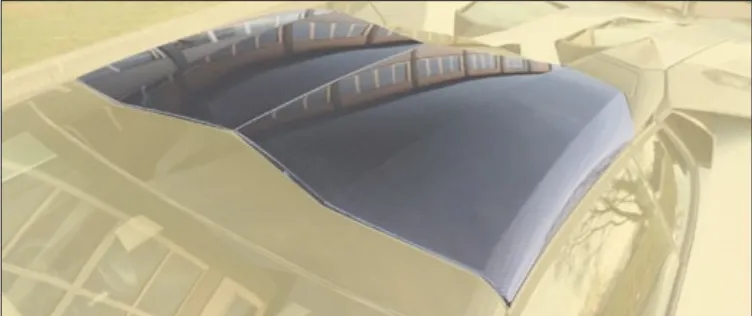
The Lamborghini Aventador Roadster's roof panel — the removable carbon monocoque cap that covers the cockpit in closed configuration — is the single largest horizontal carbon surface on the car's upper body. In the factory specification, it is produced in structural carbon but with a painted or clear-coat appearance finish that lacks the visual depth and weave precision of the Mansory programme's autoclave-cured components. Mansory's roof cover cabrio addresses this directly, replacing the factory appearance finish with a precision 3K twill book-matched surface that brings the Roadster's most prominent horizontal panel into alignment with the programme's exterior carbon language within the Mansory Carbon Fiber Body kit set for Lamborghini Aventador.
Construction & Materials
The roof cover cabrio must satisfy two structural requirements simultaneously: it must be dimensionally stable across the full temperature range from sub-zero winter storage to summer track-day surface temperatures approaching 60 °C in direct sun, and it must maintain its precise OEM latching geometry across the same range. A component that expands or contracts differentially across its plan-view area would compromise the factory seal system's compression, leading to wind noise or water ingress at the roof periphery. Mansory's laminate specification addresses this with a balanced quasi-isotropic ply stack that minimises thermally-induced distortion.
- Outer face weave: 3K twill, book-matched symmetrically about the centreline
- Internal structure: quasi-isotropic balanced laminate for minimal thermal distortion
- Cure: Autoclave full prepreg consolidation
- Resin system: toughened epoxy, UV-stable, 120 °C continuous
- Wall thickness: 2.0–2.5 mm across plan area, 3.0 mm at latch and seal perimeter flanges
- Finish: high-gloss UV-stable clear lacquer — UV-stable formulation critical for horizontal sun exposure
- Mounting: OEM Roadster latch and hinge positions, no modification
- Weight: approximately 7.5 kg (factory component weight depends on specification)
- Thermal stability: latch geometry tolerance maintained ±0.5 mm across −20 °C to +80 °C range
The quasi-isotropic laminate design is a structural engineering choice specific to the roof cover application. Unlike side panels and intake components where a single preferred load direction justifies oriented fibre placement, the roof cover experiences a complex biaxial stress state from thermal expansion, atmospheric pressure differential at speed, and latch pre-load. A quasi-isotropic laminate responds equally to all in-plane load directions, minimising the warping that would occur with directional ply stacks under these multi-axis loading conditions.
Design & Visual Function
For a Roadster owner, the roof cover's visual impact is experienced in two distinct configurations: installed (closed roof) and removed (open roof, cover stored or absent). In closed configuration, the book-matched 3K twill provides the same carbon surface area as a coupé roof — the car's upper silhouette reads as a carbon-roofed vehicle from any approach angle. In open configuration, the removed cover exposes the monocoque's inner carbon surface and the cockpit aperture, shifting the visual focus to the A-pillars, windshield surround, and engine lid — all of which benefit from their respective Mansory carbon components.
The book-matched weave specification is uniquely important for the roof cover because its large horizontal area means the weave pattern reads at a greater viewing distance than smaller components. At 3 metres, a 3K twill that is not book-matched appears as a random diagonal texture; a book-matched panel at the same distance presents a clear bilateral symmetry that the eye immediately reads as deliberate design rather than functional material placement. This distinction is visible in photographs as well as direct observation — a book-matched roof cover photographs as a designed surface, not a raw material application.
At speed, the roof cover's contribution to the Roadster's aerodynamic performance is through its dimensional stability maintaining the factory roof-body seal geometry. A roof that bulges or settles at speed creates a variable gap at the seal periphery, generating broadband noise proportional to gap size and air velocity. The Mansory component's stiffness — maintained by the autoclave laminate's controlled cure — ensures the seal geometry is preserved at all operating speeds.
Compatibility & Fitment
Designed specifically for the Lamborghini Aventador LP 700-4 Roadster (2013–2017) and LP 720-4 50° Anniversario Roadster. NOT compatible with the coupé — the coupé roof cover is a different component with different latch and seal geometry. Aventador S Roadster (MY2017+) has a revised roof system — confirm fitment for S-specification cars at order stage.
Installation & Reversibility
Installation involves removing the factory roof cover at its OEM latch positions, fitting the Mansory carbon cover in the same positions, and performing a seal compression check around the full periphery. 30–45 minutes for a workshop familiar with the Aventador Roadster's roof system. Full reversibility — the factory cover reinstalls on the same latches. A wind-noise check at motorway speed is recommended after installation to confirm seal compression is uniform.
Pairing within the Mansory Aventador programme
The roof cover cabrio is the Roadster's equivalent of the coupé's roof cover, and pairs with the engine bonnet cabrio and rear bridge to create the Roadster's complete upper carbon body specification. Adding the A-pillar cover and carbon windshield panel completes the full greenhouse perimeter in carbon — the highest-specification Roadster surround programme available.
Maintenance & Durability
The roof cover's horizontal surface accumulates environmental contamination at a higher rate than vertical body panels. A ceramic coating applied at installation creates a self-cleaning hydrophobic surface that sheds water and reduces pollen, dust, and bird deposit adhesion significantly. Clean with pH-neutral shampoo and a microfibre mitt; never use a pressure washer directly on the seal periphery, as sustained high-pressure water can compress the OEM seal's foam substrate and reduce its preload. Annual inspection of latch mechanism engagement and seal condition is recommended — replace the factory seal if compression shows permanent set exceeding 10 % of its original thickness.
Lead Time & Warranty
Lead time from order is 3–4 weeks (Roadster-specific production). Mansory covers with a 12-month warranty against manufacturing defects including delamination, lacquer voids, latch geometry deviation attributable to manufacturing error, and book-match centreline misalignment greater than 1 mm. Wind-noise attributable to dimensional distortion of the cover under the factory latch's compression is covered for the warranty period.
FAQ
Q: Does the roof cover fit without modification to the factory latch mechanism?
A: Yes — the OEM latch engagement points are dimensionally replicated in the Mansory cover. No modification to the factory latch mechanism or striker is required. If the factory latch shows wear (common on high-mileage Roadsters), replace the latch assembly before fitting the new cover for optimal engagement.
Q: Is the interior surface of the roof cover finished in carbon or painted?
A: The interior surface is produced with a structural visible-carbon finish without a lacquered outer face — appropriate for a surface that is not normally visible from outside the car. Enquire if you require a specific interior finish for a show car application.
Q: Does the weave direction match the engine bonnet cabrio when both are fitted?
A: Mansory designs the cabrio components as a programme set. The book-match centreline and 3K twill specification are matched between the roof cover and engine bonnet. Order both components together and specify that they should be supplied from the same production batch for maximum lacquer-level consistency.
Q: Is the roof cover suitable for cars that are driven in rain with the roof closed?
A: Yes — the OEM seal geometry is maintained by the Mansory cover's dimensional precision, providing the same water-tightness as the factory component. Perform the wind-noise check after installation as described above to confirm seal compression before using the car in rain.
Order or ask technical questions via WhatsApp +44 7488 818 747 or [email protected].