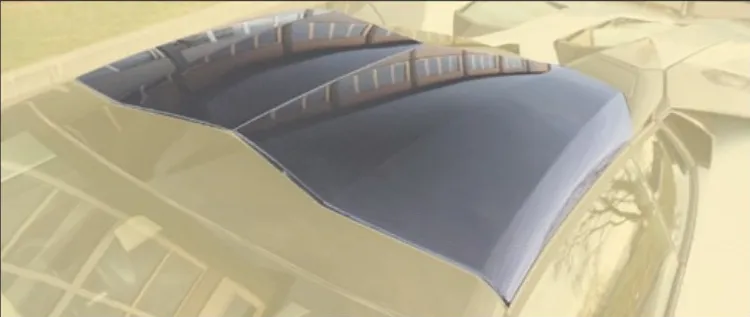
Roof cover cabrio Mansory Carbon for Lamborghini Aventador S


Mansory Carbon Roof Cover Cabrio for Lamborghini Aventador S
The Roof Cover Cabrio is a Roadster-exclusive carbon piece in the Mansory programme — a finisher that addresses the open-top architecture of the Aventador S Roadster, where the fixed roof has been replaced by a pair of removable targa panels and a reshaped tonneau zone above the naturally aspirated V12. Depending on configuration, the cover either overlays the visible upper face of the two stowed targa panels when they are clipped above the engine bay, or it serves as a carbon shroud over the panel-stowage well itself, presenting a continuous lacquered weave from the rear of the cockpit to the engine glass. It belongs to the wider Mansory Body Kit for Lamborghini Aventador S, sitting on the same surface family as the cabrio engine bonnet and the rear bridge that frames the buttresses. Owners specify it because the OEM Lamborghini panel finish is monochrome painted CFRP, and they want a tactile, optically deep weave to read from above when the roof is off the car. The piece does not alter scissor-door cuts, glass surrounds, or rear-wheel-steering hardware below — it is a strict skin replacement.
Construction & Materials
Mansory builds the Cabrio Roof Cover from a multi-stage CFRP layup designed to resist UV and thermal cycling, since this part lives in the most sun-exposed plane of the Roadster. The substrate is balanced on top and bottom faces so that the cover does not warp when the targa panels are removed and the carbon is suddenly exposed to direct sunlight after sitting in shaded cabin air.
- Outer skin: 3K twill prepreg, 245 g/m², book-matched along the panel centreline so the diagonal weave mirrors at the spine.
- Optional 2x2 plain-weave variant for owners pairing it with the plain-weave roof-cover coupé reference treatment seen on closed-top Aventador S cars.
- Cure: autoclave at ~125 °C with vacuum-debulk between plies; UV-stabilised clearcoat with HALS additive and high-flow flatting agents for matte, satin or high-gloss finish.
- Internal core: aramid-honeycomb sandwich for the larger configuration variant, solid CFRP for the panel-only finisher version; wall thickness 1.6–2.4 mm depending on zone.
- Mass: 1.7–2.6 kg per assembly versus painted OEM CFRP at ~3.0–3.7 kg in the same area.
- Mounting: retains the OEM Lamborghini latch and clip retention — the Aventador Roadster targa panels lock to the A-pillar and to the central spine via factory cam-latches, and Mansory replicates those datums to the millimetre.
- Hardware: stainless A2 fasteners, factory-spec rubber gaskets, foam isolators on rear edges where the cover meets the engine glass surround.
- Edge treatment: laser-trimmed, hand-deburred, sealant-bead on the underside lip to seal against water ingress when the panels are clipped on a wet car.
Design & Visual Function
The Aventador S Roadster top is a two-piece carbon assembly: each panel weighs roughly 6 kg in factory trim and clips into a recess above the V12 when removed. That stowage stack is visible whenever the car is being driven open. Mansory’s answer is to make the visible face of those panels — or the well that receives them — read as a single pane of fluid weave instead of a painted lid. Because the Aventador S has no ALA, there is no central aero channel disrupting the top-down view; the eye traces a clean diagonal from the rear of the cabin glass to the tip of the engine cover. The lacquered carbon picks up reflections of the scissor-door cuts when the doors are open, and the hexagonal motif used elsewhere on the body is echoed in optional inlay patches along the leading lip.
The weave alignment matters more here than on most surfaces because the cover sits horizontal — it is the first carbon plane an onlooker sees from a balcony, valet ramp or paddock walk. Mansory aligns the twill warp parallel to the longitudinal axis so that direct sun creates a single highlight line front-to-back, and oblique sun creates two converging highlights toward the rear glass. Owners who paint break the rest of the body to gloss black often choose raw matte clear here so the cover stays a touch warmer in tone than the painted shoulders, separating the open-air zone from the closed surfaces optically.
Open-top driving introduces wind acoustics. The Mansory cover keeps the underside acoustic foam used by Lamborghini and adds a thin damping layer at the panel-stowage well to control resonance between the stowed targa panels and the engine cover when the V12 is on full noise. On a dry-sump V12 with intake roar pulling through the upper plenum behind the cabin, that damping is audible in the 80–120 km/h cruise band where soft-top buffeting would otherwise mask the intake.
Compatibility & Fitment
This part is fitted to the Lamborghini Aventador S Roadster (LP740-4 S Roadster, 2017–2021) only. It does not fit the closed-roof Aventador S coupé — coupé owners should consult the dedicated roof-cover coupé reference instead, which addresses the fixed glass-to-engine spine. The Cabrio variant respects pre-SVJ Aventador S geometry: the standard buttresses, the lower-side exhaust outlet packaging, and the OEM rear-wheel-steering control unit mounted forward of the engine bay, all of which dictate the underside profile of the cover. Lamborghini parking sensors at the rear, scissor-door hinge clearance, and oil-cooler plumbing through the rear quarters are untouched.
Installation & Reversibility
Allow 2–4 hours for fit and verification. The factory targa panels detach in under a minute via two cam-latches each; the Mansory cover either replaces the painted upper skin of those panels (skin-only variant — bonded with methacrylate adhesive over the OEM substrate after debonding the OEM lacquered face) or sits over the stowage well as a clip-in shroud (well-shroud variant — uses OEM clips with M5 captive nuts). The Aventador Roadster monocoque uses methacrylate adhesive for several CFRP-to-CFRP joints, and any skin-replacement procedure on the targa panels must use a compatible methacrylate system — not epoxy — to keep substrate chemistry intact and avoid creep at hot-soak temperatures from V12 thermal management. Surface prep involves IPA wipe, scotch-pad mechanical key, and a primer flash coat where required by the topcoat. Reversibility: the well-shroud variant is fully reversible in minutes; the skin-replacement variant is permanent on those panels but the panels themselves remain interchangeable with OEM units. We recommend a Lamborghini-certified body shop or a Mansory-trained installer for the skin-replacement workflow; the well-shroud variant is achievable for an experienced detailer.
Pairing within the Mansory Aventador S programme
The Cabrio Roof Cover is most often specified alongside its Roadster sibling, the Engine Bonnet (Roadster) — together they finish the entire upper plane behind the cabin in a single carbon language so the targa panels stack onto a matched surface rather than a contrasting painted lid. For owners who want continuity to the rear roll-over hoop area, pair with the Rear Bridge so the buttresses, the bridge and the cover all carry the same weave family. As a visual cross-reference for what the closed-top equivalent looks like, the Roof Cover (coupé) uses the same weave catalogue but addresses a fixed glass roof rather than a removable two-piece system — useful for two-car collections where a coupé and a Roadster share a livery brief.
Maintenance & Durability
Of all carbon surfaces on a Roadster, the roof zone takes the most UV. Treat the lacquered weave as a high-end paint surface: pH-neutral shampoo, plush microfibre, two-bucket method, no traffic-film removers, no alkaline degreasers, no ammonia, no abrasive sponges — alkaline cleaners eat the clearcoat micro-quickly and the carbon under it browns in months. A ceramic coating with high UV absorber loading is a better match than carnauba here; carnauba breaks down under sustained sun on horizontal panels and can cloud satin clearcoats. If the car lives outdoors for long stretches, plan a re-polish and re-coat every 18–24 months, sooner on satin and matte finishes. The targa panels themselves benefit from a soft microfibre cover when stowed in the well — not because of carbon damage but to stop dust trapped between panel and shroud from sanding the underside on bumpy roads. Stone-chip repair on the cover is workshop-level: localised abrade, fill, tint-match clear, sand and polish; small surface chips can be touched in by a competent detailer.
Lead Time & Warranty
Mansory builds the Cabrio Roof Cover to order from the bespoke programme. Lead time is typically 4–8 weeks from confirmed weave/finish/variant spec to despatch-ready. The piece carries a 12-month warranty against manufacturing defects — substrate delamination, latch-mount geometry, clearcoat adhesion. Damage from collisions, alkaline chemicals, polishing-machine burn-through, or installation deviations is excluded.
FAQ
Q: Will this fit my Aventador S coupé?
A: No. This part is Roadster-only. The closed-top Aventador S has a fixed glass-and-CFRP roof; for that car please specify the Roof Cover (coupé) variant from the same Mansory family.
Q: Skin-replacement variant or well-shroud — which should I order?
A: Skin-replacement gives the cleanest single-surface read because the panels themselves become carbon-skinned, but it is a one-way modification on those panels. The well-shroud is fully reversible and is preferred by owners who keep cars short-term or expect to revert to OEM. We can spec either against your VIN.
Q: Does it interfere with stowing the targa panels?
A: No. Both variants preserve the OEM panel-stowage geometry — the cam-latch positions, panel pitch in the well, and the rear-glass clearance are all retained. You clip the panels in exactly as the factory intends.
Q: What about open-top wind noise and resonance?
A: The underside foam is retained and a thin damping layer is added at the well so the stowed panels do not chatter against the engine-cover surround at speed. With the panels off, you hear cleaner intake and exhaust note rather than panel-on-panel buzz.
Q: How does this handle direct sun all day?
A: The lacquer pack uses HALS UV absorber and is autoclave-cured for tight crosslink density, so colour shift and clearcoat micro-cracking are heavily delayed compared to ambient-cured aftermarket carbon. We still recommend a UV-loaded ceramic coating for cars that sit outdoors year-round.
Pair this Cabrio Roof Cover with the matching Roadster engine bonnet and rear bridge for a continuous carbon plane behind the cabin. To confirm variant (skin-replacement vs well-shroud), weave (3K twill or 2x2 plain), and finish (matte, satin, gloss): WhatsApp +44 7488 818 747 or [email protected].