Engine bonnet cabrio Mansory Carbon for Lamborghini Aventador S


Mansory Carbon Engine Bonnet Cabrio for Lamborghini Aventador S
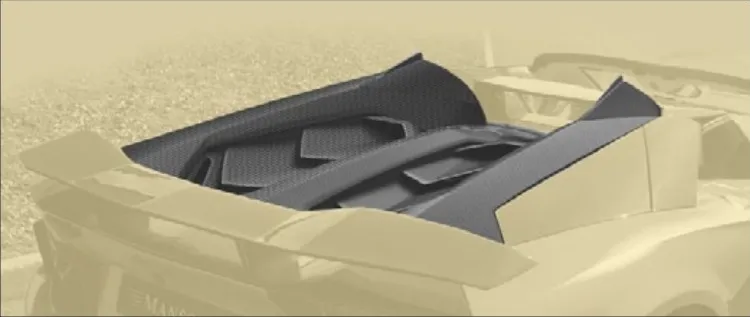
The Mansory Carbon Engine Bonnet Cabrio is a Roadster-exclusive rear lid, redrawn from the ground up so the Aventador S Roadster's two-piece carbon targa roof can stow, latch and breathe without quarrelling with the V12 thermal plume below. Sitting at the very heart of the Mansory Body Kit for Lamborghini Aventador S, this part replaces the pre-SVJ Roadster engine cover with an autoclave-cured CFRP shell whose extraction louvres, latch islands and stowage rails are geometry-mapped to the Cabrio chassis. It works with the lower-side exhaust outlets, the rear-wheel-steering pumpwork directly underneath, and the dry-sump V12's heat-rejection cycle. Owners of the open-top LP740-4 S specify it for one reason: the coupé bonnet does not fit, and only a Roadster-shaped lid lets the targa panels return to their bay.
Construction & Materials
Production starts with a hand-laid prepreg stack — outer cosmetic 3K twill at 0/45/90 orientations, core ply of unidirectional 12K tape running rear-to-front along the bonnet's longer axis, then a damping veil and an inner skin of 2x2 twill. The whole sandwich is autoclave-cured in a heated tool at roughly 120 C and 6 bar, giving a glassy first surface and laminate void content under one percent. A thin Nomex honeycomb core sits beneath the louvre belt for stiffness without mass; the latch islands and hinge mounts are pre-bonded ply build-ups so the panel never flexes around its fasteners.
The Roadster lid runs slightly thicker around the targa-stowage rim than its coupé counterpart — open-top cars cycle their bonnets more often (every roof-down session) and the rim has to absorb that wear without crazing the lacquer. A UV-stable clear topcoat shields the weave from cabin-bay heat and ozone aging.
- Outer skin: 3K 2x2 twill prepreg, autoclave-cured
- Inner skin: 2x2 twill, with damping veil between layers
- Core: Nomex honeycomb under louvre belt; solid laminate at hinge & latch islands
- Average wall thickness: 1.8–2.2 mm; rim build-up 3.5 mm
- Weight: ~6.4 kg (saves roughly 4.1 kg vs OEM Roadster lid)
- Hardware: stainless OEM-spec hinge bolts, latch retained from factory
- Finish options: gloss lacquer, satin, raw matte, forged-look infill
- Cure temperature: 120 C / 6 bar autoclave; void content under 1%
Design & Visual Function
The Cabrio bonnet's sculptural job is to host the rear edge of the soft/targa-style top arrangement while still pulling hot air off a 6.5-litre naturally aspirated V12. Mansory's solution is a raised central spine with twin hexagonal extraction louvres, slightly canted outward so the exhaust plume from the rear-bay heat zone clears the stowed targa panels rather than warming them. The louvre apertures are bevelled inward — the eye reads them as deeper than they really are, and the Lamborghini hex motif from the air-intake side windows is echoed cleanly.
Open-top driving changes how the rear deck sounds. With the targa panels removed, the cabin is acoustically wired into the engine bay; a coupé bonnet would funnel intake roar straight at the driver's neck. The Cabrio panel uses a damped honeycomb belt under the louvres and slightly narrower extraction slots, which softens the high-frequency rasp and keeps the V12 induction snarl rich rather than shrill. With the targa panels in place, the lid mates flush to the cant rails and the cabin damping returns to coupé-like values.
Visually, the Roadster lid sits a few millimetres lower at the trailing edge to keep sightlines clean over the rear deck — a small but deliberate cue that distinguishes the Cabrio silhouette from the coupé. Weave alignment runs north-south along the centreline so reflections track the spine of the car, and the louvre belt is paint-broken from the surrounding deck if the customer specifies a body-colour finish over raw weave inserts.
Compatibility & Fitment
This bonnet fits the Lamborghini Aventador S Roadster only — model years 2017 through 2021, LP740-4 S Cabrio variant. It is NOT compatible with the Aventador S coupé; the coupé equivalent is the engine-bonnet part, which has different latch geometry, no targa-stowage clearance and a flatter trailing edge. The Cabrio panel preserves OEM hinge points, gas-strut anchors, factory latch and the rubber seals that interface with the targa-roof bay. Lower-side exhaust outlets are unaffected — the bonnet tapers above them with the OEM clearance envelope intact. Rear-wheel-steering hydraulics and the dry-sump's oil-cooler return remain accessible for service. Owners running the Aventador SVJ Roadster, Aventador SV Roadster, or pre-2017 Aventador LP700-4 Roadster should not order this part; the underlying mounts differ.
Installation & Reversibility
Allow 3–5 hours in a clean bay. The OEM lid is gas-strut-supported; pop both struts, unbolt the four hinge fasteners, lift the panel away to a soft trestle. Transfer the latch, the rubber bay-seal, the hinge bushes and the stowage-rail clips to the Mansory shell. Set the panel back on the hinges, leave fasteners finger-tight, and walk the gaps — front edge to cant rail, sides to fender, rear to deck — until they sit at the factory 4 mm. Lock the hardware in a star pattern at OEM torque (around 22 Nm at the hinges). Cycle the targa panels in and out three times to confirm the soft-top tray clears the new spine geometry. Then close the bonnet onto the latch, listen for a clean primary catch, and confirm the secondary safety hook engages.
Methacrylate adhesive bonds are not used on this panel — it is a fully bolt-on swap, so reversibility is total. Reinstalling the OEM lid takes the same time and leaves no trace. For a body-colour finish the shop should scuff, prime with a flexible 2K epoxy primer compatible with autoclave-cured CFRP, then wet-on-wet to base and clear. Lacquered raw weave needs only de-mould prep and a UV-grade clear. We recommend a Mansory-trained installer or a Lamborghini-certified body shop for paint work; the swap itself is achievable for a competent independent garage with the right trestles.
Pairing within the Mansory Aventador S programme
The natural sibling on the open-top car is the roof-cover-cabrio — together those two lids bracket the targa-roof stowage zone front-and-rear, sharing weave family and lacquer batch so the rear deck reads as one continuous carbon surface when the panels are down. For owners who run both the coupé and a Roadster in the same garage, the engine-bonnet coupé part keeps the visual language consistent across both cars. To complete the engine-deck rework, add the bonnet-air-outtake: the small extraction nostril sits forward of the main bonnet louvres and accelerates hot-air rejection across the deck, which is especially welcome on a Roadster where engine-bay heat has shorter paths into the cabin.
Maintenance & Durability
Lacquered carbon ages well under sun if the topcoat is genuine UV-grade — Mansory's clear is. Avoid alkaline wheel cleaners, ammonia-based glass sprays drifting onto the lid, and abrasive sponges; these are what actually destroy the weave's optical depth, not sun. A pH-neutral car shampoo, a soft microfibre, and a quarterly carnauba or a one-shot ceramic coating keep the surface honest for years. A ceramic coating is preferable on the Cabrio bonnet specifically: it sees more standing-water exposure than a coupé lid because owners park targa-down. Inspect the rim seal each spring and any time after long sun exposure; replace the OEM rubber if it has hardened.
Engine-bay heat shielding stays as it left the factory — the Mansory shell does not require additional thermal blankets, but the bonnet's underside benefits from a periodic wipe-down to clear baked-on oil mist. Stone chips on the leading edge can be polished out at shallow depth; deeper chips need a lacquer touch-up by a carbon-trained body shop, which preserves the panel for the life of the car. Realistic service life with reasonable care: 12 to 15 years before the topcoat needs a full refresh, and the laminate itself comfortably outlasts that.
Lead Time & Warranty
Bespoke production runs 4 to 8 weeks from confirmed order. Each Cabrio lid is built to the customer's chosen finish, weave and any forged-look infill, then quality-checked against the autoclave's cure log before dispatch. A 12-month warranty covers manufacturing defects — laminate voids, lacquer crazing, hardware mis-bonds. Crash damage, stone-chip damage, paint over-spray and any modification to the louvre geometry void coverage. Keep the cure-batch certificate Mansory ships with the part; it is requested for any warranty claim.
FAQ
Q: Will this fit my Aventador S coupé?
A: No. The Cabrio bonnet is geometry-matched to the Roadster — soft/targa-top stowage clearance, latch islands and trailing-edge profile are all Cabrio-specific. For the coupé, order the engine-bonnet part instead.
Q: How much weight does it save versus the OEM Roadster lid?
A: Around 4.1 kg, panel-for-panel. The shell is approximately 6.4 kg finished; the OEM Roadster lid sits closer to 10.5 kg.
Q: Does it interfere with the targa roof going on or off?
A: No. The trailing-edge profile and rim build-up were modelled around the OEM stowage envelope. The targa panels swing down and seat into their bay with the same arc the factory ships.
Q: Lower-side exhaust outlets — any clearance issue?
A: None. The Aventador S exhaust exits sideways, well below the bonnet line. The Mansory shell maintains OEM clearance to the exhaust plume zone.
Q: Can I have it body-colour matched instead of bare carbon?
A: Yes. Specify gloss body colour, satin body colour, body colour with raw-weave louvre inserts, or full forged-look. A flexible 2K epoxy primer must precede base coat to respect the autoclave-cured CFRP substrate.
Q: Is it reversible to OEM?
A: Fully reversible. Bolt-on hinge points, OEM latch retained, no methacrylate adhesive on this panel. The factory lid bolts back in the same afternoon if needed.
Pair it with the roof-cover-cabrio and the bonnet-air-outtake for a fully resolved Roadster deck. Order, or talk through finish options: WhatsApp +44 7488 818 747 or [email protected].