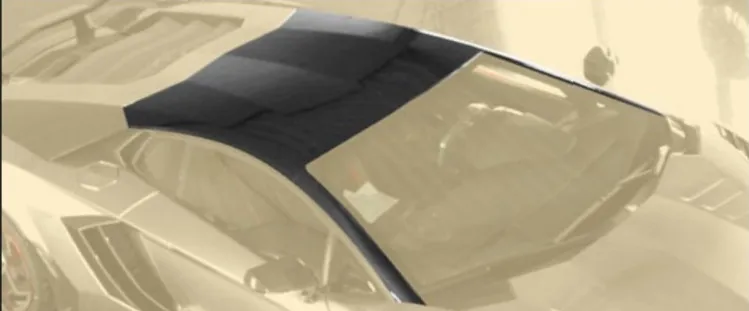
Roof cover Mansory Carbon for Lamborghini Aventador S


Mansory Carbon Roof Cover for Lamborghini Aventador S
The Mansory carbon roof cover for the Lamborghini Aventador S is the part that pulls the cabin shell into the same visual language as the carbon hood, sills and rear deck. It sits across the painted Coupé roof as a fitted overlay, converting the largest single body panel above the belt-line from a paint-only surface into a visible weave plane that ties the carbon programme together. Within the broader Mansory Body Kit for Lamborghini Aventador S, this part is what owners reach for when the lower carbon work is already on the car and the painted roof breaks the otherwise consistent woven outer skin. This is the Coupé-only roof cover; the Roadster equivalent (roof-cover-cabrio) is a separate SKU built around the targa-style removable panels. Aventador S keeps its NA 6.5-litre V12, dry-sump lubrication, scissor-hinged doors and rear-wheel-steering rear axle exactly as Sant'Agata delivered them — none touched by a roof overlay, but all informing how the panel sits relative to the door cuts and fixed glass aperture.
Construction & Materials
The roof is the most punishing carbon panel on the car: it spends every daylight minute pointing at the sun. The substrate is aerospace-grade 3K twill prepreg, laid up against a CNC-milled tool mirroring the Aventador S Coupé roof curvature, then autoclave-cured to drive resin distribution flat across the visible plane. Twill orientation is set so the weave diagonal runs continuously from windscreen header to rear glass aperture — light travels across the panel without the visual stutter you get when weave direction breaks at a join.
Outside the autoclave the panel receives a UV-blocking clear lacquer system — multiple flow coats over a tinted iso-base — then flat-sanded and machine-polished to programme depth. The result resists yellowing, holds gloss under hard sun cycling, and reads as a single continuous twill field rather than a paint-on-carbon decal.
- Visible weave: 3K twill, 2x2 diagonal, oriented header-to-tail for unbroken light travel
- Sub-laminate: biaxial UD reinforcement under the visible ply for torsional rigidity across the long span
- Cure cycle: autoclave prepreg, ramped to manufacturer profile, post-cured for resin Tg stability under summer roof temperatures
- Wall thickness: ~1.6 mm at panel centre, locally thickened to ~2.4 mm along the perimeter where it meets door seals and glass rubbers
- Mass: roughly 1.9–2.4 kg depending on perimeter trim — net of the original paint mass, the addition is modest and sits at the highest point on the car (worth thinking about for roll-centre purists)
- Lacquer stack: high-solids UV-stable clear with HALS additives, flatted between coats for buried-weave depth
- Mounting: structural double-sided 3M VHB tape strip around the perimeter, methacrylate adhesive beads at the load-aware shoulders, mechanical alignment dowels at four hidden locations
- Edge treatment: rolled and lacquered around the entire perimeter — no raw cut edges where the panel meets the rubber seal channel
Design & Visual Function
A roof panel tells the truth about a carbon build. Fenders and sills hide a lot under fast surfaces and short visual runs; the roof is large, flat-ish, and stares straight up at the sky — every lay-up imperfection, lacquer-thickness micro-shift, weave-direction mistake gets amplified by sun and read at a glance. Mansory treats the roof like a single carbon canvas. Visible-ply orientation runs the twill diagonal along the long axis of the panel, so the highlight travelling across a polished surface under street lights becomes one continuous diagonal sweep rather than a checkerboard.
The second design problem is the one the Aventador's body shape creates for itself. Aventador S has fixed glass — no sunroof, no pop-out, no vent — and that fixed-glass aperture in the rear half of the cabin sits close to the panel's trailing edge. Mansory contours the cover so the weave field draws the eye forward to the windscreen header and lets the rear glass read as a clean cut against carbon, rather than a fight between two textures. From outside, the cabin shell now matches the lower carbon work; from inside, the underside is finished cleanly so headliner-side reflections through the rear glass don't betray a raw cure surface.
And then there are the doors. The Aventador's scissor hinges live at the front A-pillar shoulder — when the door rises, it pivots up and slightly forward, and the inner edge comes within millimetres of the upper A-pillar transition. Any roof overlay has to acknowledge that geometry. The Mansory cover terminates inboard of the hinge envelope with a cleanly lacquered rolled edge, leaving OEM door rubber and hinge clearance untouched. Carbon transitions to the door's own woven inner skin without a visible step.
Compatibility & Fitment
Designed for the Lamborghini Aventador S (LP740-4 S), Coupé only, model years 2017–2021, with pre-SVJ front bumper geometry and Aventador S lower-side exhaust outlets. Roadster owners need the separate roof-cover-cabrio, engineered around the targa-style removable panels — the Coupé cover physically cannot fit a Roadster. The Coupé panel respects the OEM scissor-door hinge envelope at the A-pillar, the fixed rear glass rubber, the shark-fin antenna location, and factory roof-mounted wiring under the headliner. No drilling. The original roof remains beneath the overlay; the cover adds visible carbon without modifying any structural element of the CFRP-aluminium monocoque.
Installation & Reversibility
Plan on 3 to 5 hours for a careful single-installer fit, longer if a paint-correction pass on the underlying roof is part of the booking. The work itself is methodical rather than aggressive. The OEM roof is decontaminated with iron-fallout remover, clayed, IPA-wiped along the bond corridor and warmed gently to about 22 °C for adhesive cure behaviour. The cover is offered up dry, alignment dowels checked, and trial-clamped at the four hidden locations to verify the perimeter sits flush against the door rubbers and the rear glass seal. Once alignment is confirmed, the VHB tape backing is peeled in stages, methacrylate beads are placed at the engineered shoulder zones, and the panel is rolled down from the centre outward to push air past the perimeter. Final cure is left for 24 hours undisturbed.
The Aventador's CFRP monocoque uses methacrylate adhesive bonds in several body areas, and substrate chemistry matters. Mansory's recommended adhesive is intentionally compatible with the OEM bonded substrate — the overlay does not introduce chemistry that would compromise the original bond line if the panel is ever removed. Reversibility is by warm fishing-line followed by adhesive-residue remover; the OEM paint underneath is preserved. Recommended fit: a Lamborghini-certified body shop or Mansory-trained installer, because the panel is large and unforgiving of dry-fit errors.
Pairing within the Mansory Aventador S programme
The roof cover is one of those parts that earns its keep visually only when the cabin shell can be read as a continuous carbon surface. Owners who specify it almost always pair it with the matching engine bonnet directly behind the cabin — that pairing means the roofline flows into the engine deck without a paint break, which is the single biggest visual upgrade the upper body can take. The carbon windshield wipers cover at the leading edge of the roof is the natural third part — it closes the visual loop at the windscreen header so the eye flows from cowl, up the windscreen, across the roof, into the engine deck without ever crossing back into painted bodywork. Roadster owners cross-shopping should look at the roof-cover-cabrio instead — same programme intent, different fitment story.
Maintenance & Durability
The roof needs the most carbon-care discipline and is the part owners forget easiest. Sun, bird residue and alkaline runoff from automatic washes all aim straight at it. Mansory's UV-stable lacquer gives real headroom against amber-shift, but a properly cured ceramic coating layered over the lacquer is worth specifying — it acts as a sacrificial UV and chemistry barrier and refreshes cheaply each year. Avoid alkaline traffic-film removers, ammonia-based glass cleaners drifting onto carbon, abrasive mitts, and wheel-cleaner overspray. Bird residue lifted within hours; uric acid etches lacquer if baked in summer sun. Stone chips on the leading edge are flow-coat repairable. With sensible care the visible-ply panel holds gloss for a decade and beyond.
Lead Time & Warranty
Production lead time is 4 to 8 weeks from order confirmation. Each panel is built to order against the Aventador S Coupé tool, lacquered, polished and inspected individually. The 12-month warranty covers manufacturing and material defects — lay-up voids, lacquer adhesion, mounting hardware. Stone-strike, accident damage, third-party install errors and chemical lacquer damage are not covered, but the chip-repair workflow makes most cosmetic issues recoverable.
FAQ
Q: Does this part fit the Roadster?
A: No. This is the Coupé-only roof cover. The Roadster has removable targa-style roof panels with their own stowage geometry, and needs the separate roof-cover-cabrio SKU. The two parts share the programme but are not interchangeable.
Q: Does the cover affect cabin sound or NVH?
A: Mildly, in a positive direction. The added laminate plus its adhesive bond layer slightly damps roof-panel resonance, so wind-buffet at motorway speed and rain-on-roof noise both become subjectively lower. It is not a sound-deadening pad and should not be marketed as one — but owners who care about cabin acoustics tend to notice the change after the first long drive.
Q: Can I keep the painted body and add the carbon roof on its own?
A: You can, and a number of owners do. It works best when the lower body keeps a quiet, dark colour — graphite, nero, dark blue — so the carbon roof reads as a deliberate accent rather than a clash. Over a bright body colour the carbon roof looks more aggressive and is a stronger visual statement.
Q: Will the panel interfere with the scissor doors at the A-pillar?
A: No. The cover is engineered to terminate inboard of the scissor-hinge envelope, with a rolled, lacquered edge along the A-pillar shoulder. OEM hinge geometry is fully preserved and the doors open and close exactly as before.
Q: Hail or stone strike?
A: Comparable to a high-quality painted roof. Hail dents any panel of this size; stone strike from a tyre is more likely to chip than crack the laminate, and chips are flow-coat repairable rather than panel-replace events.
Q: Does the cover change the roof's structural behaviour?
A: No, it is an overlay panel — the structural roof beneath it does the work, exactly as Sant'Agata engineered it. Adding a thin bonded laminate above an existing structural panel does not meaningfully change torsional or crash behaviour.
Pair the Coupé roof cover with the matching engine bonnet behind the cabin and the windshield wipers cover at the windscreen header, and the upper body finally reads as one carbon surface from cowl to engine deck. Reach us via WhatsApp +44 7488 818 747 or [email protected] to specify weave, lacquer depth and any colour-tinted variant for your Aventador S Coupé.