
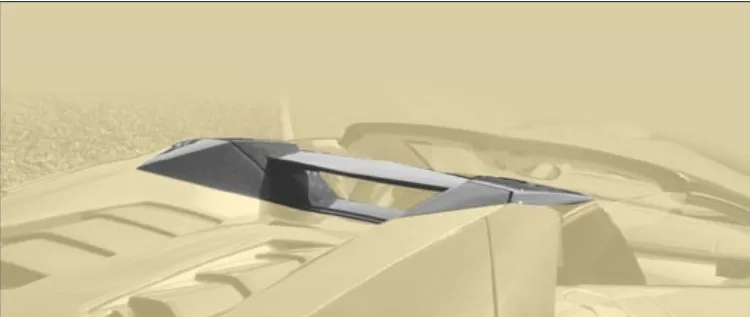
Rear bridge Mansory Carbon for Lamborghini Aventador S


Mansory Carbon Rear Bridge for Lamborghini Aventador S
The rear bridge is the horizontal carbon span that ties the Aventador S together from one rear quarter to the other, running pillar-to-pillar above the engine bonnet aperture and giving the rear silhouette its strict architectural top edge. Within the Mansory Body Kit for Lamborghini Aventador S it is the connective tissue between the C-pillar buttresses and the rear glass surround — a single sculpted crossbar that frames the naturally aspirated 6.5-litre V12 sitting underneath, brackets the rear screen, and visually anchors whichever wing or ducktail the owner specifies above it. On the LP740-4 S — coupé, scissor-doors, rear-wheel-steering, lower-side exhaust outlets, aluminium-CFRP monocoque — the factory bridge is a painted body element. Mansory replaces it with a one-piece autoclave panel whose weave runs uninterrupted across the entire span, turning a quiet structural detail into the signature visual cue that reads the car as a Mansory build at twenty paces.
Construction & Materials
The bridge is laid up as a single continuous shell rather than two halves bonded mid-span. That choice matters: a horizontal element this exposed to overhead light needs the weave lines to carry across without a splice, otherwise the eye picks up the seam every time the sun moves. Mansory builds it from prepreg CFRP layers oriented to keep the visible face dimensionally stable across the C-pillar-to-C-pillar reach, and bonds an inner reinforcement rib along the underside where the panel passes over the engine-cover hinge zone.
The substrate beneath the visible weave handles the structural job; the show layer handles the optics. Lacquer is applied in multiple thin passes with intermediate flatting, then UV-stable clear is built up to leave a deep, glassy plane that holds reflections without orange-peel distortion across the long horizontal axis.
- Outer ply: 3K twill carbon, 200 g/m², weave aligned along the pillar-to-pillar axis so reflections track the span cleanly
- Substructure: cross-plied unidirectional reinforcement under the central section, plus a bonded longitudinal stiffener on the underside for torsional rigidity across the gap
- Cure: autoclave at ~120 °C with a controlled ramp to keep the long span dimensionally true and avoid the central-bow that shows up on vacuum-only horizontal pieces
- Wall thickness: ~2.6 mm at the visible flanges, stepping to ~3.4 mm along the underside reinforcement rib
- Mass on the scale: roughly 1.6–2.0 kg depending on whether the optional inner trim cap is specified
- Finish menu: high-gloss UV clear (default), satin-matt lacquer, or raw forged-look composite for owners who want the mottled chip pattern instead of directional twill
- Hardware: stainless threaded inserts bonded into the panel; OEM-style rubber isolators at every contact point with the body to stop the bridge transmitting engine-bay vibration into the rear screen surround
- Edge treatment: chamfered and lacquer-wrapped so no raw fibre sits exposed where the panel meets paint at the C-pillar terminus
Design & Visual Function
Look at an Aventador S from three-quarter rear and the rear bridge is the part of the car you actually see most. It runs as a horizontal line above the engine bonnet, framing the rear glass and the V12 underneath, terminating at each side in the C-pillar buttress. On the painted factory car that line is quiet — body-coloured, blending into the surrounding panels. Replacing it with weave reverses the visual hierarchy: the bridge becomes the strongest horizontal element on the rear of the car, and every other detail (rear wing, ducktail, diffuser, bumper outtake, lower-side exhaust trims) reads as something hanging off that horizontal anchor.
Mansory aligns the twill so the diagonal threads run along the length of the bridge, not across it. That single decision is what makes the part look bespoke rather than aftermarket: a long horizontal piece with weave running cross-wise looks busy and short, while weave running along the span elongates the rear and helps the eye travel from buttress to buttress in one move. The hexagon language Lamborghini repeats throughout the Aventador's bodywork is echoed in the bridge's edge geometry — soft hex-derived breaks at the pillar transitions rather than a flat cut-off — so the carbon piece reads as native to the car's design vocabulary, not bolted on top of it.
For owners running a colour-on-colour exterior (matte body with gloss carbon, or satin body with raw composite) the bridge is one of the clearest places to play that contrast. Because it sits at eye level when the car is parked, and because it spans the full width of the rear, it acts as the headline statement of the carbon package — the part that announces the build before anyone reads a badge. Combined with the engine bonnet directly below it, the rear quarter becomes a continuous carbon zone that frames the V12's induction roar visually as well as acoustically.
Compatibility & Fitment
Engineered for the Lamborghini Aventador S — LP740-4 S, model years 2017 through 2021 — coupé. The Roadster uses a different rear architecture around the soft-top stowage and pairs with the Roadster engine bonnet rather than this bridge; check the Roadster-specific listings for that body. Pre-SVJ rear bumper geometry, lower-side exhaust outlets and the standard rear-screen surround are all retained — the bridge mounts to the same pickups the factory panel uses, no relocation of any electrical pass-throughs. Rear-wheel-steering hardware below is untouched. Scissor-hinge clearance at the leading edge of the bridge is preserved at OEM dimensions so doors continue to open and close without contact.
Installation & Reversibility
Plan on 2.5–4 hours for a clean fit. The factory bridge comes off after the engine bonnet is opened and the surrounding trim around the rear glass is released; OEM clips are reusable but Mansory supply a fresh set in case any have aged. Adhesive choice is not trivial here — the Aventador's CFRP-aluminium monocoque uses methacrylate-bonded panels in places, and the bridge contacts a zone where solvent-sensitive substrates are present. Mansory specify a methacrylate or polyurethane structural adhesive compatible with the factory chemistry; do not substitute generic epoxy without consulting the installer notes. Mechanical fixings carry the structural load; adhesive seals the seam and prevents drum-noise across the span.
Surface prep is straightforward: degrease, scuff the contact pads with a fine abrasive pad, tack-fit dry, mark, then bond. Reversibility is good — the bridge can be removed and the original re-installed without panel damage, which matters for owners who plan to return the car to factory specification before resale. Recommended installer: a Lamborghini-certified body shop or Mansory-trained technician for the first fit; subsequent removals (e.g. for repaint or repair) are within the comfort zone of any competent supercar workshop.
Pairing within the Mansory Aventador S programme
The bridge is a connector part — it links what sits above it to what sits below it, and the strongest builds are the ones where both neighbours are also carbon. The natural pairing below the bridge is the Engine bonnet (coupé), which carries the same weave straight under the bridge line and turns the entire rear deck into a single continuous carbon plane. Continue down to the Rear diffuser and you tie the rear together vertically as well as horizontally — bridge at the top, engine bonnet in the middle, diffuser at the floor. Many owners also specify the Rear bumper air outtake cover at the same time, because once the bridge has set the horizontal grammar of the rear, the smaller outtake covers that flank the licence-plate zone need to share the same finish or they'll read as left-over factory plastic. Three carbon parts, one coherent rear.
Maintenance & Durability
The bridge sits in a thermally active part of the car — the V12 directly below it pushes hot air upwards through the engine bonnet vents, and the underside of the bridge sees radiated heat every time the car is parked after a drive. The autoclave-cured composite is unbothered by this; the lacquer is the thing to look after. Avoid alkaline degreasers, ammonia-based glass cleaners and abrasive sponges anywhere near the lacquered weave — they micro-scratch the clear and cloud the deep glassy reflection that's the whole point of the part. A pH-neutral shampoo and a soft microfiber covers 99% of cleaning. Annual application of a ceramic-grade coating (or six-monthly carnauba if you prefer that look) keeps the UV protection topped up and the weave looking the colour it left the autoclave at, not the brown-black drift that untreated lacquered carbon settles into after a few summers. Stone-chip repairs on the bridge are unusual — the bridge sits high on the car and is rarely a target for road debris — but if it does happen, the chip is filled with matched clear, flatted, polished, and the panel is returned to specification.
Lead Time & Warranty
Lead time runs 4 to 8 weeks from order confirmation. Each bridge is built to order at Mansory — there is no warehouse stock of long horizontal panels, and that's a good thing because each one is matched to the order's chosen finish and weave orientation rather than pulled from a generic shelf. Twelve-month warranty against manufacturing defects from delivery date covers delamination, lacquer failure under normal use, and any dimensional issue that affects fit at the pickup points. Cosmetic damage from impact, abrasive cleaning, or chemical attack is excluded as standard.
FAQ
Q: Will the rear bridge fit a Roadster as well as a coupé?
A: No. The Roadster uses a different rear architecture around the soft-top stowage, and pairs with a Roadster-specific engine bonnet rather than this bridge. This part is coupé-only.
Q: How much weight does it save versus the painted factory bridge?
A: Modest — the part itself is light at 1.6–2.0 kg, and the factory bridge is already not heavy, so net saving is in the low single-digit kilos. The reason owners specify it is visual, not mass.
Q: Does the weave direction really make a visible difference at the C-pillar terminus?
A: Yes. With the weave running along the span the eye reads the bridge as one continuous horizontal element. Cross-grain weave on a long horizontal panel chops it visually into segments and shortens the perceived width of the rear.
Q: Can the bridge be removed for a future repaint without damaging the surrounding paint?
A: Yes. Mechanical fixings are accessed from the engine-bonnet side, and the bonded seam is broken with controlled heat and a thin parting blade. Done carefully it leaves the surrounding paint intact.
Q: Raw forged-look or directional twill — which ages better?
A: Both age well under proper care. Forged-look hides micro-scratches better because the random chip pattern breaks up the eye's read of any small surface defect. Directional twill shows defects more clearly but rewards good care with a deeper, more architectural reflection.
Pair the rear bridge with the engine bonnet directly below and the rear diffuser at the floor for a rear deck that reads as one continuous carbon plane. Reach us on WhatsApp +44 7488 818 747 or by email at [email protected] for finish samples, weave-orientation options and a written quote.