
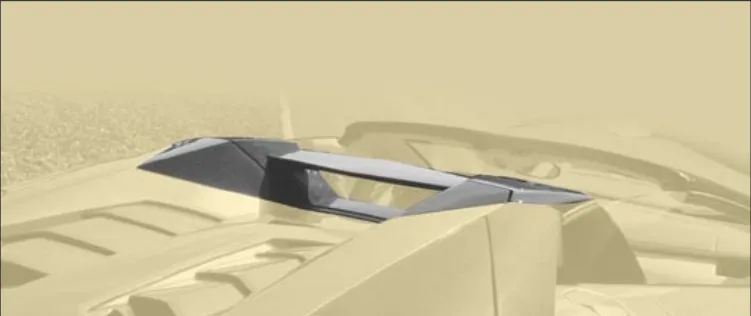
Rear bridge Mansory Carbon for Lamborghini Aventador


Rear Bridge Mansory Carbon for Lamborghini Aventador
The rear bridge is the structural and visual element that spans the engine bay opening behind the Lamborghini Aventador's rear screen, connecting the two engine lid hinge covers and forming the posterior boundary of the cockpit surround. Its position at the highest-profile structural junction on the car's upper rear makes it a focal point for any observer standing behind or at the rear three-quarter — a vantage point from which the Aventador is most frequently photographed. Mansory's carbon rear bridge replaces this factory-painted bridge element with an autoclave-cured 3K twill component, extending the programme's carbon language to the car's most structurally prominent rear junction within the Mansory Carbon Fiber Body kit set for Lamborghini Aventador.
Construction & Materials
The rear bridge's structural function — spanning the engine bay opening and supporting the engine lid hinges at its lateral terminations — requires the carbon laminate to carry both static preload from the engine lid's self-weight and dynamic loading from lid open/close cycles. Mansory's engineering team specified the bridge's laminate stack to meet these structural requirements with a margin appropriate for a car that may be driven at track days where thermal cycling of the engine bay is more aggressive than in road use.
- Outer face weave: 3K twill, 45° diagonal aligned to engine lid weave direction
- Internal structure: 2K plain biaxial reinforcement with unidirectional carbon strips at lateral hinge mounting zones
- Cure: Autoclave full prepreg consolidation
- Resin system: high-temperature toughened epoxy, 150 °C continuous — bridge position exposed to engine bay thermal radiation
- Wall thickness: 3.0 mm at hinge mounting flanges, 2.0 mm on bridge face
- Finish: high-gloss UV-stable clear lacquer
- Mounting: OEM hinge bolt positions plus supplementary body-panel clip retention
- Weight: approximately 0.45 kg
The unidirectional carbon strips at the hinge mounting zones are a structural detail that distinguishes the rear bridge from simpler panel components in the Mansory programme. The hinge bolt flanges must resist the full weight of the engine lid under dynamic loading — opening or closing the lid at speed (as occurs in production-car photography or show events) creates a transient torque at the hinge mounting that significantly exceeds the static weight load. The UD strip reinforcement provides the additional through-thickness shear strength needed to maintain the flange's dimensional integrity across this loading cycle.
Design & Visual Function
The rear bridge's visual contribution to the Aventador's programme is disproportionate to its area. Because it occupies the junction between the engine lid, the rear screen surround, and the engine bay opening, it is the component that visually locks the rear upper bodywork together. A painted bridge against carbon engine lid and rear screen surround creates a colour-contrast break at the car's most structural-looking junction — a detail that experienced Lamborghini owners recognise immediately as an incomplete specification.
The 3K twill face of the Mansory rear bridge, when matched to the engine lid and rear screen surround specification, creates a continuous carbon span across the car's full upper rear — from the rear performance wing mounting roots down through the engine lid to the bridge and rear screen surround. This unbroken carbon field is the visual foundation of the Aventador programme's rear upper architecture.
At car shows and private viewings, the rear bridge is the first component that detail-conscious judges examine when assessing the completeness of an Aventador carbon programme. It is the element that most reliably distinguishes an owner who has specified the programme systematically from one who has selected individual pieces without regard to the complete visual picture.
Compatibility & Fitment
Designed for the Lamborghini Aventador LP 700-4 (2011–2016) and LP 720-4 50° Anniversario coupé. The Aventador Roadster has a different rear bridge geometry — the Roadster-specific rear bridge is available separately; confirm body style at order stage. Aventador S (MY2017+) revised the rear structure — the Mansory S programme covers that model.
Installation & Reversibility
Installation requires removal of the existing bridge panel via the hinge bolt positions and body-panel clips, fitting the carbon bridge in the same fastener positions, and torquing the hinge bolts to OEM specification. 60–90 minutes for an experienced workshop. Full reversibility — the factory bridge reinstalls in the same positions. Engine lid realignment check is recommended after bridge replacement to confirm hinge geometry is undisturbed.
Pairing within the Mansory Aventador programme
The rear bridge pairs logically with the rear performance wing or rear high performance wing above, and the replacement air intake rear below the engine lid plane. For a comprehensive upper rear specification, combine the rear bridge with the air intake cover and the designed big air intake to create a fully coordinated carbon rear upper that extends from wing root to sill line.
Maintenance & Durability
The rear bridge's proximity to the engine bay means it is exposed to elevated ambient temperatures during prolonged track use — the 150 °C resin system maintains full structural and aesthetic performance at the thermal environment the bridge position encounters. Maintenance involves pH-neutral cleaning, annual inspection of hinge bolt torque (thermal cycling can relax fastener preload over multiple seasons of track use), and ceramic coating for hydrophobicity. The bridge's lacquer should be inspected for stone chip damage from the rear tyre's ejection path after track sessions and recoated at a bodyshop as required.
Lead Time & Warranty
Lead time from order is 2–3 weeks. Mansory covers with a 12-month warranty against manufacturing defects including delamination, lacquer voids, and hinge flange dimensional deviation attributable to manufacturing error. Structural failure at the hinge mounting zone under normal operating loads (engine lid open/close cycles at OEM speed) is covered for the warranty period.
The rear bridge's thermal environment is worth quantifying for owners who use their Aventador on closed circuits. During a sustained track session, the Aventador's V12 engine bay reaches ambient temperatures of 120–140 °C in the upper zone immediately below the engine lid and rear bridge. The bridge, positioned above the engine bay's upper limit, typically experiences sustained temperatures of 80–100 °C at its underside during a full session — well within the 150 °C rated resin system's continuous operating margin. A bridge specified with a standard 80 °C epoxy would begin showing resin softening in these conditions after multiple track sessions, eventually leading to micro-cracking in the laminate and progressive stiffness reduction. Mansory's 150 °C specification eliminates this degradation mechanism entirely, maintaining the bridge's structural integrity across unlimited track use at normal ambient temperatures.
For competitive owners who enter their Aventador in Concorso d'Eleganza events or equivalent show judging, the rear bridge is one of the components that judging panels score specifically under "completeness of the exterior carbon programme" criteria. Experienced Lamborghini class judges will note the presence or absence of carbon at the rear bridge position as part of their systematic inspection of the upper rear body — a painted bridge in an otherwise comprehensive carbon build is as visible to a trained judge as a missing front splitter. Specifying the Mansory rear bridge eliminates this scoring vulnerability in a class where completeness of programme execution is a primary discriminator between competitive entries.
FAQ
Q: Does the rear bridge include the hinge cover panels at its lateral ends?
A: The rear bridge component covers the main horizontal span. Hinge cover panels may be included depending on the specific Aventador build year's factory configuration — confirm at order stage whether your car's hinge covers are integrated with the bridge panel or separate.
Q: Is the weave direction matched to the Mansory engine lid and rear screen surround?
A: Yes — the 3K twill weave direction is specified to match the adjacent engine lid and rear screen surround components in the Mansory programme. When ordered as part of the complete rear upper specification, Mansory supplies bridge, lid, and surround from the same production batch to ensure lacquer level and weave density consistency.
Q: Can the rear bridge be fitted without removing the engine lid?
A: The hinge bolt positions require the engine lid to be raised for access. Full removal of the lid simplifies the installation but is not strictly required; a workshop with experience on the Aventador's rear structure can fit the bridge with the lid raised.
Q: Is the 150 °C resin necessary for a car that is road-driven only?
A: The 150 °C specification provides a significant margin above the ambient temperature the bridge experiences even on a sustained motorway run in summer. For road-only cars, a standard 120 °C resin would be technically sufficient — but Mansory standardises on 150 °C for all rear engine-adjacent components to maintain consistent thermal margin across the programme regardless of individual use patterns.
Order or ask technical questions via WhatsApp +44 7488 818 747 or [email protected].