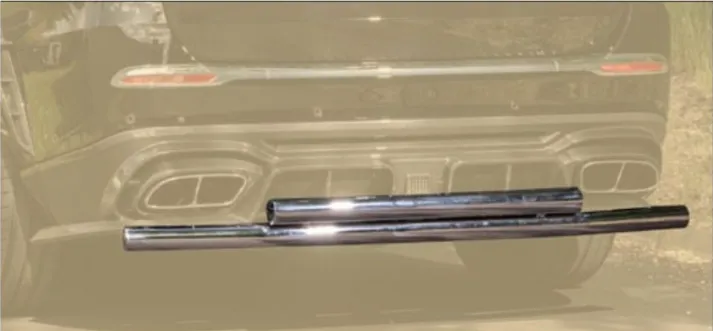
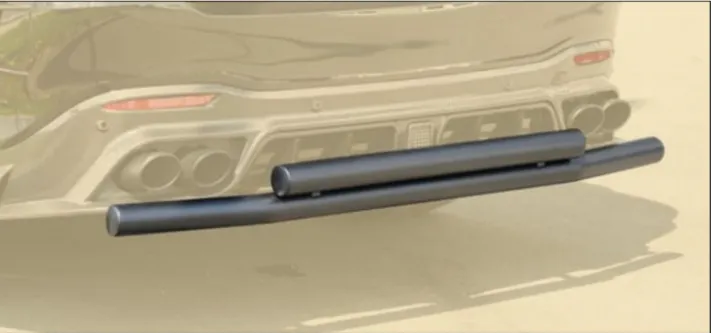
Rear protective frame Mansory for Mercedes GLS X167


Mansory Rear Protective Frame for Mercedes-Benz GLS X167
The Mansory rear protective frame is the closing chapter of the protective hardware suite within the Mansory Body Kit for Mercedes GLS X167 programme. Mounted across the rear of the X167 — the seven-seat flagship that Mercedes positions as the S-Class of SUVs — it is a sculpted underrun / bull-bar style member that reads as bespoke coachbuilt jewellery while behaving as a serious piece of low-speed protection. On a vehicle whose tailgate handles family luggage, golf bags and the occasional dockside trolley, the rear face is exactly where parking-lot scuffs, trolley strikes and reverse-into-bollard moments happen, and the frame answers that. The bar is engineered to clear the hatch sweep when the powered tailgate opens, to preserve departure angle when AIRMATIC raises the GLS into off-road or loading height, and — critically — to accommodate either the dual-outlet exhausts of the GLS 450 / 580 or the four central-mounted tips of the AMG GLS 63 with its Panamericana grille and 4.0-litre V8 BiTurbo theatre.
Construction & Materials
Unlike pure carbon panels in the rest of the Mansory GLS programme, the protective-frame parts are deliberately hybrid. They have to absorb genuine impact energy and survive trolley dings, bollard scrapes and reversing-into-furniture moments without delaminating, so a structural metal core is wrapped in carbon shrouding for the visual and weight signature Mansory clientele expect.
- Structural core: seamless steel tubing, or aerospace-grade aluminium alloy on weight-priority builds, with internal gusseting where the bar meets the OEM rear crash-rail mounts.
- Outer skin: 3K twill or 2K plain carbon shroud bonded over the metal core, vacuum-formed and post-cured for a dimensionally stable wrap.
- Tube wall thickness: typically 2.0–3.0 mm on the steel variant, 3.5–4.5 mm on aluminium, sized for parking-speed impact rather than trackday loads.
- Finish options: matte powder-coat in body-coordinated tone, satin black with exposed weave inserts, or full deep-gloss lacquer over the carbon shroud with UV-stable clear topcoat.
- Mounting: bolts directly to the OEM rear crash-rail (the same impact beam Mercedes uses for the bumper), no chassis welding, no longitudinal modification.
- Hardware: stainless A4 fasteners with rubberised isolators to decouple acoustic resonance from the body-in-white.
- Approximate dry weight: 10–16 kg depending on length, end-cap geometry and core material.
- Edge treatment: rolled returns and chamfered ends to keep paintwork on neighbouring bumper covers safe during repeated removal/refit cycles.
Design & Visual Function
The geometry of the rear frame is governed by three constraints that simply do not exist on the front bar. First, the powered tailgate of the GLS X167 traces a long arc when it lifts — sensors, cameras and the wiper-spray nozzle for the rear hatch all live inside that arc — so every transverse element of the frame is set forward of the tailgate sweep envelope, with vertical clearance verified against the highest hatch position. Second, AIRMATIC is allowed to raise the body for loading or unsealed-road work; the frame must therefore preserve the published departure angle even at maximum lift, which is achieved by tucking the lower edge of the bar slightly inboard of the bumper trailing line. Third, the diffuser zone underneath the frame is busy: on the AMG GLS 63 the M177 V8 BiTurbo exits through four central-mounted tips clustered tightly at the diffuser centreline, while the GLS 580 with its M256-derived 4.0-litre V8 BiTurbo and the inline-six GLS 450 with EQ Boost mild-hybrid present a wider, calmer dual-outlet arrangement.
Mansory therefore offers the rear frame in two cutout maps. The AMG-spec frame steps clear of the quad-tip cluster, with a generous central recess, heat-shielded inner edges and a slightly raised crossbar to keep the carbon skin out of the post-throttle-blip plume. The standard / 580-spec frame closes more confidently across the lower bumper because the dual outlets sit at the corners and do not require central evacuation. In both cases the bar interacts visually with the diffuser-with-brake-light geometry below it: the brake-light line of the diffuser stays unobstructed from a following driver's eye line, the parking sensors keep their sensing cones, and the rear-camera washer aperture remains exposed.
Construction is bolted rather than welded. Mansory deliberately avoids welding the carbon-shrouded core to the OEM crash-rail because welding would compromise both the carbon wrap and the factory crumple behaviour. Instead, the bar bolts through the same captive nuts and reinforced points the bumper itself uses, so the OEM impact path is preserved and the part remains fully reversible at any point in ownership.
Compatibility & Fitment
The frame is engineered for the Mercedes-Benz GLS X167 from the 2019 model-year onward, including the post-MY2024 facelift, and covers the full engine line-up: GLS 450 with the inline-six and EQ Boost mild-hybrid, GLS 580 with the 4.0-litre V8 BiTurbo, and AMG GLS 63 with its 603-horsepower V8 and Panamericana grille. The mounting interface is the OEM rear crash-rail — unchanged across the line-up — so the bar fits regardless of trim. The two cutout maps (dual-outlet for 450/580 and quad-tip for AMG GLS 63) are selected at the time of order. The tailgate kick-sensor zone under the rear bumper is preserved, so hands-free hatch opening continues to work; the rear-view camera and its washer aperture remain unobstructed; AIRMATIC self-levelling, 4MATIC actuation and 9G-TRONIC reverse-gear logic are all electrically and mechanically untouched. Towbar-equipped GLS variants require the towbar-specific frame variant; this is flagged at order.
Installation & Reversibility
Fitting the rear protective frame is bumper-out work and should be carried out by a Mercedes-certified body shop or a Mansory-trained installer. Plan four to eight hours: remove the rear bumper cover, expose the OEM crash-rail mounts, bolt the frame to the rail using the supplied stainless hardware and rubberised isolators, route any optional sensor harness, refit the bumper, torque to spec, verify parking-sensor and rear-camera function, and confirm the tailgate sweep envelope on three repeat cycles. Because the bar bonds to the factory crash-rail through OEM points, the part is fully reversible. Removing it returns the GLS to original specification with no body-in-white modification, no trimmed wiring and no welded interfaces.
Pairing within the Mansory GLS X167 programme
The single most important pairing is functional and visual at once: the rear protective frame and front protective frame are designed to be specified together. They share material logic, finish palette and bolt-to-OEM-crash-rail philosophy, and they bracket the GLS X167 silhouette with matching protective theatre at both ends. Below the rear frame, the natural sibling is the diffuser with integrated brake light, which carries the carbon language down into the lower bumper while keeping the third brake-light signature visible to following traffic. Owners after a slightly cleaner brake-light line, or working with an existing high-mounted CHMSL setup, often pair the frame with the standard Mansory carbon diffuser instead. Up top, the roof spoiler closes the rear-three-quarter aesthetic and visually finishes the carbon dialogue from above the tailgate down to the bar at street height.
Maintenance & Durability
The rear frame sees the harshest chemistry on the car. Road salt, dishwasher-style trolley fluids in resort car parks, soft-drink spills loaded into the boot, and the occasional pressure-wash blast all converge here. The matte powder-coat finish is extremely tolerant of all of this provided two rules are observed: pH-neutral shampoo only — no alkaline degreasers and no ammonia-based glass cleaners drifting onto the bar — and no abrasive sponges. A microfibre wash and a soft-bristle detail brush around the carbon shroud edges are sufficient. The kick-sensor area beneath the rear bumper deserves its own monthly clean: dried mud or salt crust in that zone can trigger phantom hatch openings or, more commonly, suppress a legitimate kick gesture. If a stone-chip exposes the steel core, touch-in is straightforward at any Mercedes-certified body shop — the part is paint-repairable in situ. Heavier impact damage is handled by removing the bar, refurbishing the carbon shroud and recoating; in extreme cases the entire frame is replaced under the lead-time schedule. PPF is rarely needed on the bar itself — the powder-coat is more impact-tolerant than lacquered carbon — but a strip of PPF on the adjacent bumper cover where the frame meets the painted body is a sensible specification.
Lead Time & Warranty
Lead time is four to eight weeks. Each Mansory rear protective frame is built to order against the customer's selected core material, finish, exhaust cutout map (dual or quad) and any towbar specification, then shipped with installation hardware and torque documentation. Warranty is twelve months against manufacturing defects in the carbon shroud, structural core, finish system and supplied hardware.
FAQ
Q: Does the powered tailgate kick-sensor still work after the rear frame is fitted?
A: Yes. The frame geometry is set forward of the kick-sensor cone beneath the rear bumper, so hands-free hatch opening continues to function. We do recommend keeping that zone clean of mud and salt crust to keep the gesture detection crisp.
Q: My GLS is an AMG GLS 63 with the four central-mounted exhausts. Is there a special version of the frame?
A: Yes. The AMG-spec frame has a wider central recess, heat-shielded inner edges and a slightly raised crossbar to clear the quad-tip cluster of the M177 V8 BiTurbo. The GLS 450 and GLS 580 receive the dual-outlet variant, which closes more confidently across the lower bumper.
Q: Will AIRMATIC raising the body change how the frame sits relative to departure angle?
A: No. The lower edge of the bar is tucked slightly inboard of the bumper trailing line specifically so departure angle is preserved at the highest AIRMATIC ride-height position. The frame does not become the lowest point of the rear under any allowed lift mode.
Q: Can I have the frame finished to match the body colour?
A: Yes. Body-coordinated matte powder-coat, satin black with exposed-weave inserts and full deep-gloss lacquer over the carbon shroud are all available. Spectro samples are matched to your VIN paint code at order.
Q: What is the lead time and is the part reversible?
A: Lead time is four to eight weeks. The frame bolts to the OEM rear crash-rail through factory mount points — no welding, no chassis modification — so removal at any point in ownership returns the GLS to original specification.
The Mansory rear protective frame closes the protective duo at the rear of the GLS X167 — the front-protective-frame is its natural other half, and both bars deserve to be specified together for the matching theatre and the matching defence. To configure exhaust cutout map, finish and towbar specification, contact WhatsApp +44 7488 818 747 or [email protected].