Diffuser Mansory Carbon for Mercedes GLS X167


Diffuser — Mansory Carbon for Mercedes GLS X167
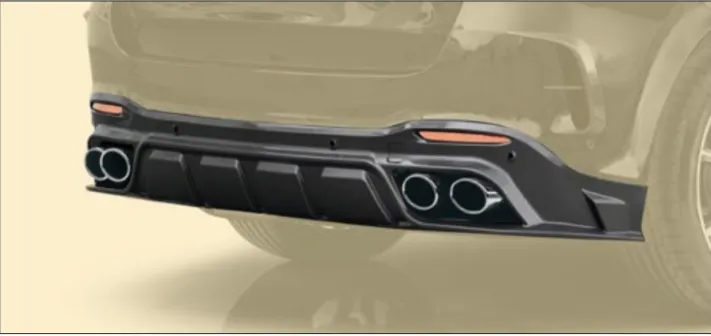
The plain Mansory carbon diffuser is the rear-facing centrepiece of the Mansory Body Kit for Mercedes GLS X167 for owners who want full coachbuilt theatre at the back of the car without an integrated brake-light splice. Sculpted fins frame the lower bumper zone, drop visual mass beneath the tailgate and choreograph air leaving the underbody around the dual exhaust outlets of the GLS 450 and 580 — or the four central-mounted outlets of the AMG GLS 63 4.0L V8 BiTurbo. It is the simpler, cleaner trade-off versus the brake-light variant: same Mansory bespoke carbon language, the same theatre-of-arrival presence, but a purely mechanical install with no rear-harness tap, no canbus coding and no second filament to ever replace. Owners who already specified an OEM third-brake-light upgrade, or who simply prefer carbon panels free of any electrical content, default to this part.
Construction & Materials
The diffuser is laid up from aerospace-grade prepreg carbon, with a 3K twill outer ply chosen so the weave reads correctly across the long, fin-flanked rear of the GLS X167 — a panel wide enough that an off-axis weave would betray itself the first time the car rolls into a hotel forecourt under low light. Mansory's bespoke shop autoclave-cures the part under controlled pressure to drive out micro-voids, then finishes it in their signature deep-gloss UV-stable lacquer (raw exposed-weave with matte UV clear is available on request).
- Outer ply: 3K twill prepreg carbon, weave aligned to the bumper centre-line and mirrored on the outer fins.
- Inner laminate: multi-axial carbon with localised reinforcement around the exhaust cut-outs and the lower mounting tabs.
- Cure: full autoclave under controlled pressure and ramped temperature — not vacuum-bag-only.
- Wall thickness: ~2.0–2.6 mm across the main body, stepping up locally where the fins meet the substrate.
- Weight: ~3.2–3.8 kg depending on variant fitment (AMG GLS 63 cut-out is more aggressive around four exhausts and removes a touch more material).
- Hardware: stainless studs, rubber-isolated washers, and a carrier sub-frame that bolts to OEM bumper-skin hard-points — zero new holes in painted metalwork.
- Finish: deep-gloss UV-stable lacquer as standard; raw weave with matte UV clear, or weave-with-coloured-pinstripe, available bespoke.
- No electrical content: no harness, no canbus module, no LED — a strictly mechanical assembly.
Design & Visual Function
Visually, the plain diffuser drops the apparent mass of the rear bumper. The GLS X167 is a 5.21 m, ~2.49 t luxury seven-seater — without intervention the lower rear can read tall and slab-sided, particularly after a paint refresh. Mansory's fin geometry interrupts that slab, runs vertical shadow lines beside the exhausts, and ties the rear visually to the front-lip and side-skirt language of the wider carbon programme. On AMG GLS 63 the four central-mounted exhausts sit symmetrically inside the diffuser cut-out and the fin spacing is tuned so each exhaust has its own visual frame; on GLS 450 / 580 with dual outlets the centre fin pairs read as a calmer, more upright statement. Either way the bumper above the diffuser stays untouched — reflectors, fog lamps and parking-sensor cones are preserved, and the OEM tow-eye access cover still opens.
Aerodynamically, the role on a GLS is honest: it tidies underbody airflow leaving the rear axle, breaks the wake more cleanly behind the heavy SUV silhouette, and reduces the puff of dust that settles on the lower tailgate at motorway speed. This is bespoke coachbuilt theatre, not trackday downforce. The GLS programme is about presence, not lap times — and the plain diffuser is deliberately the calmer of the two diffuser options, letting the rear hatch emblem and the exhausts do the talking rather than introducing an additional light element.
Against the brake-light variant, the design difference is intentional: the plain diffuser keeps the centre fin run uninterrupted by a translucent lens, so the carbon weave reads as a single continuous panel from one exhaust frame to the other. Owners who want the rear of the car to feel like one solid carbon sculpture — rather than a sculpture with an inset light — default here. It also pairs more sympathetically with cars where a custom interior third-brake-light or aftermarket high-mount LED has already been specified, avoiding visual duplication.
Compatibility & Fitment
Designed for the Mercedes-Benz GLS X167 (2019–present, sold from MY2020) including the post-MY2024 facelift, across all engine variants — GLS 450 (3.0 L inline-6 + EQ Boost mild-hybrid), GLS 580 / 580 4MATIC (4.0 L V8 BiTurbo) and AMG GLS 63 (4.0 L V8 BiTurbo, ~603 hp). Two exhaust cut-out variants are produced: a dual-outlet cut-out for GLS 450 / 580 and a four-central-exhaust cut-out for AMG GLS 63. Confirm exhaust trim before order — swapping cut-out variants is not field-trimmable on a finished lacquered panel. The diffuser keeps OEM rear parking sensors fully active in their original cones, preserves the rear-camera washer aperture, and clears AIRMATIC self-levelling at every ride-height setting including kneel-load mode. Tow-bar electrical sockets and the retractable tow-ball assembly (where specified from factory) remain accessible.
Installation & Reversibility
Allow 2.5–4 hours at a Mercedes-certified body shop or a Mansory-trained installer. The lower section of the rear bumper skin is dropped, the carrier sub-frame is bolted to OEM hard-points, and the diffuser is offered up, shimmed flush, then torqued down via stainless studs through rubber-isolated washers. Trim primer is applied where the carrier passes near painted bumper edges to prevent micro-abrasion. Crucially, because there is no harness on the plain variant, no canbus coding, no rear-light integration tap and no Star/XENTRY adaption is required — the diffuser is mechanically complete the moment the last stud is torqued. That is a meaningful part of why owners pick this version: it is faster to fit, quicker to remove for paint correction or PPF refresh, and there is no electrical splice that a future workshop could miscode. Reversibility is total: unbolt the carrier, restore the original lower bumper section, and the bumper skin returns to OEM with no visible scars.
Pairing within the Mansory GLS X167 programme
The most direct sibling decision is between this part and the Diffuser with Brake Light Mansory Carbon for Mercedes GLS X167 — same fin language, but the brake-light version embeds an LED bar in the centre fin run with a rear-harness tap, whereas this plain version stays purely mechanical. Owners who want the rear sculpted in one continuous carbon sweep, who already have an aftermarket high-mount brake light, or who simply prefer to avoid any electrical splice, choose the plain diffuser. For a coherent rear-end build, pair this diffuser with the Rear Protective Frame Mansory for Mercedes GLS X167, which adds a bull-bar style underrun protection above the diffuser line and frames the tailgate sweep without conflicting with the diffuser geometry. Finally, the Air Outtake Splitter Mansory Carbon for Mercedes GLS X167 is a natural sidewall companion — it carries the same fin grammar forward into the rear-quarter air-outlet zone, so the carbon language reads as one continuous arc from rear bumper around to the rear arch.
Maintenance & Durability
Lacquered carbon on a luxury seven-seat SUV needs sane care. Hand-wash with a pH-neutral shampoo, a clean lambswool mitt and the two-bucket method; rinse before the panel dries. Avoid alkaline traffic-film removers, ammonia-based glass cleaners drifting onto the diffuser, and abrasive sponges — any one of those will dull the lacquer over a season. A high-quality ceramic coating (9H-class) layered over the factory lacquer extends UV stability and makes brake-dust and exhaust-soot release dramatically easier on lacquered weave; carnauba wax is acceptable but needs more frequent reapplication and offers less chemical resistance. Because the GLS sees school-run, long-distance and occasional gravel use, the diffuser sees more rock-chip exposure than a coupé would; consider a section of self-healing PPF over the leading lower edge of the diffuser if the car frequently runs unsealed roads. If a fin chips, a Mansory-trained refinisher can re-lay localised cloth, recure and blend the lacquer — a full-panel respray is rarely needed. Underbody steam-cleaning is fine; pressure-washer wands held closer than 30 cm to the lacquer edge are not.
Lead Time & Warranty
Lead time is typically 4–8 weeks from order confirmation, reflecting Mansory's bespoke autoclave production and per-car finish QC. Each diffuser is serialised and inspected before despatch. A 12-month warranty covers manufacturing defects in laminate and finish; cosmetic damage caused by fitment outside Mansory-trained workshops, by alkaline cleaners or by impact is excluded. Order confirmation requires VIN and exhaust-trim confirmation (dual vs four-central) so the correct cut-out variant is laid up.
FAQ
Q: Why pick the plain diffuser over the brake-light variant?
A: Two practical reasons. First, no electrical splice into the OEM rear-light harness, which means no canbus coding, no future workshop confusion, and a faster install. Second, visual: the plain diffuser keeps the carbon weave running continuously across the centre fins instead of being interrupted by a lens, which some owners prefer aesthetically. If you have an aftermarket or upgraded OEM third-brake-light already, the plain version avoids visual duplication.
Q: Will it fit my AMG GLS 63 with four central exhausts?
A: Yes — the AMG variant is laid up with a four-central-exhaust cut-out so each tailpipe sits symmetrically framed. Confirm AMG GLS 63 spec at order so the correct cut-out is produced; the dual-outlet cut-out for GLS 450 / 580 is not interchangeable on a finished panel.
Q: Does it preserve the rear parking sensors and reverse camera?
A: Yes. The diffuser sits below the sensor array and below the camera washer aperture; the OEM cones are not blocked or redirected. AIRMATIC self-levelling and kneel-load mode are also unaffected.
Q: Can it be removed without leaving marks on the bumper?
A: Yes — the carrier sub-frame uses OEM hard-points, no new holes are drilled into painted metalwork, and the bumper skin returns to factory state once the carrier is unbolted. That is part of why this plain version is popular: it is genuinely reversible.
Q: How does it interact with a tow-ball or trailer wiring?
A: The diffuser is shaped to clear factory-spec retractable tow-ball assemblies and the trailer electrical socket remains accessible. If an aftermarket fixed tow-bar has been retrofitted, send a photo and we will confirm clearance before order.
Q: Lacquered or raw exposed weave — which ages better on a daily-driven GLS?
A: Lacquered is the safer default for a daily SUV: more chip-tolerant, easier to ceramic-coat, easier to refinish locally if a stone hits. Raw weave with matte UV clear is striking but demands more disciplined care and more frequent UV-clear reapplication — better suited to garaged collection cars than school-run duty.
Pair the plain diffuser with the rear protective frame and the air-outtake splitter for a coherent, continuous carbon language across the back of the GLS without any electrical splice in the rear lighting harness. To configure exhaust-cut-out variant, finish (lacquered vs raw weave) and lead-time, contact us via WhatsApp +44 7488 818 747 or [email protected].