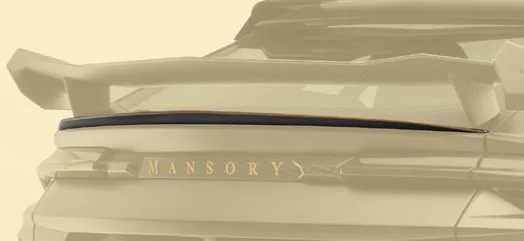
Rear decklid spoiler Mansory for Lamborghini Urus Venatus


Mansory Rear Decklid Spoiler for Lamborghini Urus Venatus
The Mansory rear decklid spoiler is a discrete, ducktail-style carbon lip that sits on the upper edge of the Urus rear hatch, finishing the Venatus carbon programme without committing to the full motorsport silhouette of a pedestal wing. Within the wider Mansory Body Kit for Lamborghini Urus Venatus S, this part plays the role of an aesthetic and aero refinement — it tightens the rear visual line, picks up the tail-light geometry and works in concert with Lamborghini's hexagonal DNA, the Y-pattern LED DRL up front and the rear-wheel-steering stance. It suits owners who run the twin-turbo V8 super-SUV in Strada and Sport more than Corsa, who want a coherent carbon programme with the bonnet, mirrors and rear hatch panel, but who do not want a track-style high-performance wing dominating the rear glass.
Construction & Materials
The spoiler is laminated as a single-piece carbon shell, designed to follow the precise sweep of the OEM rear hatch and the upper edge of the rear glass. Mansory's bespoke production process delivers the same surface quality across every part of the Venatus programme — autoclave-cured prepreg with controlled fibre orientation, pre-bonded mounting tabs and Mansory's deep-gloss UV-stable lacquer (or, on request, a primed-for-paint variant for owners specifying body-colour finish over carbon).
- 3K twill prepreg lay-up across the visible upper surface, with a 2K plain or biaxial sub-layer for stiffness in the trailing edge.
- Autoclave-cured at controlled temperature and pressure for low void content and consistent panel rigidity.
- Wall thickness approximately 2.0–2.6 mm across the central blade, tapered to roughly 1.6 mm at the tips for a clean visual termination.
- Net component weight in the region of 1.0–1.4 kg — a modest gain over the OEM trim line on the decklid edge.
- Mounting via 3M VHB high-bond automotive tape on engineered contact patches, with hidden alignment clips at the tab locations to lock pitch and angle.
- Finish options: Mansory deep-gloss UV-stable lacquer over visible 3K weave, satin / silk-matte clear, or fully primed for body-colour respray.
- Edges hand-finished and post-cured; trailing lip radiused to avoid stress concentration and to keep the rear-end wash flow attached.
- Compatible with full ceramic coating; optional PPF can be applied after lacquer cure if the owner intends to use the car in mixed conditions.
Design & Visual Function
Visually, the spoiler integrates with the Urus rear hatch in a deliberately discrete way. Where the performance-wing-EVO sits up on a pedestal and rewrites the silhouette, the decklid spoiler keeps the existing roofline and tail-light line intact and simply tightens the trailing edge — a ducktail-style continuation of the bodyline rather than a separate aero element. The blade is shaped to mirror the upper edge of the rear glass and to flow into the tail-light line on both sides, so from three-quarter angles it reads as factory-evolved bodywork rather than an add-on. With Mansory deep-gloss lacquer the weave catches the same light as the bonnet and mirror caps, drawing the carbon programme into a single visual narrative.
Aerodynamically, the contribution is modest but real. The spoiler creates a small pressure step at the trailing edge of the decklid, helping to detach flow cleanly above the rear glass and stabilising the rear axle at sustained autobahn-grade speed. It does not generate the level of downforce associated with the high-performance roof spoiler or the performance-wing-EVO, and that is precisely the point — the trade-off is subtler aesthetics and lower visual aggression in exchange for less peak downforce. For owners who do not chase apex speed at a track day, this balance is usually the right one for the Urus's daily-use profile.
Within a carbon programme, the decklid spoiler plays beautifully against either rear hatch panel variant. With the silver-logo rear hatch panel, the visual story is restrained — brushed Mansory wordmark, ducktail blade, deep-gloss carbon, no theatre. With the illuminated-logo rear hatch panel, the spoiler frames the LED-lit Mansory wordmark from above, so at night the rear of the car reads as a single composed graphic — blade, logo, tail-light line. Both choices work; the decision is between silent visual weight and night-time presence.
Compatibility & Fitment
Designed for the Lamborghini Urus, Urus S facelift and Urus Performante (2018–present). Despite the slug naming, the Venatus parts retrofit cleanly across the Urus line. The spoiler is engineered to preserve the rear-hatch sweep clearance through the full opening arc — there is no contact between the blade and the roof, the wiper, or the C-pillar trim at any point in the hatch travel. The rear-camera washer aperture and the high-mount stop-light remain fully unobstructed; rear-view camera coverage and the parking-sensor cone are unchanged. Adaptive air-suspension self-levelling, rear-wheel-steering geometry and the six driving-mode aero state are all unaffected by this trim-level addition. Urus does not have ALA, so there is no active-aero element to interfere with on the rear of this car.
Installation & Reversibility
Installation is comparatively quick: a Mansory-trained or Lamborghini-certified installer typically completes the job in 1.5 to 2.5 hours including primer prep, dry-fit and final bond. The contact zone on the OEM decklid is degreased, lightly abraded where appropriate and primed; the spoiler is dry-fitted with the integrated alignment clips, the 3M VHB protective film is then peeled and the part is bonded under hand pressure along the engineered contact patches. The bond is left to cure undisturbed for the manufacturer-specified dwell time before the car is washed or driven in heavy rain.
The mount is reversible. With heat and patience, the spoiler can be removed at a later date and the residual VHB cleaned off the OEM paint without permanent damage, which protects resale value and keeps a future return-to-stock option open. DIY removal is feasible for an experienced enthusiast; first-time installation is best left to a body shop because the alignment to the tail-light line and to the rear-glass edge benefits from professional eye and a proper jig.
Pairing within the Mansory Urus Venatus programme
The decklid spoiler sits at the centre of a small cluster of rear-area parts. Three obvious siblings are worth highlighting. First, the silver-logo rear hatch panel, Rear Hatch Panel (Silver Logo) — Mansory for Lamborghini Urus Venatus, which keeps the rear story discreet and pairs cleanly with the ducktail blade for a quietly composed tail. Second, the illuminated-logo variant, Rear Hatch Panel (Illuminated Logo) — Mansory for Lamborghini Urus Venatus, which converts the rear into a night-time graphic with the spoiler framing the LED wordmark from above. Third, for owners who later decide they want more peak downforce and a more aggressive silhouette, the pedestal alternative is Performance Wing EVO — Mansory for Lamborghini Urus Venatus; some owners specify the decklid spoiler as the daily configuration and reserve the performance wing as a future upgrade path. Owners chasing a fully integrated rear-and-roof aero feel often add High-Performance Roof Spoiler — Mansory for Lamborghini Urus Venatus on top, where the roof spoiler manages flow off the rear glass and the decklid spoiler closes the trailing edge underneath it.
Maintenance & Durability
The decklid spoiler sits in a relatively forgiving zone — it is shielded from the worst rock-chip exposure that the front bonnet and race-flaps have to absorb — but it does see the full rear-end wash, road salt and the occasional brush from luggage being loaded. Lacquered carbon should be washed with pH-neutral shampoo, rinsed thoroughly and dried with a soft microfibre. Avoid alkaline cleaners, ammonia-based glass products migrating onto the blade, abrasive sponges, traffic-film removers used neat and any drive-through machine wash with stiff brushes — these are the realistic enemies of the deep-gloss lacquer.
A ceramic coating renewed annually is the most cost-effective protection regime; high-end carnauba waxes are also acceptable for owners who prefer a softer optical depth. If the spoiler is chipped — typically by careless luggage or by a high-pressure wash nozzle held too close — small impacts can be repaired by a competent body shop using a localised lacquer respray, and a fully-cracked unit can be replaced as a single panel without disturbing the surrounding bodywork. With sensible care, the lacquer holds optical clarity for many years; in dry storage the laminate itself is effectively timeless.
Lead Time & Warranty
Lead time for a bespoke Mansory rear decklid spoiler is in the region of 4 to 8 weeks from order to dispatch, reflecting the autoclave production cycle and the surface inspection regime. Lacquered variants and primed variants follow the same window. The part carries a 12-month warranty against manufacturing defects, covering laminate integrity, bonded mounting hardware and lacquer adhesion under normal use; the warranty does not cover impact damage, chemical attack from inappropriate cleaners or installation errors made outside a qualified body shop.
FAQ
Q: How is the decklid spoiler different from the performance-wing-EVO?
A: The decklid spoiler is a discrete ducktail-style lip integrated into the rear hatch line — minimal visual change, modest aero contribution, no pedestal. The performance-wing-EVO is a large pedestal-mounted rear wing — substantial downforce, dominant silhouette, motorsport-derived. The decklid spoiler is the daily-use answer; the EVO wing is the track-day statement.
Q: Will it fit my Urus / Urus S / Urus Performante?
A: Yes — the same part fits the original Urus, the post-2022 Urus S facelift and the Urus Performante. The slug uses generic Venatus naming because the part retrofits cleanly across the line.
Q: Can I order it primed and have it body-coloured?
A: Yes. The primed variant is supplied ready for paint. We recommend a Lamborghini-certified body shop matches the OEM paint code on a sprayout card before respraying the spoiler, then clear-coats and post-cures. Body-coloured execution makes the spoiler almost invisible at a glance — appropriate for a more discreet build.
Q: Will the spoiler clear the rear hatch sweep?
A: Yes. The blade is engineered to clear the full opening arc of the rear hatch with comfortable margin to the roof, the wiper and the C-pillar trim. The OEM camera-washer aperture and the high-mount stop-light remain unobstructed.
Q: What lead time should I plan for?
A: Plan for 4 to 8 weeks from confirmed order to dispatch, reflecting the autoclave production cycle. Installation itself is 1.5 to 2.5 hours at a qualified body shop.
Pair the rear decklid spoiler with a silver-logo or illuminated-logo rear hatch panel for a coherent rear-end story, or escalate to a performance-wing-EVO when the brief turns toward downforce. To configure your Venatus carbon programme, talk to us — WhatsApp +44 7488 818 747 or [email protected].