Rear hatch panel with silver logo Mansory for Lamborghini Urus Venatus


Rear Hatch Panel with Silver Logo Mansory for Lamborghini Urus Venatus
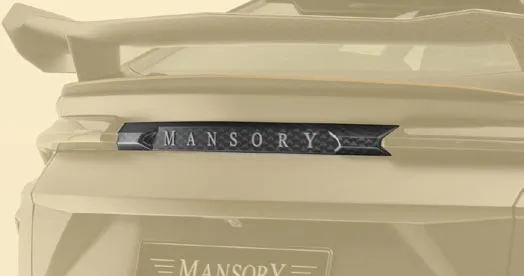
The rear hatch panel with silver Mansory wordmark closes the visual story of the Mansory Venatus carbon programme on the Lamborghini Urus, Urus S and Urus Performante. This is the full-width carbon plate that bridges the OEM tail-light cluster — laid across the boot line where the factory leaves a body-coloured trim strip — and it carries a silver-finish Mansory wordmark inset into the weave at dead centre. It is the silent visual sibling of the illuminated-logo variant: same panel geometry, same lacquered carbon body, but the wordmark is a milled-and-anodised silver inlay rather than an LED-backlit lens. Specified as part of the Mansory Body Kit for Lamborghini Urus Venatus S, it locks the rear elevation onto the same carbon vocabulary as the front bonnet, race-flaps and roof spoiler — twin-turbocharged V8, hexagonal Lambo DNA, Y-DRL up front and now a single uninterrupted carbon band across the back.
Construction & Materials
The panel is laid up in aerospace-grade prepreg over a CAD-milled tooling form taken directly from the OEM hatch-line of the post-facelift Urus S. Wall thickness is matched to the original trim it overlays so panel gaps stay OEM-tight, and the silver wordmark is recessed into the weave during layup so it sits flush — no proud pad, no glued-on badge.
- 3K twill-weave carbon fibre (2×2 satin) on the visible face, with a thin glass-tissue scrim on the bond face for primer adhesion and dimensional stability.
- Autoclave-cured prepreg, 6 bar / 125°C cycle, post-cured for resin glass-transition above 130°C — no soft spots in summer heat.
- Wall thickness 1.6–1.9 mm depending on zone; reinforcement ribs along the upper edge so the panel does not flex when the boot lid slams.
- Mansory deep-gloss lacquer with UV-blocking clear, hand-flatted and machine-polished to a piano finish that matches the front bonnet weave under the same light.
- Silver Mansory wordmark milled from solid aluminium billet, anodised type-II in a satin-silver tone tuned to read silver in daylight without going chrome under flashbulbs.
- Wordmark is recessed into the carbon during layup (not surface-bonded), then sealed at the perimeter with a black structural adhesive line that reads as a deliberate paint-break.
- Mounting hardware: pre-bonded steel clip-bosses at the OEM trim-strip locations, supplemented by 3M VHB 5952 acrylic foam tape around the perimeter for a continuous, water-tight bond.
- Net panel weight 0.9–1.1 kg — replacing a body-coloured plastic strip of similar mass; this is a styling part, not a weight-saving part.
Design & Visual Function
On the OEM Urus, the strip between the tail-lights is a body-coloured plastic trim — clean, but visually it splits the rear into left and right halves and breaks the carbon-and-metal vocabulary that Mansory establishes everywhere else on the car. This panel does the opposite job: it pulls the entire rear graphic into one uninterrupted carbon band, lets the OEM tail-light cluster sit as a pair of horizontal red bars against a black-weave canvas, and centres the silver Mansory wordmark on the visual axis. The wordmark is large enough to read from twenty metres but flush enough that it never competes with the tail-light signature.
The duo trade-off versus the illuminated-logo variant comes down to two questions: when do you want the car seen, and do you want to splice into the wiring loom? The illuminated-logo variant adds an LED-backlit Mansory wordmark wired to the OEM marker-light or DRL feed, so the wordmark glows whenever the parking lights are on — pure night theatre, valet-stand presence, hotel-forecourt reveal. The silver-logo panel here is the daytime-clean answer: showroom-static, photography-friendly, and zero electrical splice. Specify silver if the car lives mostly in daylight, if you want a calmer rear graphic, or if the build philosophy is ‘no harness modifications anywhere’; specify illuminated if the car is a night-driven event piece and the LED reveal is the whole point.
Visually, the silver wordmark also harmonises with the brushed-metal accents Lamborghini already uses on the Urus — door pulls, lower sill blades, exhaust-tip surround on certain trims — so the rear elevation does not pick up an extra colour. It reads as carbon and silver, period, against the OEM body colour. Under direct sun, the satin anodising kills hot-spot glare; under garage halogen, it deepens to a graphite-silver that pairs beautifully with the lacquered weave around it.
Compatibility & Fitment
Designed for the Lamborghini Urus, Urus S and Urus Performante (2018–present). The Venatus slug naming is generic across the line — these panels retrofit between pre-facelift and post-facelift cars because the OEM tail-light cluster geometry was carried over. The panel mounts over (or in place of) the factory trim strip between the tail-lights; the OEM tail-light units, rear camera, parking sensors, hatch-release button and emergency-release loop are all retained and unaffected. Adaptive air-suspension self-levelling, six driving-mode behaviour (Strada, Sport, Corsa, Sabbia, Terra, Neve), rear-wheel-steering geometry and the 8-speed ZF logic are untouched — this is a styling overlay on the bodywork, not a functional change. Cars optioned with the rear sport-exhaust four-tip layout fit without modification.
Installation & Reversibility
Allow 1–1.5 hours on a lift or with the boot lid fully raised. Workflow: remove the OEM trim strip (clipped, not bonded; six clips on the post-facelift Urus S, four on the pre-facelift Urus), degrease the substrate with isopropyl alcohol, dry-fit the carbon panel to confirm gap and parallelism with the tail-light upper edge, peel the 3M VHB liner in stages and press home from the centre outward to avoid trapping air. The pre-bonded clip-bosses index into the original trim-strip locations so alignment is automatic. No drilling. No cutting of the OEM panel. Crucially, no electrical splice — this is the key practical advantage over the illuminated variant, which needs a tap-in to the OEM marker-light feed and one to two extra hours of wiring time. Reversibility is high: if the panel is ever removed, the VHB releases with heat-gun and fishing-line technique, and the OEM trim strip can be re-clipped because the clip locations are unmodified. A Lamborghini-certified body shop or Mansory-trained installer is recommended for a perfect first-time fit, but the work itself is well within the comfort zone of any competent detailer.
Pairing within the Mansory Urus Venatus programme
The most natural pairing is the duo decision itself — silver-logo here versus the rear hatch panel with illuminated logo; specify one or the other depending on whether the car is a daytime showroom piece or a night-driven event car, and the rest of the rear elevation falls into place around that choice. From there, the panel slots into a coherent rear-end build with the rear decklid spoiler, which sits directly above this panel on the boot lid and shares the same lacquered weave so the carbon band reads as one continuous gesture from spoiler lip down to tail-light line. Owners chasing the full motorsport-derived rear silhouette add the performance wing EVO, which lifts the rear graphic into a three-tier composition — wing, hatch panel, splitter — and ties the back of the car to the front bonnet and race-flap programme up front.
Maintenance & Durability
Wash with pH-neutral shampoo only; the lacquered carbon hates alkaline cleaners, ammonia-based glass cleaners that drift onto the panel, and any abrasive sponge. A two-bucket wash with a soft microfibre mitt is the right protocol. The silver anodised wordmark tolerates the same chemistry as the carbon around it — do not use polishing compound on the wordmark itself, as it will dull the satin anodising and expose bare aluminium underneath. A six-monthly ceramic-coat top-up keeps water beading and protects the lacquer from UV-yellowing; carnauba is fine for purists but needs more frequent reapplication. Because the panel sits low and central, it sees less rock-chip exposure than a front bonnet — paint-protection film over carbon is not necessary here. Repair workflow if the lacquer ever chips: a Mansory-trained refinisher can spot-repair without replacing the whole panel, the silver wordmark unbolts from the back face for re-anodising or replacement, and the entire panel can be removed and re-bonded as a single unit if a tail-light is ever changed out under warranty.
Lead Time & Warranty
Lead time is 4–8 weeks from order confirmation, reflecting Mansory's bespoke production cycle — the wordmark is anodised in batches, and each panel is hand-flatted and polished individually before final QC. A 12-month warranty covers manufacturing defects in the layup, lacquer and wordmark anodising; cosmetic damage from impact, alkaline cleaners or aftermarket polishing compound is excluded as standard.
FAQ
Q: Silver-logo or illuminated-logo — which one should I order?
A: If the car is mostly seen in daylight, lives on showroom and concours rotation, or you want zero modifications to the OEM wiring loom, specify silver. If the car is a night-driven event piece — hotel forecourts, dinner valets, late-evening cruises — and the LED wordmark reveal is part of the theatre, specify illuminated. Both panels share the same carbon body and the same fitment.
Q: Does it fit the pre-facelift Urus, the Urus S and the Urus Performante?
A: Yes — all three. The OEM tail-light cluster geometry was carried over across the line, and the panel indexes into the factory trim-strip clip locations so alignment is identical. The slug uses the generic Venatus naming because Mansory parts retrofit across the Urus range.
Q: How long does fitment take, and do I need an electrical splice?
A: 1–1.5 hours, no electrical splice. That is the practical advantage over the illuminated variant, which needs an extra one to two hours to tap into the OEM marker-light or DRL feed. The silver-logo panel is pure mechanical fitment — clip locations plus 3M VHB perimeter bond.
Q: If I scratch the lacquer or chip the wordmark, can it be repaired?
A: Yes. The lacquered carbon can be spot-repaired by a Mansory-trained refinisher without replacing the whole panel; deeper damage is fixed by re-flatting and re-lacquering the affected zone. The silver wordmark is mechanically retained from the back face, so it can be unbolted, re-anodised, or replaced individually without touching the carbon body.
Q: Why silver instead of polished or chrome for the wordmark?
A: Satin anodising kills hot-spot glare under direct sun and reads as a calm graphite-silver under garage halogen, where polished metal would flare into the camera lens. It also harmonises with the brushed-metal accents Lamborghini already uses on the Urus — door pulls, lower sill blades, certain exhaust-tip surrounds — so the rear elevation reads as carbon-and-silver as a unified palette rather than carbon plus an extra colour.
Pair the silver-logo panel with the matching Mansory rear-decklid spoiler and performance wing EVO for a full carbon rear-end programme, then specify the front bonnet and race-flap variant of choice up front. WhatsApp +44 7488 818 747 or email [email protected] for spec sheets, lead times and the build matrix.