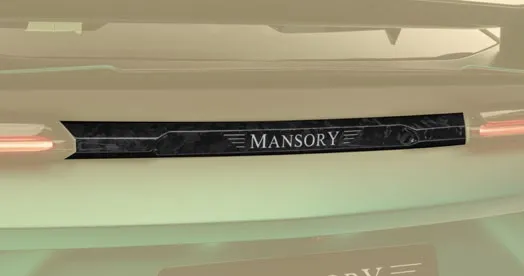
Rear hatch panel with illuminated logo Mansory for Lamborghini Urus Venatus


Rear Hatch Panel with Illuminated Logo — Mansory for Lamborghini Urus Venatus
The illuminated rear hatch panel is the night-theatre version of the Mansory Venatus tailgate signature — a carbon spine across the upper rear hatch of the Lamborghini Urus, with the Mansory wordmark cut as a translucent inlay and backlit by an integrated LED module. By day the panel reads as a calm carbon ribbon between the tail-light clusters; the moment the side-lights, DRL or running-light circuit comes alive at dusk, the wordmark glows from within the weave. Within the wider Mansory Body Kit for Lamborghini Urus Venatus S programme it sits as the deliberate alternative to the silent silver-logo panel — same shell, same fit, but a different evening personality on a 4.0-litre twin-turbo V8 super-SUV with Y-pattern DRL, hexagonal Lambo design DNA, 8-speed ZF transmission and rear-wheel-steering chassis.
Construction & Materials
The panel itself is the same coachbuilt carbon shell as the silver-logo version — what changes is the wordmark zone and the electrical pack hidden behind it. Underneath the visible weave the Mansory letters are routed through the substrate, fitted with a translucent diffuser, and lit from the rear by an LED strip module that bonds to the inside face of the panel. A short wiring harness exits the lower edge with a quick-connect splice ready for tap-in to a low-current OEM rear circuit.
- Shell weave: 3K twill prepreg over a structural mat, autoclave-cured, wall thickness 1.7–2.1 mm — identical to the silent twin so silhouette and gap geometry stay in sync.
- Lettering cut-out: CNC-routed Mansory wordmark on the centreline; back-filled with a milk-white polycarbonate diffuser bonded under the carbon to keep the day-time read clean.
- LED module: sealed strip in warm-white as standard (Mansory signature 3000–3500 K), low draw, total module <6 W; tuned to glow evenly across the wordmark without hotspots or shadow lines.
- Ingress protection: module and end-caps rated IP67 — sealed against pressure-wash, rain, snow, dust; suitable for the Urus’s mixed road / occasional gravel usage profile.
- Wiring harness: automotive-grade looms with a quick-connect tap-in connector, designed to splice into the OEM marker / running-light or licence-plate-light feed without cutting the OEM loom outright.
- Finish: Mansory deep-gloss UV-stable lacquer over the visible weave; satin or matt available on request as a bespoke option.
- Mounting: OEM-spec adhesive footprint plus reinforced clip points on the inner face — bonds to the upper hatch panel without drilling.
- Weight: ~480–560 g including LED hardware — a few tens of grams over the silent silver-logo panel, no chassis-relevant impact.
Design & Visual Function
The visual brief here is night theatre. During the day the illuminated panel is intentionally quiet — owners who want a louder day signature usually pair it with brighter trim elsewhere. At dusk, the moment the Urus turns on its side-lights or the Y-pattern DRL fires up, the Mansory wordmark wakes up from inside the weave. The diffuser is tuned to glow evenly across the entire word, with the carbon framing it; the effect is a warm-white horizontal bar of branding floating between the rear lights, level with the camera and the licence plate. It’s the rear-end equivalent of a coachbuilt nameplate that only appears when the lights are on.
Standard tone is warm-white to align with factory rear marker hues; on request the LED can be supplied in a signature colour, though warm-white default is cleanest across Urus body colours from Bianco Monocerus to Nero Noctis. Brightness is calibrated so the wordmark is unmistakable from twenty metres without competing with brake or fog functions — decorative running-light illumination, not a functional lamp.
The duo trade-off versus the silent silver-logo panel is straightforward. Silver-logo gives a confident day silhouette with no electrical splice, no harness, no power draw — ideal for owners who treat the Urus as a daytime presence car or simply do not want to add wiring to a fresh build. Illuminated-logo trades a small amount of installation complexity (one electrical tap-in) and a low-current draw whenever the running-lights are on for a piece of theatre nobody else can replicate — a coachbuilt wordmark glowing at dusk. LED life is rated at roughly 50,000 hours, effectively the rest of the car’s life.
Compatibility & Fitment
Compatible with Lamborghini Urus, Urus S and Urus Performante (2018–present), including the post-2022 facelift. The slug uses the generic Venatus naming because the panel retrofits across the line — pre- and post-facelift hatches share the relevant geometry. Mounting is over the OEM upper rear hatch panel; fixings respect the existing hatch structure, the rear camera lens, the licence-plate cavity and the OEM rear parking-sensor cluster — none of these are obstructed or relocated. Rear-wheel-steering geometry, adaptive air-suspension self-levelling and the six driving modes (Strada / Sport / Corsa / Sabbia / Terra / Neve) are completely unaffected by the panel; this is a body-side cosmetic with one electrical splice, not a chassis or aero part.
Electrically, the harness is engineered to splice into a low-current OEM rear feed — typically the marker / running-light circuit or the licence-plate-light feed — so the wordmark illuminates whenever the side-lights or DRL are active, and switches off with the rest of the running-light system. The exact tap-in point is selected by the installer based on the build year and market wiring, but in every case the splice is on a low-current line with no impact on CAN-bus diagnostics, no relay or controller required, and no warning light on the OEM cluster.
Installation & Reversibility
Installation runs roughly two to three hours for a competent technician — meaningfully longer than the silent silver-logo panel because of the wiring step. The shell itself bonds to the upper hatch with the same OEM-spec adhesive footprint and reinforced clip points as the silver-logo twin; the additional time is consumed entirely by the electrical splice, which involves locating the chosen donor circuit, routing the harness through the hatch interior, fitting the quick-connect tap-in, and verifying behaviour through ignition / side-light / DRL / brake-light cycles to confirm the wordmark only lights with the running-light circuit and remains independent of brake and fog functions.
For this reason the panel is a qualified-installer job — the bonding workflow alone is intermediate, but any electrical splice on a Lamborghini hatch should be routed through a Lamborghini-certified body shop or a Mansory-trained installer with Urus-loom experience. Reversibility is straightforward: the panel removes by reversing the bonding process and the harness can be unspliced and the donor circuit returned to its OEM state.
Pairing within the Mansory Urus Venatus programme
The most natural pairing is with its silent twin — buyers often look at both panels back-to-back to decide between night theatre and day silhouette, and a small number of build briefs even alternate them across two cars in the same garage. After that, the cluster is about coherent illuminated branding around the car.
- Rear hatch panel — silver logo — the silent twin: same shell, same fit, no electrical splice, brushed-metal Mansory wordmark for owners who want a louder day signature without LED wiring.
- Performance roof logo — pairs as part of an illuminated-branding cluster, balancing a glowing top-down signature against the glowing rear wordmark from above and behind.
- Rear decklid spoiler — completes the rear visual stack underneath the illuminated panel, with the carbon spoiler reading as the lower line and the glowing wordmark as the upper line.
Maintenance & Durability
Cosmetic maintenance follows standard lacquered-carbon care. Use pH-neutral shampoo, soft microfibre wash mitts and dedicated carbon-friendly drying towels. Avoid alkaline degreasers, ammonia-based glass cleaners, abrasive sponges and unsupervised rotary polishers — these kill UV-stable lacquer over carbon faster than anything else. A ceramic coating is the recommended long-term protection; carnauba waxes work but need frequent reapplication. Pressure-washing is fine — IP67 LED module, sealed bond line.
Electrically the LED hardware is service-light. Expected life is roughly 50,000 hours; on a typical owner duty cycle that is decades of theatre. Power draw at standstill is under 6 W with side-lights on, low enough to be a non-event for the OEM electrical budget — and the wordmark switches off with the running-light system, so there is no parasitic draw when the car is parked. If the panel ever chips or scuffs, repair workflow mirrors the silver-logo version, and the LED module is independently replaceable without rebuilding the shell.
Lead Time & Warranty
Lead time runs roughly four to eight weeks, which is normal for Mansory bespoke production — each panel is built to order with the LED pack bonded and tested before despatch. The unit ships with a 12-month manufacturer’s warranty against defects in materials and workmanship covering both the carbon shell and the LED hardware. Plan installation for a window after delivery so a Lamborghini-certified body shop or Mansory-trained installer can handle the splice in a single appointment.
FAQ
Q: Which OEM circuit does the wordmark tie into?
A: A low-current rear running-light feed — typically the marker / running-light circuit or the licence-plate-light line, selected by the installer based on build year and market loom. The wordmark switches on with the side-lights or DRL and switches off with them; it is not tied to the brake or fog circuits and does not behave as a functional lamp.
Q: How visible is the wordmark at night?
A: Designed to read clearly from twenty metres without dominating the rear lighting signature. Brightness is tuned to sit just above OEM marker-light intensity — unmistakably a Mansory wordmark, never competing with brake or fog functions, never dazzling traffic behind.
Q: What is the IP rating and is it safe to pressure-wash?
A: The LED module and end-caps are rated IP67. Pressure-washing the rear of the car is fine; the panel-to-hatch bond line is sealed and the harness exit is protected. Avoid pointing a high-pressure jet directly at the splice region inside the hatch during cabin cleaning.
Q: Does it fit pre-facelift Urus, Urus S and Urus Performante?
A: Yes — the slug uses generic Venatus naming because the panel retrofits across all three (Urus, Urus S and Urus Performante from 2018 onwards). Pre- and post-2022-facelift hatches share the relevant geometry.
Q: How long is the lead time?
A: About four to eight weeks for Mansory bespoke production. The build slot is confirmed at order; installation is then scheduled with a Lamborghini-certified body shop or Mansory-trained installer to handle the splice cleanly.
For the silent visual without an electrical splice, see the rear hatch panel with silver logo; for full programme assembly, return to the Mansory Body Kit for Lamborghini Urus Venatus S. To configure your build or talk through the duo trade-off, WhatsApp +44 7488 818 747 or email [email protected].