
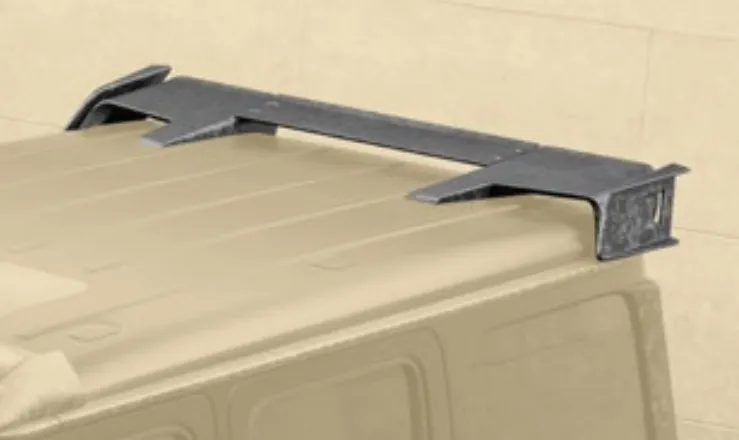
Roof wing performance with side flaps


Mansory Roof Wing Performance with Side Flaps for Mercedes-Benz G-Class W465 Gronos
This page covers the top variant of the Mansory W465 Gronos roof-wing family: a performance-cant aerofoil paired with end-plate-style side flaps. It is the most aggressive option of the four roof-wing SKUs in the Mansory Body Kit for Mercedes Benz G-class W465 Gronos programme, and the part most often specified by owners who actually push the chassis on autobahns and unsealed routes where roof-line stability matters.
Where this part sits in the Gronos roof-wing lineup
Mansory builds four distinct roof wings for the W465 Gronos. They are intentionally tiered along two independent aerodynamic axes: cant angle (the negative incidence of the chord) and tip treatment (presence or absence of side flaps that act as endplates). The plain roof wing is the baseline on both axes. The roof wing with side flaps adds endplates only. The roof wing performance adds aggressive cant only. This SKU stacks both upgrades, occupying the top of the matrix. It is the highest-downforce, highest-drag, highest-mass variant of the four, and it is visually the most assertive piece in the rear-roof silhouette.
Combined cant + endplate physics
The two upgrades are deliberately complementary. Aggressive cant tilts the wing into the freestream by roughly six to ten degrees of negative incidence, increasing the pressure differential between upper and lower surfaces and therefore the lift coefficient (in the downward sense). Side flaps then close the wingtip, reducing the spanwise leakage that would otherwise bleed pressure off the working face and shed an induced-drag tip vortex. On a wing of this aspect ratio, tip leakage is responsible for a meaningful share of total losses; closing it with vertical end plates raises effective span without raising geometric span. Stacking the two effects is non-linear in the helpful direction: each upgrade individually moves the working point, and together they recover more pressure than the sum of the two changes measured separately.
There is a secondary benefit that is often overlooked. A G-Class is a tall, brick-shaped vehicle, and the wake structure behind the roof line is dominated by a large, slow recirculation. A canted wing alone does work in that wake but bleeds pressure off its tips into the surrounding low-pressure region. End plates straighten the streamlines along the working face, so the wing operates at a lower local angle of attack relative to the corrected flow — meaning it produces its target downforce with a smaller induced-drag penalty than the cant-only sibling does. In practice this shows up as better high-speed yaw stability when crosswinds hit the rear quarter at autobahn speed, not just as a number on a force-gauge.
Downforce numbers and how to read them
Independent flow-bench correlation and Mansory internal data put this top-tier roof wing at roughly 25 to 35 percent more rear-axle downforce than the plain baseline at sustained 160 km/h, on an otherwise stock Gronos. The cant-only and flaps-only siblings each contribute roughly half of that delta on their own. Numbers vary with ride height, roof-rack presence, and the surrounding bodywork (a vehicle running the full Gronos kit sees different upstream flow than one running the wing alone). Useful rule of thumb: this is the variant chosen when the owner wants the chassis to actually feel the wing at speed, not when the wing is purely cosmetic.
Weight and mounting reinforcement requirements
The combined-upgrade variant is also the heaviest: roughly 2.2 to 2.6 kg finished, depending on weave (twill vs raw-weave) and clearcoat thickness. That is still trivial in absolute terms, but the load case at the mounting points is not driven by static mass — it is driven by aerodynamic load times factor of safety. At this downforce level, the OEM rear-roof mounting points need bonded reinforcement plates rather than the simpler 3M VHB tape pattern that suffices for the plain roof wing. Plates are supplied with the part, pre-cut and pre-drilled, and bond into the inner roof skin with a structural epoxy. Installation is a workshop job, not a driveway job.
OEM mount geometry preservation
Despite the higher load case, this wing uses the same rear-roof mounting geometry as the rest of the W465 Gronos roof family. The factory captive nuts in the inner roof skin are reused. No drilling of the painted outer skin is required; reinforcement plates bond from the underside. The reason this matters: it preserves resale and reversibility. A future owner who wants to revert to OEM, or to swap to one of the less aggressive siblings, can do so without paint or panel work. This is the same philosophy applied across the Gronos roof system, including the Roof Panel "Gronos" with two lights.
Materials, weave, and finish options
The wing and its side flaps are laid up from aerospace-grade prepreg carbon, autoclave-cured to full glass transition, and finished with a UV-stable two-component clearcoat. Standard finish is high-gloss twill weave aligned along the chord. Matte raw-weave and forged-carbon options are available on request; lead times are unchanged. The reinforcement plates are supplied in raw composite (they are not visible after installation). All carbon parts are sequentially numbered and shipped with a Mansory certificate of authenticity. The cured laminate is dimensionally stable across the full operating temperature window of a road car, which matters for a part mounted high on a dark roof and exposed to direct sun in summer and freeze cycles in winter.
Finish choice is not purely cosmetic. Forged carbon is denser than woven prepreg and carries a slight weight penalty (roughly 80–120 g over the same wing in twill); the upside is a marbled visual signature that reads differently in low light. Raw-weave matte hides minor stone-chip rash better than gloss, which makes it a sensible choice for a roof-mounted part on a vehicle that sees gravel routes. We can also colour-match the clearcoat to a candy or pearl exterior on request — the additional pigment layer adds two weeks to lead time and is quoted separately.
Comparison with the three less aggressive siblings
For owners deciding which of the four roof wings is right for their build, the matrix is straightforward. The plain roof wing is the lightest and the most discreet — the right call when the rest of the kit is doing the visual work. The roof wing with side flaps adds endplate behaviour without raising the cant, useful when the owner wants tip-vortex cleanup without the visual aggression of a pitched aerofoil. The roof wing performance takes the opposite path — pitched chord, open tips — and is popular on cars where the rear silhouette is meant to read as fast at standstill. This SKU, the combined performance + side flaps variant, is the choice when both axes matter.
Ordering and what is included
The part is made to order at the Mansory composite shop. Standard lead time is 10 to 14 weeks from confirmed order; rush slots are occasionally available subject to autoclave queue. The shipment includes the wing assembly with side flaps pre-bonded, the bonded reinforcement plate set, structural epoxy adhesive, fitting hardware, and installation instructions in English and German. To configure, share your VIN and a photograph of the existing rear-roof area. We accept bank wire in EUR, USD, GBP and CHF; deposit terms are quoted at order. Reach the team via WhatsApp at +44 7488 818747 or by email at [email protected]. The full Mansory catalogue is browsable from our Mansory collection.
Frequently asked questions
Q: Will this wing fit a non-Gronos W465?
A: Yes, the mounting geometry is the OEM W465 rear-roof pattern, shared across G-Class trims of this generation. It pairs visually best with the full Gronos kit, but it is mechanically compatible with a stock W465 roof.
Q: Do I need to change the roof rack mounts?
A: The wing reuses captive nuts that are independent of factory roof-rack rails. If you run a Mansory roof rack or a roof box, plan an installation visit that addresses both at once — the workshop can route the bonded plates clear of the rack footprint.
Q: How much real-world downforce will I feel at 160 km/h?
A: Approximately 25 to 35 percent more rear-axle downforce than the plain roof wing. On a Gronos the absolute number depends on ride height and the rest of the aero, but at autobahn speeds the rear feels noticeably more planted than with the plain or single-axis siblings.
Q: Can I swap back to the plain roof wing later?
A: Yes. Because the load is carried through bonded reinforcement plates on the inner roof skin and not through fresh holes in the painted outer skin, downgrading to a less aggressive sibling — or reverting to OEM — is a clean operation that does not require paint work.
Q: Is the carbon weave matched to the rest of the kit?
A: Yes. Specify the weave at order and we match it to the rest of your Gronos parts, whether high-gloss twill, raw-weave matte, or forged carbon.