
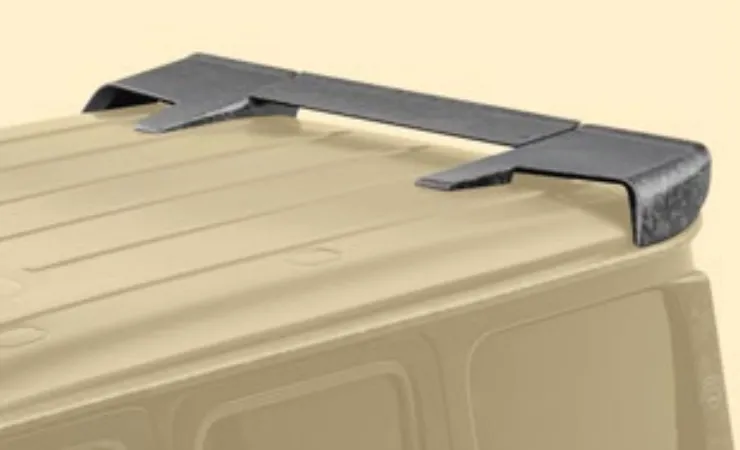
Roof wing performance


Mansory Roof Wing Performance for Mercedes-Benz G-Class W465 Gronos
The roof wing is the most visually loud and aerodynamically active piece of the Mansory Gronos kit for the new W465 generation Mercedes-Benz G-Class. Within that family, the Performance variant is not a cosmetic relabel — it is a re-shaped wing with a deeper chord and a more aggressive negative cant angle, designed for owners who actually load the chassis at speed. If you spend real time above 150 km/h on the autobahn, on closed courses, or pushing the box on a track day, this is the wing the Mansory engineering team builds for that brief.
This part belongs to the parent build Mansory Body Kit for Mercedes Benz G-class W465 Gronos and is part of the wider Mansory tuning collection at hodoor.world. Below is a deep dive into why the geometry matters, how it is laid up, who actually benefits from it, and how it compares against the three sibling roof-wing variants for the same kit.
Cant Angle: Why Negative Incidence Changes the Car
The cant angle, sometimes called angle of attack or angle of incidence, is the rotation of the wing element around its lateral axis. The baseline Mansory roof wing for the W465 Gronos sits at a moderate cant of roughly 2–4° negative — a setting that keeps drag low, gives a clean visual, and trims a bit of rear-end lift at motorway cruising speeds. The Performance variant rotates that element down to roughly 6–10° of negative incidence.
That shift sounds small in degrees but the aerodynamic consequence is large. Downforce on a finite-span wing scales with the lift coefficient, which itself rises non-linearly with angle of attack right up to stall. Doubling the cant angle in this range typically more than doubles the vertical force generated at a given speed. On a tall, blunt vehicle like the G-Class — which already fights significant rear-end lift because of its boxy aft and near-vertical tailgate — that extra rear axle load is what stabilises the car at the kind of speeds owners of a Gronos are not just capable of, but tempted to use.
Chord Depth and the Downforce Coefficient
Chord is the front-to-back depth of the wing profile. The Performance roof wing carries a noticeably deeper chord than the baseline part. A larger chord means a longer pressure-recovery surface on the underside of the wing, which is where downforce is generated, and it increases the planform area exposed to the airstream.
In practical terms the Performance wing produces a higher peak CL (lift coefficient, here used as downforce coefficient with sign reversed) for the same dynamic pressure. Combined with the steeper cant, the result is rear-axle downforce that stays useful even when crosswinds and yaw upset the airflow over the roof. On a stock-cant wing, those same conditions can sometimes leave you with little more than a styling element.
Drag-vs-Downforce Trade-off (Be Honest About It)
There is no free aerodynamic lunch. The Performance wing trades a measurable but modest drag penalty for its downforce gain. Because the W465 G-Class is already not a drag-coefficient champion — the body is essentially a brick — the relative penalty of running a deeper, more canted wing is small as a percentage of total drag. You will feel it as a marginal reduction in coast-down distance and a tiny bump in autobahn fuel consumption at sustained 200+ km/h. You will feel the downforce gain a great deal more, in the form of a rear axle that no longer goes light on long crests.
Who Actually Benefits From the Performance Variant
This is the wing for the high-speed regular user. If your car spends most of its life crawling through cities at 30 km/h and the occasional weekend cruise, the visual difference is real but the aerodynamic difference is not something you will ever feel — the baseline roof wing is enough. The Performance wing earns its keep when:
- You routinely run unrestricted autobahn sections above 150 km/h.
- You take the G-Class to track days or driver-training events on closed courses.
- You drive long, fast, sweeping mountain passes where rear-axle planting genuinely changes the car’s behaviour in transitions.
- You want the visual statement of a more aggressive cant angle and a deeper wing element, regardless of speed.
Carbon Layup and Construction
The wing is built from autoclave-cured pre-preg carbon fibre, with a structural inner skeleton bonded into the wing element to handle the much higher peak loads the Performance geometry generates compared with the baseline part. Because aerodynamic load scales with the square of velocity, a wing producing roughly twice the downforce at 200 km/h sees four times the load at 250 km/h — the laminate schedule is specified accordingly. Surface finish is the same Mansory pre-preg twill the rest of the kit uses, with a clear UV-stable lacquer for outdoor durability.
Mounting and Fitment
The Performance wing uses the same pair of structural mounting points as the other Gronos roof wings, bonded and through-fixed to the OEM roof skin reinforcement zone. Crucially, the higher loads of this variant mean torque values for the mounting hardware are higher than for the baseline wing, and the bonding chemistry is specified for the additional shear. Installation is for an experienced Mansory or premium-bodywork shop. We supply the part, mounting kit, torque values, and detailed fitment notes; we do not recommend a driveway install.
Comparison vs Sibling Wing Variants
The W465 Gronos kit offers four roof-wing options. Choosing between them is mostly a question of how aggressive the aerodynamics need to be and whether you want side flaps:
- Roof wing — baseline cant (~2–4°), no side flaps. Visual upgrade, mild rear-lift trim. The default choice for city/cruise use.
- Roof wing with side flaps — baseline cant plus side flaps that add rear-quarter visual width and a small contribution to airflow attachment. Good for owners who want the look of a more elaborate aero package without the high-speed brief.
- Roof wing performance (this product) — aggressive cant (~6–10°), deeper chord, no side flaps. The high-speed downforce option. Trades a small drag penalty for real measurable rear-axle planting at speed.
- Roof wing performance with side flaps — top-tier: aggressive Performance geometry plus the side flaps. Maximum visual statement and aerodynamic effect. Pick this if you want everything and accept the largest drag penalty of the four.
If you are matching the wing to the Mansory Roof panel with 6 lights for a full overland-meets-circuit silhouette, the Performance wing is the variant that visually balances the depth of that lit roof panel best.
Ordering and Lead Time
Every Mansory Performance roof wing is laid up to order. Standard lead time is 10–14 weeks from confirmed order and deposit. Pricing is in EUR and depends on finish (clear lacquer, body-colour, or visible carbon twill) and on whether you order it with a paired set of side flaps later. Worldwide shipping is available. To confirm specification, finish, and current production slot:
- WhatsApp: +44 7488 818747
- Email: [email protected]
Quote the parent kit — Mansory Body Kit for Mercedes-Benz G-Class W465 Gronos — and the part name (Roof wing performance) when reaching out. We will confirm a build slot, finish options, and shipping in one reply.
FAQ
Q: How is this different from the standard Mansory roof wing?
A: The Performance variant has a deeper chord and a steeper negative cant angle (~6–10° versus ~2–4°). It is engineered to generate real downforce above 150 km/h instead of being primarily a styling element.
Q: Will I notice the downforce in normal driving?
A: At urban and back-road speeds, no — visible aerodynamic effect on a wing only becomes meaningful as dynamic pressure builds. You will start to feel rear-axle planting on unrestricted autobahn pulls and on long, fast sweeping curves. Below ~120 km/h the experience is dominated by chassis tune, not by the wing.
Q: Does the Performance wing affect fuel economy?
A: There is a small drag penalty compared with the baseline wing, in the order of a couple of percent of total drag at high cruise speeds. On a vehicle with the frontal area of a G-Class it is essentially noise in your day-to-day fuel use.
Q: Can I add side flaps to this wing later?
A: The Performance wing is designed without side flaps. If you want the side-flap geometry combined with the Performance cant and chord, order the Roof wing performance with side flaps directly — retrofitting flaps onto the Performance base is not supported because of mounting differences.
Q: Is the wing structurally rated for sustained high speed?
A: Yes. The Performance wing uses a heavier laminate schedule and reinforced bonding to handle the higher aerodynamic loads its geometry generates. Mansory engineers the part for sustained autobahn use and trackday cycling.