
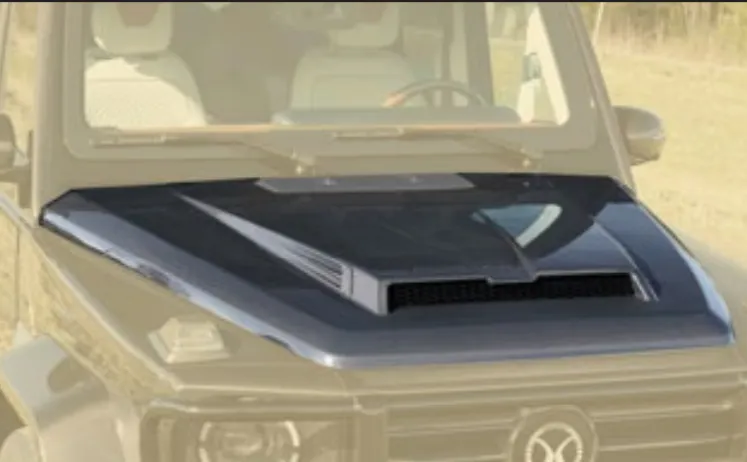
Engine bonnet II


Engine Bonnet II — Thermal-Vented Carbon Hood for Mercedes-Benz G-Class W465 Gronos
The W465 Gronos hood family is built around three philosophies. The Performance engine bonnet trades function for a clean uninterrupted skin; the Engine Bonnet IV chases minimum mass and surface aerodynamics with vortex strakes. Bonnet II occupies the middle ground that neither of those addresses: a visible-carbon panel engineered specifically around heat extraction. If your G63 carries a stage-2 calibration, an upgraded turbo cartridge, a larger intercooler, or simply lives in a warm-climate driving cycle, Bonnet II is the only hood in the W465 Gronos catalogue designed to push that thermal load out of the bay before it reaches the intake charge, the wiring loom, or the brake-fluid reservoir.
Why a Vented Hood Matters on a Stage-Tuned M177
The 4.0 L M177 V8 in the G63 produces meaningful underbonnet heat even in stock form. After tuning, the picture changes sharply. Typical surface readings on a warmed-up car after a fifteen-minute moderate run:
- Turbo housings: 480–620 °C internally, with external shell and heat-shield surfaces holding 280–360 °C.
- Exhaust manifold studs: 320–410 °C radiating into the V-bank space.
- Air-to-air intercooler outlet pipework: 80–120 °C after a single hard pull, climbing further with consecutive runs.
- Cabin-side firewall: 55–75 °C, the boundary that determines HVAC system load.
None of this is unusual — what is unusual is that the OEM aluminium hood is essentially a sealed lid that traps a stagnation pocket of hot air directly above the intake plenum. Bonnet II breaks that seal in the right place.
The Real Aerodynamic Trick: Outlet Placement, Not Inlet Pressure
A common misconception is that a vented hood works by forcing high-pressure air down into the engine bay. On a vehicle of this height and frontal area, stagnation pressure on the upper hood surface is modest — and trying to ram-feed cooler air through bonnet openings rarely produces the result owners imagine. The mechanism that genuinely matters is the opposite: low-pressure outlet extraction. Air accelerating over the curvature of the hood produces a localised low-pressure region (a Bernoulli effect over a convex surface). If the louvre outlets are positioned where that low-pressure region is most stable across the speed envelope, the engine bay experiences a continuous suction that pulls hot air upward and out. Bonnet II's vent geometry is laid out around this principle — the louvres are placed downstream of the hood crown, not at the leading edge.
Vent Geometry: Slots over Scoops
Mansory chose horizontal louvre slots rather than open scoops for several reasons that go beyond appearance:
- Water management. Angled louvre blades shed rain and washwater outward and downward instead of letting it pool inside the bay.
- Debris rejection. The slot pitch (approximately 12–14 mm between blades) and blade overlap deflect leaves, road grit, and stones from entering the engine compartment.
- Boundary-layer alignment. Slots that run with the local flow direction extract more efficiently per unit aperture than scoops that interrupt the flow.
- Visual coherence. The horizontal blade pattern echoes the W465 grille treatment and the side air-intake module on the wide front mask, creating a unified language across the front fascia.
Layup, Cure, and Why the Carbon Looks the Way It Does
Bonnet II is built using the same composite discipline as the rest of the Mansory hood programme:
- Visible face: 200 g/m² 2×2 twill prepreg, oriented to keep the weave pattern continuous across the louvre lip and around the centre crown.
- Structural plies: unidirectional reinforcements along the perimeter, hinge mounts, and latch beam — load paths that need stiffness rather than visual character.
- Cure cycle: autoclave consolidation at approximately 130 °C, 6 bar, vacuum-bag debulked, void content held below 1.5 %.
- Local reinforcement around vent apertures: additional bias-ply layers framing each louvre opening to prevent stress-raiser cracking at the slot corners over thermal-cycling life.
The result is a panel that handles the temperature gradient between a sun-soaked outer skin and a turbo-radiated inner face without distortion or surface print-through.
Weight: The Middle Ground, on Purpose
Where the Performance bonnet sits at roughly 5.5–7 kg as a finished panel and Bonnet IV trims that to 3.2–3.5 kg through honeycomb coring and aggressive thinning, Bonnet II finishes at approximately 6–7 kg. That is intentional. The vent apertures remove material, but the surrounding reinforcement frames and the louvre blades themselves add it back. Compared to the OEM aluminium lid (12–16 kg depending on year and trim), the saving is still 5–10 kg removed from the front overhang — meaningful on a chassis where pitch-axis inertia is the dominant ride-quality lever.
Fitment and OEM Hinge Compatibility
Bonnet II is a direct replacement for the factory hood. It bolts to the OEM hinge geometry, accepts the OEM latch and safety-catch hardware, and routes the washer-jet feed through the same passage as stock. Installation calls for:
- Removal of the original hood, transfer of underbonnet sound deadening (or replacement with a Mansory thermal liner sized for vented panels).
- Reattachment of hinges with anti-vibration washers; torque to factory specification.
- Gap setting at three boundaries — front 3.5–4.5 mm to the mask, sides 3–4 mm to the fenders, rear 4–5 mm to the cowl.
- Verification that the louvre band sits parallel to the cowl line within ±1 mm across the width.
Plan on roughly 2 hours for a workshop familiar with composite panels. The hood interface is identical between the Basic and Wide body specifications, so no body-width audit is required before ordering.
Finish Options
- Visible 2×2 twill, gloss clear-coat: the canonical Mansory carbon look, weave pattern reading clearly under direct light.
- Visible 2×2 twill, satin clear-coat: lower glare, easier to keep clean, popular on darker base colours.
- Forged carbon (raw chopped-strand): Mansory's signature marbled pattern, no two panels identical.
- Body-colour: primed shell painted to factory or bespoke code, vent louvres highlighted in contrast carbon if specified.
Bonnet II vs Performance Bonnet vs Bonnet IV — Which One Fits
- Performance engine bonnet — choose if you run a stock or lightly mapped car, prefer an unbroken hood surface, and want the simplest visual upgrade.
- Bonnet II (this panel) — choose if your car is stage-tuned, runs a hotter-than-stock turbo or intercooler package, sees long highway pulls, or simply lives in a hot climate. The only hood that solves heat soak.
- Bonnet IV — choose if outright weight reduction and surface aerodynamics are the priority, with rear-edge slot extraction handling thermal load at speed. Race brief, not daily-driver brief.
Frequently Asked Questions
Q: Does Bonnet II need any ECU calibration changes after fitting?
A: No. The hood is a passive panel — no sensors, no actuators, no interface with the vehicle electronics. Tuning is independent and remains as you have it.
Q: Will rain or carwash water enter the engine bay through the louvres?
A: The louvre blades are angled outward and slightly downward, with overlap between adjacent slats. Standard rainfall and brush-style carwash exposure shed externally. High-pressure jet washing aimed directly into the slots from underneath is not recommended — the Mansory thermal liner under the panel handles incidental moisture, but pressure-washing into the apertures should be avoided.
Q: How much heat does the panel actually pull out compared to the closed Performance bonnet?
A: On Mansory's bench data, post-shutdown heat-soak peak in the intake manifold region drops by 12–18 °C versus a sealed hood, and the soak persists for a noticeably shorter window. Under continuous high-speed driving the difference is smaller in absolute terms but more consistent — the suction is steady at speed.
Q: Can I retrofit Bonnet II later if I currently run the Performance bonnet?
A: Yes. Both panels share the same hinge interface and latch geometry. The change-over is a two-hour swap and does not touch any other body component, so upgrading from Performance to II as your build evolves is straightforward.
Q: Does the louvre band affect rear-spoiler or roof-wing flow?
A: Marginally. The louvres sit far enough downstream of the hood crown that the flow continues to attach across the cowl and up the windshield as it would on a closed hood. Owners running the Mansory roof wing have not reported any change in wing effectiveness after the swap.
Ordering and Lead Time
Each Bonnet II is laid up to order. Lead time runs 10–14 weeks from finish-spec confirmation to crate-out. Pricing depends on the chosen finish and any contrasting treatment of the louvre frames. Hodoor handles worldwide freight in carbon-safe crating with desiccant pads and edge-foam protection.
Cross-references in the same kit you may want to consider together: the matching carbon engine cover for the M177 complements a vented hood by reducing radiant heat from the V-bank, and the wide front mask with side air intakes feeds additional cool air into the bay at the inlet side, balancing the extraction Bonnet II provides on the outlet side.
WhatsApp: +44 7488 818 747 — finish selection, fitment confirmation by VIN, lead-time slot booking.
Email: [email protected] — written quotes, freight options, bundle pricing.
Parent kit reference: Mansory Body Kit for Mercedes-Benz G-Class W465 Gronos. Full Mansory G-Class catalogue: Mansory collection.