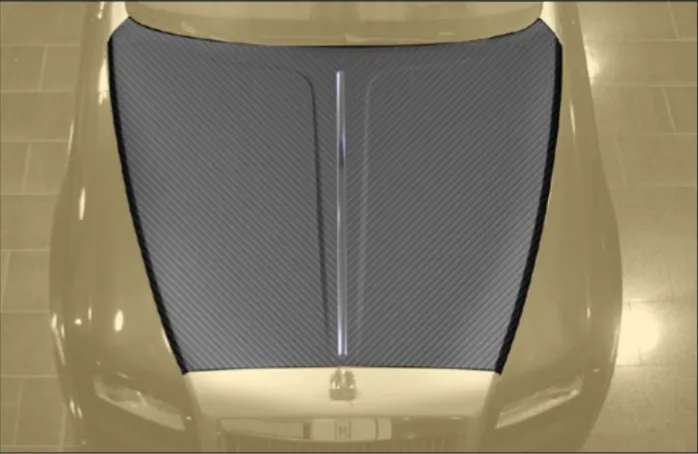
Engine bonnet with bar exposed Mansory Carbon for Rolls-Royce Dawn


Engine Bonnet with Bar (Exposed Weave) — Mansory Carbon for Rolls-Royce Dawn
This is the exposed-weave sibling to Mansory's lacquered carbon engine bonnet for the Rolls-Royce Dawn — same coachbuilt panel, same central longitudinal bar bisecting the deck, same twin-turbo V12 thermal-management brief, but with the 3K twill left visibly on display under a UV-stable clear coat only. No opaque pigment, no colour break, no body-matched paint — the carbon is the finish. It is part of the wider Mansory Body Kit for Rolls-Royce Dawn programme and is intended for owners who want the weave to read as the design language of the car: drophead silhouette, Spirit of Ecstasy still presiding, but the bonnet between the cabin and the boot lid now speaks raw composite rather than coachwork colour. Because the Dawn is convertible-only, that bonnet is exposed to direct overhead sunlight every time the soft top is stowed — which is precisely why this variant is engineered around UV stability rather than aesthetic lacquer alone.
Construction & Materials
The shell is laid up identically to the lacquered variant — that is non-negotiable for fitment and for crash-pulse compatibility with the soft-top mechanism behind it — but the surface treatment is the divergence point. After demoulding from the autoclave the panel is sanded, vacuum-degassed and finished with a marine-grade UV-stable clear coat in two thin coats, polished between passes. There is no tinted lacquer, no flatting compound that would flatten the weave's depth. What you see is the actual top ply of 3K twill: 2/2 herringbone, oriented and indexed so the diagonal flows from the windscreen base toward the boot lid in a continuous run, with the central bar's weave running parallel to the bar's longitudinal axis rather than fighting it.
- Top ply: 3K twill, 2/2 herringbone, 200 gsm, hand-indexed for diagonal continuity across the full deck and the bar
- Substructure: 4–5 plies of biaxial woven carbon plus a foam core in the central bar for torsional stability
- Cure: full autoclave at ~120 °C and ~6 bar — prepreg, no wet-layup, no resin pooling under the clear coat
- Surface: UV-stable two-component aerospace clear coat, hand-polished, no opaque pigment, no flatting agent
- Wall thickness: ~2.4–3.0 mm in the deck, ~5–7 mm at the bar's reinforced spine
- Weight: roughly 35–40 % below the OEM steel/aluminium bonnet assembly the panel replaces
- Hardware: marine-grade stainless hinges, OEM-pattern strut sockets, factory-routed pop-up actuator threads
- Finish option excluded by design: any tint, any candy, any body-colour wrap — that is the lacquered card's territory
Design & Visual Function
The lacquered variant is about restraint; this panel is the opposite proposition — the weave is the surface. From three metres away in low sun, a tinted lacquered carbon bonnet reads as a glossy panel with a faint texture; this exposed-weave panel reads first as carbon, second as a Rolls-Royce. Owners who specify it tend toward darker coachwork (Diamond Black, Burnout Grey, Smokey Quartz) where the weave's anthracite tone integrates, or deliberately against a pale body — Arctic White, English White — where the bonnet becomes the visual centre of the car when the soft top is folded down.
The central bar matters more here than on the lacquered card. With lacquer the bar reads as a sculpted ridge; with raw weave the bar reads as a different weave geometry, its parallel diagonals against the deck's diagonals creating a herringbone-meets-spine effect that only carbon can do. Mansory hand-indexes this transition in the mould; cheaper exposed-weave panels betray themselves at exactly this junction with a kinked or mirrored weave.
Against the Pantheon grille's verticals, the diagonal weave creates the deliberate tension Mansory carries through the rest of the Dawn programme. Spirit of Ecstasy still rises against a glossy clear surface, just one that happens to be transparent. Under direct sun, the weave shows micro-iridescence the lacquered variant cannot reproduce — that is the look an owner is buying.
Compatibility & Fitment
Rolls-Royce Dawn (2015–2023, all variants including Black Badge), drophead convertible only — the only Dawn body style that exists. The panel retains every OEM interface: bonnet pop-up pyro actuators, the ambient illuminated pinstripe channel along the centreline (which can be retained, deleted or rerouted as a customer option at order), Spirit of Ecstasy mast and retraction motor, hinge geometry and gas-strut mounts, washer-jet feeds and bonnet-closure micro-switches. The panel does not foul the soft-top stowage path because the soft-top stows behind the cabin, not under the bonnet — but the front edge geometry is Dawn-specific and this panel is not a Wraith fit even though the cars share underpinnings; Wraith has a fixed roof and a different front-deck pressing.
Installation & Reversibility
Plan on 4–6 hours with two technicians at a Rolls-Royce-certified body shop or Mansory-trained installer. The panel is OEM-interface — every mount point is a factory point — so no drilling, no panel cutting, no adhesive on body steel. Procedure is OEM bonnet removal, transfer of hinges and pyro actuators with new fasteners, seating onto the hinges, alignment with the cowl and front fenders to factory shut-line tolerance, gas-strut transfer, micro-switch verification, ambient pinstripe reconnection if retained, and a closure-cycle test with the soft top both raised and stowed. Reversibility is full: keep the OEM bonnet in climate-controlled storage. Because there is no paint involved, the longest sub-task of the lacquered install — paint prep and bake — drops out entirely.
Pairing within the Mansory Dawn programme
The first pairing decision is the lacquered-versus-exposed call itself. The direct sibling is the body-matched version: Engine Bonnet with Bar (Mansory Carbon). Lacquered preserves the coachbuilt continuity of body colour from fender to bonnet to boot; exposed weave breaks that continuity deliberately and makes the bonnet a feature panel. There is a wrong combination — exposed weave bonnet against fully lacquered body-matched fenders reads as an island of raw carbon. Commit to a programme.
Visually, the exposed-weave bonnet wants to be pinned to other exposed-weave high-points. Forward in the driver's eyeline, the Mirror Housing with Indicator Flasher in matched UV-clear weave continues the surface. Aft of the windscreen, the A-Pillar Cover bridges between the bonnet's diagonal weave and the stowed soft-top fabric — without it, the transition reads abrupt. Forward of the grille, the Front Grill Frame in matched exposed weave bookends the Pantheon graphic. Two mirrors, two A-pillars, one grille frame, one bonnet — the smallest credible exposed-weave programme around the cabin.
Maintenance & Durability
This is the section where the exposed-weave card diverges most sharply from the lacquered one. The Dawn is a drophead — the bonnet sees direct overhead sun every time the soft top is stowed, every kilometre of every top-down drive. Generic carbon clear coats yellow under that exposure within 18–24 months; a yellowed clear over raw weave is unrecoverable without sanding back and re-clearing the entire panel. Mansory specifies an aerospace-grade two-component UV-stable clear coat for exactly this reason — it carries an HALS (hindered amine light stabilizer) package and a UV absorber that hold the optical water-clear state for 8–10 years of normal exposure with sane care.
Sane care on a Dawn means a ceramic coating layered over the clear coat within the first month of delivery. A 9H SiO2 or SiC ceramic adds a sacrificial UV-blocking and hydrophobic layer above the manufacturer's clear — it is not a substitute for the clear, it is the topcoat that takes bird-strike, bug-acid and road-tar attack first. Carnauba wax is fine as a top-up between ceramic services but is not a substitute. Reapply ceramic every 18–24 months by appointment with a detailer who has worked on raw carbon, not just on lacquered paint — polishing tolerances are different.
What kills exposed-weave panels: alkaline wheel cleaners drifting onto the bonnet edge, ammonia glass cleaners migrating through cloths, abrasive sponges, automated tunnel washes with hard brushes, and bird droppings left more than an hour in summer sun. Hand wash with pH-neutral shampoo, two-bucket method, microfibre only. If a chip occurs, the panel can be locally re-cleared by a Mansory-trained finisher; whole-panel re-clear is a 1–2 day shop job.
Weave alignment matters because, unlike on a lacquered panel, you can see the diagonal flow — if the diagonals are off, you will see it in every photograph. Mansory mould tolerance on hand-indexed twill is checked against a registration jig at three points across the deck. That is what you are paying for, and why this panel exists as a programme part rather than a generic carbon bonnet.
Lead Time & Warranty
4–8 weeks bespoke production at Mansory's Brand, Bavaria facility, including the autoclave cycle, hand surface finishing, UV-clear application and weave-alignment QC. Twelve-month manufacturing-defect warranty covering substructure delamination, hardware integrity and clear-coat adhesion under normal exposure conditions. The warranty does not cover ceramic-coat wear (consumable) or impact damage from road debris, and it specifically excludes panels exposed to alkaline cleaners or automated brush washes — keep your wash receipts if a claim ever comes up.
FAQ
Q: Will the raw weave yellow on a Dawn that lives top-down in summer?
A: Not within the warranty period if the UV-stable clear coat is preserved by a ceramic topcoat reapplied every 18–24 months. The Mansory clear is HALS-stabilized aerospace-grade specifically for this exposure case. Yellowing is a clear-coat failure, not a weave failure, and it is preventable.
Q: Can I switch from exposed to lacquered later, or vice versa?
A: You cannot lacquer over an existing UV clear without sanding the panel back to bare weave and recoating — it is a full refinish, roughly equivalent to ordering a new lacquered panel. Decide before order.
Q: Will the exposed bonnet look right with chrome Spirit of Ecstasy and chrome grille surrounds?
A: Yes. The anthracite weave reads as a deliberate counterpoint to chrome — Mansory's design language relies on that contrast. Gold or rose-gold mascot details against cool anthracite carbon read even stronger.
Q: Is this a fit for the Wraith?
A: No. Despite shared underpinnings, the Wraith has a fixed roof and a different front bonnet pressing — pop-up actuator geometry, hinge spacing and front-edge curvature all differ. Dawn-specific.
Q: Does the ambient illuminated pinstripe still work?
A: Yes if specified at order. The fibre-optic feed transfers from the OEM bonnet during install, routed along the seam where deck meets bar. Can also be deleted at order for a pure-weave centreline.
Q: Lead time and can I see a swatch first?
A: 4–8 weeks production. Yes — request a 3K twill swatch with the UV-clear treatment and a small bar-junction reference piece at order, delivered ahead of the panel.
Pair the exposed-weave bonnet with mirror housings and an A-pillar cover in the same finish to commit the front of the car to the carbon programme rather than leaving it stranded. Order or specify the Dawn programme: WhatsApp +44 7488 818 747 or [email protected].