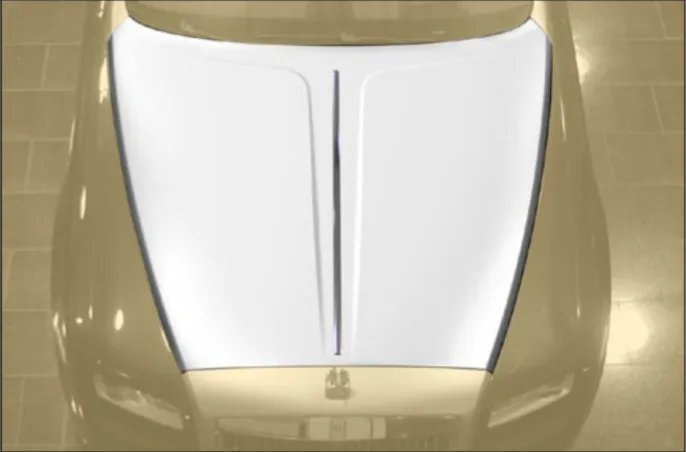
Engine bonnet with bar Mansory Carbon for Rolls-Royce Dawn


Engine Bonnet with Bar (Lacquered) — Mansory Carbon for Rolls-Royce Dawn
The lacquered Engine Bonnet with Bar is the most theatrical Mansory carbon panel on the Rolls-Royce Dawn — a full replacement front bonnet pressed in autoclaved carbon fibre, sealed under deep-gloss lacquer, and crowned by a central V-shaped bar that runs back from the Spirit of Ecstasy plinth toward the windscreen base. It belongs at the very top of the Mansory Body Kit for Rolls-Royce Dawn hierarchy, transforming the long, calm aluminium expanse above the 6.6L twin-turbocharged V12 into a sculpted, paint-matched centrepiece. Owners specify it when the rest of the drophead has already gone bespoke — Pantheon grille frame, ambiente illumination, fenders, side skirts — and the bonnet is the last surface still speaking factory language. Lacquered finish is the choice for buyers who want presence without breaking the coachbuilt grace of the Dawn silhouette.
Construction & Materials
The panel is laid up over a high-precision tooling buck taken from the OEM Dawn bonnet, then cured in a heated autoclave under vacuum and pressure to compact the laminate and eliminate porosity. The central V-bar is a pre-formed sub-component bonded into a recessed channel during the secondary cure, so the bar reads as a continuous sculpted ridge rather than a bolted-on accessory. After demoulding the panel is wet-sanded, primed and finished in Mansory's deep-gloss lacquer system — either fully paint-matched to the customer's Rolls-Royce coachwork colour, or finished as a clear-over-weave gloss that lets a hint of carbon texture telegraph through under direct light.
- Weave: 3K twill carbon, fine-ply orientation across the central crown for even reflectivity
- Cure: autoclave prepreg, ~120 °C cycle, vacuum-bag debulk between plies
- Wall thickness: ~2.0–2.4 mm across the main pressing, ~3.0 mm at the V-bar core
- Approximate weight: 8.5–10.0 kg finished (varies with paint scheme — full body-colour adds ~0.4 kg over clear lacquer)
- Hinge interface: OEM Rolls-Royce hinge brackets, gas-strut mounts and latch geometry preserved
- Underside: ribbed reinforcement, bonded steel reinforcement plate at the latch, OEM insulation pad fitment retained
- Finish options: deep-gloss paint-matched lacquer, clear-over-weave high-gloss, or two-tone (body-colour panel with raw-look V-bar centre)
- Hardware: stainless threaded inserts moulded into the laminate at every OEM mounting point — no through-bolts visible from above
Design & Visual Function
Visually, the lacquered finish is the quieter of the two bar bonnets in the Mansory Dawn programme. Where the exposed-weave variant deliberately advertises the carbon — every twill diamond catching daylight, the bar reading as a graphic stripe of woven texture — the lacquered version dissolves the bonnet back into the bodywork. Paint-matched in the same hue as the rest of the car, it reads first as a sculpted ridge, only second as a carbon part, and the V-bar becomes a shadow line rather than a contrast band. That restraint is exactly why some Dawn owners pick it: the drophead's whole language is hush, glide, and theatre-of-arrival, not motorsport, and a fully lacquered panel keeps the conversation at the level of coachbuilding.
Functionally, the V-bar geometry does real work. It introduces a central crease that reads from the driving seat as well as from outside the car, lengthening the perceived bonnet and tightening the line that runs from the Spirit of Ecstasy down the windscreen base. The bar's shoulders also subtly redirect airflow over the bonnet crown toward the cowl vents, supporting thermal venting from the twin-turbocharged V12 underneath — the 6.6L unit and its intercoolers run hot when the drophead is driven hard with the soft top down, and the marginal flow improvement is welcome on long top-down stints. The illuminated bonnet pinstripe pathway, where specified, runs uninterrupted: Mansory routes the optical fibre channel along the original OEM path so the night-time pinstripe still pools light correctly under the Spirit of Ecstasy.
Against the exposed-weave sibling, the trade-off is straightforward. Exposed weave is loud, photogenic, and announces the Mansory programme from forty metres away. Lacquered is composed, integrated, and reveals itself only when the light moves across it. Most Dawn buyers commission one or the other based on the rest of the car: dark coachwork with chrome surrounds tends to invite exposed weave; lighter or more pastel bespoke RR colours tend to settle into lacquered.
Compatibility & Fitment
Designed exclusively for the Rolls-Royce Dawn (2015–2023), all variants including Black Badge. Drophead convertible only — the Dawn was never offered as a coupé, and this bonnet's pressing geometry, hinge geometry and cowl interface are Dawn-specific. It will not fit the Wraith despite the shared platform: the Wraith bonnet has different cowl-to-windscreen geometry and a different latch position, and Mansory's Wraith carbon programme uses a different tool entirely. OEM Rolls-Royce parking sensors are not located in this panel, so no sensor migration is required. The illuminated bonnet pinstripe (where the car was originally specified with that option) is fully retained — the optical fibre and its trim cap reinstall into a moulded channel along the centreline, beside but not crossing the V-bar. Coach-door geometry, soft-top stowage path and Spirit of Ecstasy retraction (where fitted) are all unaffected — the bonnet ends well forward of the soft-top's tonneau cover, so cycling the roof up and down clears the new panel exactly as before.
Installation & Reversibility
Plan on 4–6 hours for an experienced Rolls-Royce-certified body shop, plus paint-shop time if the panel ships in primer for a body-colour final coat. The procedure is: depressurise and disconnect the gas struts, support the OEM bonnet on a padded cradle, unbolt at the hinges, transfer the OEM insulation pad, latch reinforcement and any pinstripe wiring loom to the new carbon panel, hang the new bonnet, and shim/align until panel gaps match the front fenders and the cowl shut-line is even at both A-pillars. Critical alignment checks: the gap to each front fender should be uniform along the full length, the leading edge should sit flush with the grille shroud without lipping, and the V-bar should read perfectly symmetric to the Spirit of Ecstasy axis from a five-metre walk-up view. Reversibility is total — the OEM bonnet stores flat on a padded rack and can be reinstalled at any time, returning the Dawn to factory-original presentation. We do not recommend DIY installation: the panel is large, valuable, and alignment is unforgiving.
Pairing within the Mansory Dawn programme
The single most useful cross-reference is the exposed-weave sibling — the Engine Bonnet with Bar (Exposed Weave) Mansory Carbon for Rolls-Royce Dawn. Same tool, same geometry, same V-bar — entirely different visual register. If you are still deciding, the rule of thumb is: lacquered for integration with bespoke coachwork colours, exposed weave for contrast and theatre. Order both quotes side by side before committing.
From there, the most coherent visual pairings sit on the front of the car. The Mansory Carbon Front Fenders for Rolls-Royce Dawn share the bonnet's shut-line and finish — speccing them in the same lacquered system gives a continuous painted carbon surface from the leading edge of the fender all the way back to the cowl. The Mansory Carbon Front Grill Frame for Rolls-Royce Dawn redraws the Pantheon surround so the V-bar's leading-edge geometry has a deliberate visual answer just below it — bonnet bar pointing back, grille frame stepping forward, Spirit of Ecstasy in the apex of the two gestures. For a sportier reading on a Black Badge, the Mansory Carbon Air Outtake Splitter for Front Fender (Rolls-Royce Dawn) echoes the bonnet's carbon language in a smaller key on each flank, and helps relieve hot air from the V12 bay on long top-down runs.
Maintenance & Durability
Lacquered carbon on a drophead lives a hard life: direct UV with the soft top stowed, occasional unprotected rain, and a full thermal cycle every time the V12 is started. The most important early step is a ceramic coating over the Mansory lacquer — a sacrificial layer that handles UV and bird-strike acid before either reaches the clearcoat. Wash with pH-neutral shampoo, two-bucket method, microfibre mitt; dry with a plush twist-loop towel. Never let alkaline wheel cleaner, ammonia-based glass cleaner or any abrasive sponge touch the bonnet — they will cloud the lacquer and can leach into the weave-side of the laminate. If a stone chip happens, book a Rolls-Royce-certified bodyshop for spot-respray promptly; chips left through a winter let moisture lift surrounding lacquer in days. Carnauba wax is fine over ceramic but no substitute for it. With sensible care the system holds gallery-grade gloss for years; with neglect, UV will haze it in one summer of top-down use.
Lead Time & Warranty
Lead time is 4–8 weeks from order confirmation. Each bonnet is laid up to order and finish-matched to the customer's specified RR coachwork colour or chosen clear-over-weave gloss. Mansory provides a 12-month warranty against manufacturing defects in the laminate, the V-bar bond and the lacquer system; the warranty does not cover stone-chip impact, alkaline-cleaner damage, or improper installation by a non-certified shop.
FAQ
Q: How is this different from the exposed-weave bonnet?
A: Identical panel and V-bar geometry. The lacquered version is finished in deep-gloss paint (body-colour or clear) so the bonnet integrates with the coachwork; the exposed-weave version leaves the 3K twill visible under clear lacquer for an explicit carbon statement. Same tool, same fitment, opposite visual register.
Q: Will it fit a Black Badge Dawn?
A: Yes — fitment is identical across all Dawn trims from 2015 to 2023, including Black Badge. Hinges, latch, gas struts and pinstripe loom are preserved.
Q: Does it work on a Wraith?
A: No. Despite shared underpinnings, the Dawn bonnet's cowl interface and hinge geometry are Dawn-specific. Mansory builds a separate bonnet for the Wraith programme.
Q: How much weight is saved?
A: Real-world saving is modest — typically 6–9 kg versus the OEM aluminium bonnet, depending on paint scheme. The point of this part is presence, not weight reduction; the Dawn is a 2.5-tonne drophead and a few kilos at the nose are below the threshold of dynamic feel.
Q: Can I keep the illuminated bonnet pinstripe?
A: Yes. The optical fibre and its trim cap transfer to a moulded channel on the new panel. The pinstripe lights up exactly as before, running parallel to but not crossing the V-bar.
Q: Can I have the V-bar in a different finish from the rest of the bonnet?
A: Yes — a popular two-tone option is a body-colour main panel with the V-bar in clear-over-weave, so the bar reads as a textured carbon stripe up the crown. Specify at order.
Q: Does it interfere with soft-top operation?
A: No. The bonnet ends well forward of the tonneau cover. Soft-top stowage and deployment are unaffected.
Pair this lacquered bonnet with the matching front fenders and the Pantheon grille frame for a fully resolved coachbuilt nose. To configure finish, two-tone options or to compare directly with the exposed-weave variant, contact us on WhatsApp +44 7488 818 747 or [email protected].