
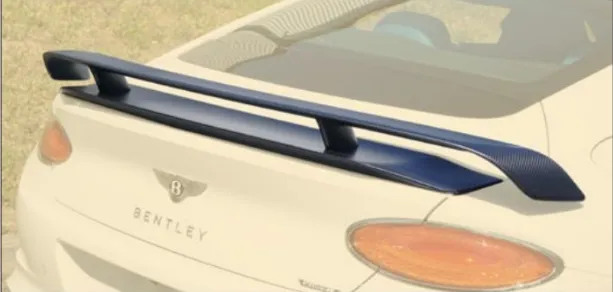
Biplane performance wing with decklid spoiler Mansory Carbon for Bentley Continental GT GTC V8


Biplane performance wing with decklid spoiler Mansory Carbon for Bentley Continental GT GTC V8
Within the Mansory Body Kit for Bentley Continental GT 2nd-Gen (D2A) this is the maximalist rear package: not just a wing, not just a lip, but both as a single-SKU bundle, designed to work as one aerodynamic system. The decklid lip cleans up the boot trailing edge so the main biplane wing receives well-conditioned, attached flow, while the biplane itself introduces real, axle-loading downforce. It is the heaviest visual statement in the kit and the one that genuinely changes the way the car drives at sustained speed. Owners who specify this bundle are usually building a Continental that is meant to be looked at as much as driven — the rear three-quarter view is unambiguously a Mansory tuning car.
Construction & Materials
Both elements are autoclave-cured 3K twill carbon shells over closed-cell foam cores. The biplane uprights are solid-laminate forged-carbon stanchions bonded to aluminium inserts that take the bolt clamp load into the structural decklid frame, not the painted skin. The decklid lip uses VHB plus through-fasteners as on the standalone version. The bundling matters: the slot gap between the two biplane elements is dimensioned with the decklid lip in place, so removing the lip and running just the wing on its own is technically possible but slightly off the design point.
The forged-carbon upright is the engineering centrepiece of the package. Forged carbon — chopped tow compression-moulded under heat — has near-isotropic mechanical properties, which is exactly what a bolted-stanchion application needs. Directional weave laminates carry tension along the fibre but show stress concentration around bolt holes; forged carbon does not. The result is a stanchion that takes the wing load without the upright cracking around the bolt insert after a winter of expansion cycles.
- 3K twill carbon, 0/90 ply orientation on outer skins
- Autoclave cure 6 bar / 120 °C — both wing elements and lip
- Solid forged-carbon uprights with bonded aluminium torque inserts
- Wing chord ≈ 220 mm upper element, ≈ 240 mm lower element
- Combined assembly weight ≈ 6.8 kg (lip 1.4 kg, wing assembly 5.4 kg)
- Stainless M8 hardware into the decklid structural frame, captive-nut backing plates
- Two-pack UV clear, gloss standard, hand-rubbed satin or matte on request
- Edge-sealed laminate at all open faces — no fibre exposed to UV
Design & Visual Function
The biplane is a true twin-element wing: an upper main plane and a lower flap-style element separated by a calibrated slot gap. At motorway and autobahn speed, energised flow through the slot keeps the boundary layer attached on the upper element to a much higher angle of attack than a single-plane wing would tolerate. The result is a meaningful pressure differential — high pressure on the underside of each element, low pressure on the upper — translating directly into vertical load over the rear axle. The two-element architecture is the same idea aerospace uses on slatted high-lift devices: the slot bleeds high-energy flow over the trailing element so it does not stall.
Underneath, the decklid lip does subtle but important aero work: it lifts the wake origin off the boot skin and pre-conditions flow before it reaches the wing leading edge. Without the lip, the wing would receive more separated, turbulent air; with the lip, the wing operates closer to its design point. This is why the bundled SKU exists in the first place — the two parts were tuned together. Pulling them apart loses a percentage of the achievable rear-axle load.
Drag delta versus the OEM trim is real but acceptable on a 600 hp drivetrain — rough order of magnitude in single-digit drag counts. What the package buys you is rear stability at speed, an axle that does not feel light over crests at 250 km/h, and a visual presence that no amount of vinyl wrap on factory bodywork can replicate. Visually the package is unambiguous. The biplane sits roughly 270 mm above the decklid surface, dominating the rear three-quarter view, while the lip below adds breadth to the boot edge.
Compatibility & Fitment
Bentley Continental GT 2nd-generation (D2A) coupé, V8 and W12 powertrains. Compatibility with the GTC convertible is constrained: the biplane uprights mount into the structural decklid frame, which on the GTC is shorter and shares space with the soft-top mechanism. The standard bundle therefore targets the coupé; GTC owners should consult on the dedicated single-element performance wing for GTC instead. Cars with rear-vision camera or tow-bar prep should be confirmed at order — neither precludes fitment but both can affect the trim panel reinstall.
Installation & Reversibility
This is a body-shop install: budget half a day. The decklid trim panel must be removed, the four upright fasteners torque-clamped through the structural frame with the supplied backing plates, and the bond-line for the lip prepared with isopropyl. The wing assembly arrives pre-assembled — the installer torques the uprights, sets the lip with VHB and through-fasteners, then refits the trim panel. Reversibility is reasonable: the wing leaves four sealed hardware holes in the decklid frame, and the lip releases under a heat gun. Plan for a respray of the decklid skin if absolute factory return is required.
Pairing within the Mansory Continental GT programme
This rear-aero bundle is most often combined with the front bumper with front lip so that front and rear downforce remain balanced under load, and with the rear bumper with diffuser II to extract underbody flow and cancel the wake low-pressure region the wing creates. Owners going full programme often add the engine bonnet for visual coherence across the upper surfaces.
Maintenance & Durability
The wing surfaces are reachable but awkward — a long-handled microfibre wand reaches the underside of the upper element. Avoid pressure washers within 30 cm of the slot gap; water intrusion into the slot rarely matters but can carry road grime onto the underside, where it is harder to detail off. Lacquer life under regular ceramic maintenance comfortably exceeds eight years. The uprights are forged carbon and effectively immune to fatigue at road loads. Bug splatter on the leading edges of both elements should be removed inside 24 hours; baked-on protein etches lacquer.
Lead Time & Warranty
Lead time is 3–4 weeks given the bundled tooling and lacquer steps. The 12-month warranty against manufacturing defects covers laminate quality, upright bond integrity and lacquer adhesion under normal use. Bundle pricing is more favourable than ordering wing and lip as separate SKUs — confirm at consultation.
Why the bundle exists as one SKU
The biplane wing and the decklid lip are fundamentally two separate aerodynamic objects, and Mansory could have priced them independently. They are bundled here because the design tuning was done with both in place: the wing's angle of attack, the slot gap, the upright height, and the lip's break-point geometry are all set against each other rather than each in isolation. Buying the wing and lip as a bundle therefore guarantees that the customer ends up with the configuration the atelier actually validated, rather than two parts that meet in the middle of the decklid in a slightly sub-optimal way. The bundle is also where pricing is most attractive — the alternative is to order the standalone biplane and the lip separately, which works fine but costs more and ends up at the same final visual result.
FAQ
Q: How much downforce does the biplane actually produce?
A: At 250 km/h the pair generates a meaningful axle-load increment — the marketing claim is "noticeable rear stability"; the engineering reality is that the rear axle feels planted instead of light at sustained autobahn speed.
Q: Will this fit a GTC convertible?
A: Not as bundled. GTC owners should specify the dedicated single-element GTC wing because of soft-top stowage clearance.
Q: Is the slot gap adjustable?
A: No. The slot is fixed by the upright geometry and tuned at design — an adjustable slot would compromise stiffness on a road-going wing.
Q: How is the biplane secured against vibration?
A: Each upright is torque-clamped through an aluminium insert into the decklid frame, with thread-lock and backing plates. There is no measurable resonance below 280 km/h.
Q: Can the wing be ordered without the lip?
A: Yes — order the standalone biplane SKU. The bundled package exists because the lip pre-conditions flow into the wing, but each part is also sold separately.
Specify gloss or satin, coupé or GTC consultation, and pair with a balanced front splitter for honest end-to-end aero. Order via WhatsApp +44 7488 818 747 or [email protected].