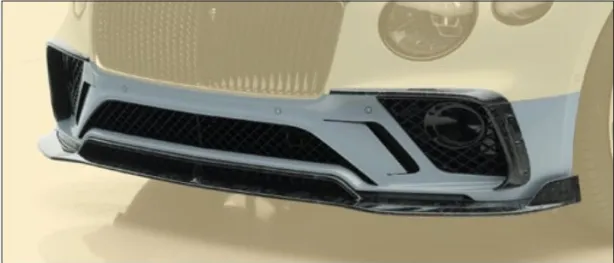
Front bumper with front lip Mansory Carbon for Bentley Continental GT GTC V8


Front bumper with front lip Mansory Carbon for Bentley Continental GT GTC V8
The Mansory carbon front bumper with integrated front lip is the centerpiece of the Continental GT 2nd-generation styling programme — a complete replacement for the OEM bumper skin rather than an add-on lip or splitter overlay. It re-profiles the entire forward face of the car: a deeper central air dam, larger flanking intakes, and a one-piece carbon lower lip that extends roughly 35–40 mm farther forward than the OEM moulding. Position-wise, it is the part that defines the Mansory silhouette from the front three-quarter view, and it sets the visual tone for the rest of the kit. See the full programme it belongs to: Mansory Body Kit for Bentley Continental GT 2nd-Gen (D2A).
Construction & Materials
The bumper is hand-laminated as a single skin over a high-temperature epoxy tooling buck taken directly from a 3D-scanned OEM bumper, then trimmed and post-cured. The lip is co-bonded as a structural sub-shell rather than glued on as an afterthought, which is why the leading edge resists the typical aftermarket cracking pattern when a kerb is kissed at low speed.
- 3K twill visible-carbon outer skin, 0/45/90 ply schedule for impact distribution
- Autoclave cure at 120 °C, 6 bar — full resin compaction, void content under 1.5 %
- Wall thickness 2.4–3.0 mm across the main skin, locally 4.5 mm at the lip leading edge
- Approx. 8.6 kg complete vs. ~13.2 kg for the OEM injection-moulded bumper assembly
- OEM-style M6 captive nuts at the crash-bar interface; no drilling of the crash-bar required
- Stainless steel impact-absorber brackets pre-bonded into the rear face of the bumper
- UV-stable 2K acrylic-urethane lacquer, 60–80 µm, hand-flatted to a consistent gloss across the weave
- Cut-outs pre-machined for OEM PDC sensors, washer jets, and the V8 lower grille apertures
Design & Visual Function
Aerodynamically the bumper does two things at once. First, the front lip extends the leading splitter plane forward and slightly downward, reducing the air mass that escapes underneath the car at high speed; the residual stagnation zone shifts forward by roughly 60–80 mm versus the OEM bumper, lifting nose pressure and reducing front-axle aerodynamic lift in the 180–250 km/h band typical of Continental GT V8 cruising. Second, the enlarged side intakes feed cleaner, less recirculated air to the brake-cooling ducts and to the V8 charge-air coolers, with the inlet area increased by approximately 22 % over OEM.
Visually, the dominant change is geometry: the central mouth is widened and squared off, the corner intakes are taller and pulled outward, and the lower lip introduces a continuous chord line that runs from corner to corner without a soft mid-section. Under low sun, the 3K twill weave reads cleanly across the lip leading edge — there is no resin-rich glassy patch where the lay-up is bridged, because the leading edge is a single ply wrap over a foam former rather than two skins glued together.
The bumper is designed to live with the rest of the Mansory front-end programme. The cut-outs accept Mansory grille variants without machining, and the upper bumper line transitions cleanly into the carbon engine bonnet shut-line. The lip is profiled with a sharp lower edge that, when viewed from the front, presents a thin shadow line — the visual cue that telegraphs splitter geometry rather than a rounded "valance" lip. That shadow line is also where the eye breaks the front mass into two horizontal bands: bumper above, lip below, and the proportions of those two bands are tuned so that the lip looks like a structural feature, not a tacked-on appendage.
Headlight integration deserves a note of its own. The OEM headlight matrix sits in a rebated housing in the bumper upper face; the Mansory tooling preserves the rebate angle and the housing draft to within tooling tolerance, so the headlight gasket seats correctly and there is no light-pipe leakage along the upper shut-line. This is one of the small things that separates a properly engineered carbon bumper from a cosmetic copy — most aftermarket bumpers fudge the headlight rebate and end up needing foam gap-fillers, which look like exactly what they are.
Compatibility & Fitment
The part is engineered around the Bentley Continental GT 2nd-generation platform (D2A), V8 4.0L twin-turbo, in both coupé and GTC convertible body styles. It uses the OEM front crash-bar geometry, OEM headlight datum, and the OEM PDC sensor positions, so model-year revisions inside the V8 production window are accommodated. W12 cars share the front structure but use a different lower grille treatment; this bumper is built for the V8 lower aperture pattern and is not a 1:1 swap for the W12 unless the W12 grille blanks are also fitted. Cars with factory ACC radar are supported — the radar window is preserved at the OEM angle and the carbon thickness in front of the radar is held under spec for radar transparency.
Installation & Reversibility
Installation is a workshop job, not a driveway one. Plan 5–7 hours: remove the OEM bumper, transfer the wiring loom, PDC sensors, washer hoses, and ACC radar to the new shell, then mount via the OEM M6 captive points and the impact-absorber brackets. Headlight gap shimming is sometimes required by 0.5–1.0 mm to chase a flush shut-line on cars whose front structure has previously been disturbed. The part is fully reversible — the OEM bumper bolts back on without re-drilling — and we recommend a Bentley-experienced bodyshop or a Mansory-trained installer for first-time fitment.
Pairing within the Mansory Continental GT programme
The front bumper is the anchor; the rest of the kit reads off its geometry. Common pairings are the Mansory carbon side skirts for a continuous lower chord line, the front fenders with stripe to widen the front track visually, and the 15-lamels performance grill to fill the deeper central aperture this bumper opens up.
Maintenance & Durability
The lip leading edge is the part you will live with day-to-day. Treat it like a paint surface: hand-wash, soft pH-neutral shampoo, two-bucket method. Apply a hard-shell carnauba or a quality SiO2 sealant every six to eight weeks; the UV barrier is in the lacquer, not in the carbon, and a tired lacquer is what eventually goes milky on cheap aftermarket bumpers. Avoid alkaline traffic-film removers and forecourt rotary brushes. Stone chips below 2 mm can be touched in by a competent paint correction shop without a re-shoot. Expect a 7–10 year service life on the lacquer with reasonable care; the carbon laminate itself is essentially indefinite.
Lead Time & Warranty
Lead time on the bumper is 3–4 weeks from order confirmation, longer than smaller trim parts because of the autoclave slot and the post-cure cycle. The part ships in a foam-cradle wooden crate. A 12-month warranty against manufacturing defects applies — voids, delamination, lacquer adhesion failures, mounting hardware faults. Impact damage and kerb strikes are not covered by the warranty but are repairable; structural carbon repair on this geometry is a routine job for a competent composite shop.
FAQ
Q: Will the lip ground out on a normal driveway?
A: It sits roughly 35–40 mm lower than the OEM bumper at the lowest point. Most domestic driveways and multi-storey ramps are negotiable at an angle; very steep approaches (1:6 or sharper) want a pre-emptive diagonal approach. Air-suspension equipped cars in lift mode have ample clearance.
Q: Does the bumper work with factory PDC and ACC radar?
A: Yes. PDC sensor housings transfer to OEM positions; the radar window is held to thickness spec so adaptive cruise and AEB remain functional after fitment.
Q: Can I order it primed instead of visible carbon?
A: Yes — a primed paint-ready variant can be specified at order time. Lead time is identical, lacquer step is replaced with high-build epoxy primer ready for a body-colour shoot.
Q: What is the actual weight saving over OEM?
A: Approximately 4.5–4.8 kg at the front overhang. Modest in absolute terms, but it is unsprung-adjacent mass ahead of the front axle, so the dynamic effect on turn-in and on suspension load reversal is meaningfully larger than the kilogram figure suggests.
Q: Is it crash-tested?
A: The bumper preserves the OEM crash-bar and impact-absorber path; the carbon skin is a cosmetic and aerodynamic shell and is not load-bearing in a frontal impact. Pedestrian-impact certification is not claimed for the modified geometry — this is normal for aftermarket carbon bumpers and is accepted in most road jurisdictions for individual approval.
Q: How does the lip behave at autobahn speed?
A: The lip plus the deeper central air dam shift the front stagnation zone forward, which lifts pressure on the upper bumper face and reduces underbody spill. In practice the front of the car feels more planted at sustained 220–250 km/h than it does on the OEM bumper, with less floating-on-air sensation through the steering. The effect is more about flow conditioning than measured downforce in absolute terms.
Q: Does ambient temperature affect the carbon during the day?
A: Carbon-epoxy laminate has a coefficient of thermal expansion an order of magnitude lower than aluminium. The bumper does not creak or pop at temperature transitions the way an OEM plastic bumper sometimes does on a frosty morning. Lacquer is the more temperature-sensitive surface; standard automotive lacquer is rated for the temperature range a road car will see.
Pair this bumper with the matching diffuser and skirts to lock in the lower chord line of the Mansory programme. CTA: WhatsApp +44 7488 818 747 or [email protected].