
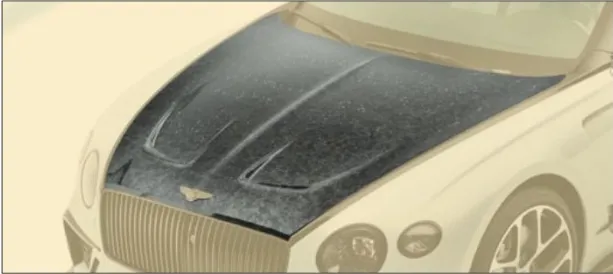
Engine bonnet Mansory Carbon for Bentley Continental GT GTC V8


Engine bonnet Mansory Carbon for Bentley Continental GT GTC V8
The standard Mansory carbon engine bonnet for the Continental GT 2nd-gen is the clean-surface variant of the bonnet programme, designed for owners who want the visual mass of a full-carbon hood without the more aggressive ducted look of the alternative version. It is one of the largest single carbon panels in the Mansory Body Kit for Bentley Continental GT 2nd-Gen (D2A), and because it sits at eye level for anyone walking up to the car, it carries a disproportionate amount of the kit's visual weight. The bonnet replaces the OEM aluminium pressing one-for-one and uses the original hinges, latch and weatherstrip so the rest of the engine bay closure system is untouched.
Construction & Materials
The bonnet is built as a two-part bonded assembly: an A-surface skin laid in 2x2 twill prepreg over a structural inner pan that mirrors the OEM aluminium reinforcement geometry. The inner pan is a separate moulded part with localised foam cores at the hinge mount and latch tongue, and it is bonded to the skin with a structural epoxy paste under fixture so the gap line and crown remain dimensionally stable through cure.
That two-shell architecture is what stops a large carbon bonnet from drumming on the highway. A single-skin carbon hood saves more weight on paper but vibrates audibly at touring speed; the bonded pan kills that resonance and lets the panel behave like the OEM piece in terms of feel when you close it.
Resin selection matters as much as the layup. We specify an automotive-grade epoxy with a glass transition temperature high enough that the panel does not soften in real-world summer heat over a black engine bay; this is a common failure mode in low-grade aftermarket carbon hoods, where the panel develops a slight crown sag after a hot summer and the shut line drifts. Our cure cycle and resin choice are dimensioned around the Continental GT's actual under-bonnet thermal profile, not generic carbon-hood assumptions.
- Outer skin: 2x2 twill prepreg, oriented diagonal to the centre crown line for a balanced reflection from front and side
- Inner pan: woven and uni-directional carbon hybrid layup, autoclave cured
- Bond paste: structural epoxy, fixture-cured under temperature
- Total finished weight: approx. 9.5 kg, against approx. 17 kg for the OEM aluminium bonnet
- Hinge mount: OEM-pattern steel inserts, threaded and laminated into the inner pan
- Latch tongue: matched to the factory striker geometry, no shimming required on most cars
- Finish: high-build 2K UV-stable clear, gloss as standard, satin available
- Surface QC: full panel inspected under raking light pre-clear and post-clear for resin print-through
Design & Visual Function
This is the calmer of the two Mansory bonnet options. The surface is solid, with no power vents and no centre power bulge, which means the visual emphasis falls entirely on the depth of the carbon weave and the crown geometry. Mansory's design intent here was a luxury-tuner read: the panel is unmistakably carbon, but it does not advertise the engine bay below it. The result is a bonnet that pairs well with chrome-grille builds and with cars whose owners want the Mansory body silhouette without the obvious cooling-hood aesthetic.
Aerodynamically the panel is a faithful copy of the OEM bonnet's pressure surface. The crown radius matches factory, the leading edge transitions into the bumper shutline at the same rake, and there are no openings for stagnation pressure to leak into the engine bay. This matters in practice because the Continental GT's original under-bonnet flow is balanced around a sealed hood; opening the upper surface, as the bonnet II does, changes the cooling pack exit pressure and is a deliberate engineering choice. The standard bonnet leaves that balance untouched, which is the right answer for owners who do not run track sessions or aggressive remap tunes.
Visually the panel reads heavier than its actual mass. The deep wet-look clear over the woven 2x2 makes the bonnet feel like a slab of dark glass when the car is parked under sunlight, and the lack of surface interruptions makes any minor crown imperfection immediately visible. For that reason every panel is laser-scanned against a master before it leaves QC.
There is also a quieter functional benefit to the solid panel that does not show up in the spec sheet. With no apertures, the bonnet contributes nothing to under-bonnet noise transmission to the cabin; the OEM bonnet liner sits flush against the inner pan, and the air column above the engine remains sealed. Owners who use the GT primarily as a grand tourer rather than a track car appreciate that the standard bonnet preserves the cabin acoustic character without the small whistle some vented hoods can introduce at high speed.
The crown geometry deserves a final note. The OEM Continental GT bonnet has a very specific, gently-tensioned crown that contributes to the car's refined-but-muscular profile, and any aftermarket bonnet that misses that crown by more than a millimetre will look wrong from a distance. Our master pattern was scanned off a known-good OEM panel and the moulded skin is dimensionally controlled across the crown to a tolerance well inside what the human eye can resolve at walk-around distance.
Compatibility & Fitment
Fits Bentley Continental GT 2nd-generation D2A platform, both V8 and W12, GT coupé and GTC convertible. The bonnet uses the OEM hinge pattern and latch geometry, so no body shop modifications are required for installation. Cars with factory bonnet liner and sound deadening will need to transfer those parts to the new panel; the inner pan is moulded to accept the OEM clip pattern of the standard liner without drilling.
Installation & Reversibility
Installation requires removing the OEM bonnet, transferring the hinge bolts and the latch hardware, and refitting to the new panel. Budget around 3 hours including alignment, plus a road test for any rattle or shut-line correction. A trained Bentley body technician can do this in less; we strongly advise against a generalist workshop because the GT's bonnet alignment interacts with both fenders and the front bumper, and a poor shut line will telegraph across the whole nose. The OEM bonnet can be reinstalled at any time with no consequence to the chassis or the rest of the car.
Pairing within the Mansory Continental GT programme
This bonnet is the natural companion to the Mansory carbon bonnet logo for owners who want the badge in carbon rather than chrome, to the front fenders with stripe for a unified front-end carbon read, and to either the 31-lamel chromed grill or its performance counterpart depending on the build's overall direction.
Maintenance & Durability
Treat this panel like any premium clearcoated body surface. Hand wash with pH-neutral shampoo, dry with a clean plush microfibre, and apply a quality SiO2-hybrid coating to give the lacquer a sacrificial top layer against UV and bird-droppings. Park out of direct sun where possible during long storage; while the 2K clear is UV-stabilised, prolonged south-facing summer exposure will eventually amber the resin layer. Stone chips on the leading edge can be filled with localised clear; cracking or delamination is repaired only by full panel replacement.
Lead Time & Warranty
Lead time is typically 3 to 4 weeks from order confirmation, longer than smaller trim parts because of the autoclave fixture time and the QC scan stage. The bonnet ships with full hardware and protective foam packing in a custom crate. Warranty is 12 months against manufacturing defects in the laminate, the bond between skin and inner pan, and the lacquer system; impact, third-party fitment, and chemical attack are excluded.
FAQ
Q: Does the bonnet fit the W12 the same as the V8?
A: Yes, the bonnet pressing geometry on the OEM Continental GT is shared between V8 and W12 cars, and our part is dimensioned off that common pressing.
Q: Will I lose the OEM bonnet sound insulation?
A: No. The inner pan is moulded with the OEM clip pattern, so the factory liner transfers across.
Q: Can I have the bonnet finished in painted body colour with carbon weave only on a section?
A: Custom split-finish is offered on request; lead time extends to 5 weeks for a painted/carbon split build.
Q: What weight saving do I actually realise on the front axle?
A: Around 7 to 8 kg off the front axle versus the OEM bonnet, which is meaningful for transient turn-in feel without changing suspension geometry.
Q: Will this bonnet rattle or drum at motorway speeds?
A: No, the bonded inner pan and structural foam zones are specifically engineered to prevent the drumming behaviour you sometimes hear with single-skin carbon hoods.
Order this bonnet alongside the carbon logo, fender stripes and your chosen grill for a coherent Mansory front-end. Get a configuration quote via WhatsApp +44 7488 818 747 or [email protected].