
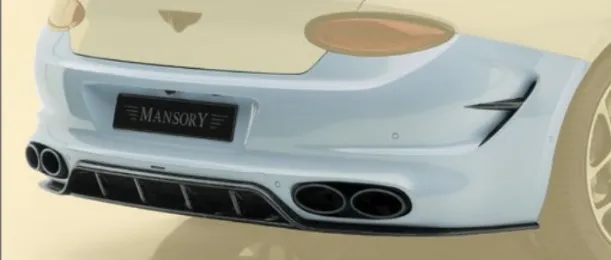
Rear bumper with diffuser II Mansory Carbon for Bentley Continental GT GTC V8


Rear bumper with diffuser II Mansory Carbon for Bentley Continental GT GTC V8
Diffuser II is the more aggressive of the two Mansory rear bumper variants for the Continental GT 2nd-gen — five expansion channels instead of three, plus an integrated lower vent that pulls heat from the rear-axle and rear-brake region. Where diffuser I keeps the rear face clean and orthodox, II goes overtly motorsport-flavoured. It is the variant of choice for owners who already run the more aggressive front-end pieces and want the rear visual to match. As a part, its job is the same as I — close the underbody airflow envelope, frame the V8 quad tips — but it pushes the geometry harder and adds a thermal management feature that I does not have. Programme context: Mansory Body Kit for Bentley Continental GT 2nd-Gen (D2A).
Construction & Materials
The shell construction matches diffuser I — single-piece autoclave layup with co-bonded strakes — but the strake density is higher and the lower vent introduces a secondary internal duct. Internal stiffening is therefore more substantial: a hidden rib runs across the back of the lower vent to maintain shell rigidity, since the vent aperture removes a useful chunk of cross-section.
- 3K twill visible-carbon outer skin, 2x2 plain backing, plus internal stiffening rib at the lower vent
- Autoclave epoxy cure, 120 °C / 6 bar, void content under 1.5 %
- Wall thickness 2.6–3.2 mm main skin, 3.5–4.5 mm at strake roots and lower-vent throat
- Approx. 9.8 kg complete (vs. ~14.0 kg OEM bumper assembly)
- Five strakes between and outboard of the V8 quad tips
- Integrated lower brake-cooling / rear-axle heat-extraction vent, central on the lower face
- Stainless M6 captive hardware, OEM-pattern; no chassis modification
- UV-stable 2K acrylic-urethane lacquer, hand-flatted, 60–80 µm
Design & Visual Function
The five-channel layout drops the strake angle to about 9° while increasing the swept area of the diffuser by roughly 30–35 % over OEM. The lower vent is functional: at speed, the underbody pressure is positive at the front of the rear axle and negative at the trailing edge of the diffuser, and the vent connects the high-pressure rear-axle region to the low-pressure diffuser exit, pulling warm air out of the rear-brake and rear-axle bay. The effect is small on a road car but real, and on track-day usage it noticeably reduces rear-brake heat-soak in repeated heavy braking sequences.
Visually, the more aggressive vane geometry and the lower vent fundamentally change the proportion of the rear face. The car looks lower and wider from straight-on, and the V8 quad tips read as part of a structured frame rather than as standalone exits. The carbon-weave run on diffuser II is broken into two zones — a lateral run on the upper bumper face and a longitudinal run inside the diffuser channels — which is a deliberate choice to emphasise the channel depth. Done badly, that mixed weave run looks chaotic; done with attention to the overlap zones, which Mansory does, it gives the rear face a layered carbon texture that diffuser I deliberately avoids.
Diffuser II is the one to spec if the car will be photographed often, will be track-driven occasionally, or is paired with a more assertive front lip and a wing rather than a decklid spoiler. The five-channel layout creates more shadow lines along the lower face, and shadow lines are what give a carbon part its sculptural quality in photography.
One subtle point: the lower vent throat is finished in flat black inside the duct, not in visible carbon. That is deliberate — a visible-carbon duct interior would catch light and would visually flatten the depth of the vent. The flat-black interior reads as a properly recessed opening, which is the visual register Mansory wants. The vent exit at the rear of the diffuser is also flat black for the same reason.
Strake spacing on this variant is asymmetric in a way that diffuser I is not: the two outboard pairs of strakes are tighter than the two inboard pairs, which on the eye reads as a "speed effect" — strake density visually accelerating outward. The aerodynamic effect of that asymmetry is small; the visual effect is the reason it exists.
Compatibility & Fitment
Built around the Bentley Continental GT 2nd-generation (D2A) V8 4.0L coupé and GTC convertible. Sized to the V8 quad-tip exhaust pattern; not a 1:1 swap on W12 cars unless the W12 is converted to V8 quad-tip exhaust geometry. Cars with the OEM tow-pack are accommodated via a removable lower section over the receiver, in the same way as diffuser I. Factory PDC, reverse camera, and tow-eye access are preserved.
Installation & Reversibility
Slightly more involved than diffuser I because the lower vent has a secondary inner duct that needs alignment to the rear-subframe heat-shielding. Plan 6–7 hours of bench time. The diffuser-to-tip clearance target is the same 12–14 mm to allow for thermal expansion of the V8 exhaust. The job is fully reversible; the OEM bumper bolts back on the original mount points without modification to the car.
Pairing within the Mansory Continental GT programme
Diffuser II reads best with assertive front and roof elements rather than understated ones. Common pairings: the Mansory carbon front bumper with front lip at the nose, the biplane performance wing in place of a decklid spoiler, and the front fenders with stripe to widen the visual track to match the more aggressive rear.
Maintenance & Durability
The lower vent collects more road grime than the rest of the rear face — it is a pressure-driven channel and effectively a vacuum cleaner for whatever the rear wheels throw forward. Plan a more thorough wash routine of the vent throat every two weeks, and inspect the inner duct every six months for stone build-up. Lacquer care matches the rest of the kit: hand-wash, pH-neutral shampoo, hard-shell sealant every six to eight weeks. Heat-discolouration of lacquer adjacent to the inboard exhaust tips is the same wear item as on diffuser I and is not warranty-covered.
Lead Time & Warranty
Lead time is 3–4 weeks. The part ships in a foam-cradle wooden crate sized to protect both the diffuser strakes and the lower vent throat. A 12-month warranty against manufacturing defects applies — laminate voids, delamination, lacquer adhesion, hardware. Kerb damage, stone chips, and heat-induced lacquer ageing are wear items.
FAQ
Q: How is diffuser II different from diffuser I?
A: Five expansion channels vs. three, plus an integrated lower brake-cooling / rear-axle heat-extraction vent in the central lower face. The vane angle is shallower and the swept diffuser area is larger. II is the motorsport-flavoured variant; I is the cleaner orthodox one.
Q: Does the lower vent actually do something?
A: Yes. It connects the positive-pressure rear-axle bay to the negative-pressure diffuser-exit zone. On road use the effect is small. On track-day repeated heavy braking, it measurably reduces rear-brake heat-soak.
Q: Can I retrofit diffuser II without changing the rest of the kit?
A: Mechanically yes — the rear bumper is a self-contained replacement. Aesthetically, II tends to read better with assertive front and rear elements; with an OEM front and a soft decklid lip it can look out of context.
Q: Will the lower vent let road spray into the rear-axle bay?
A: No. The internal duct guides air through to the exit and the rear-axle bay is heat-shielded as standard. Spray drains through the rear-subframe drain points as on a stock car.
Q: Is it noisier than diffuser I at speed?
A: Marginally. The five-channel geometry produces a slightly higher-frequency turbulence signature behind the car. At interior level, with windows up, it is not perceptible against the V8 exhaust note.
Q: Will the lower vent require any chassis modification?
A: No chassis modification. The vent is a self-contained duct internal to the bumper shell, with the inlet and outlet both within the bumper geometry. Existing rear-subframe heat shielding is retained as-is.
Q: Can I switch between diffuser I and diffuser II later?
A: Yes. Both are bolt-on replacements for the OEM bumper using the same OEM mount points. Owners sometimes start with diffuser I and upgrade to diffuser II later as the rest of the kit is built up. The OEM bumper can also be refitted at any time.
Q: How visible is the asymmetric strake spacing in person?
A: Visible at any angle that gives a clear view of the diffuser face — straight-on, three-quarter, and low-angle photography. Less visible in night-time ambient light, where the channel shadows blur into one another.
Pair this rear bumper with the biplane wing and the matching front bumper to lock in the assertive Mansory programme look. CTA: WhatsApp +44 7488 818 747 or [email protected].