
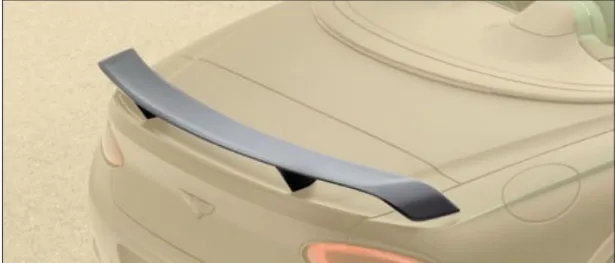
Performance wing for GTC Mansory Carbon for Bentley Continental GT GTC V8


Performance wing for GTC Mansory Carbon for Bentley Continental GT GTC V8
The convertible Continental GTC is a different aerodynamic problem to the coupé. The decklid is shorter, the structural frame is shallower, and the soft-top stowage envelope intrudes from below into the very volume a coupé wing would normally clamp into. Mansory therefore developed a dedicated single-element wing for the GTC — shorter chord, narrower upright spread, and a hardware path tuned to miss the roof mechanism. Within the Mansory Body Kit for Bentley Continental GT 2nd-Gen (D2A), this is the only rear wing actually validated on the convertible body, and the only one that respects the soft-top kinematic across its full cycling range.
Construction & Materials
A single-element airfoil over a foam former, autoclave-cured to the same standard as the coupé biplane. The uprights are shorter and clamp into a section of the GTC decklid frame that has been confirmed clear of the soft-top kinematic. Hardware passes through to backing plates that distribute load away from the soft-top hinge mounts. The chord and span are deliberately moderate — a long-span wing on a convertible amplifies twist under asymmetric loading because the GTC structure is less torsionally stiff than the coupé, so Mansory size the wing inside the envelope where chassis compliance does not wash out the aero result.
Backing-plate strategy on the GTC is meaningfully different from the coupé. On the coupé the structural decklid frame can take a clamping load almost anywhere along its length; on the GTC the frame is interrupted by the soft-top hinge zones, so the backing plates are shaped to bridge those interruptions and put their footprint on continuous metal. This is invisible after the trim panel is refitted, but it is the reason a GTC-specific wing exists at all.
- 3K twill outer skin, uniaxial tension layer along the chord
- Autoclave cure 6 bar / 120 °C — same process as coupé wing
- Element chord ≈ 230 mm; span tuned to GTC decklid width
- Shorter, GTC-specific forged-carbon uprights with aluminium inserts
- Assembly weight ≈ 4.6 kg, lighter than the twin-element coupé biplane
- Stainless M8 hardware; backing plates spread load around soft-top hinge zones
- Two-pack UV clear lacquer, gloss standard, satin or matte on request
- Sealed perimeter against UV and water ingress at all open laminate edges
Design & Visual Function
The aerodynamic brief on a convertible is different from a coupé. Open-roof airflow over the rear deck is far more turbulent — the wake from the cabin and roof crown is broader and lower-energy, particularly with the top down. A twin-element biplane in that environment would spend much of its time operating in unsteady, partially separated flow, and the slot would not deliver its design jet consistently; a single-element wing of carefully chosen chord and AoA, by contrast, sits high enough on its uprights to reach cleaner air, and is more tolerant of the unsteady inflow it does receive.
Pressure differential and induced rear downforce are the same physics as on the coupé wing — high pressure underneath, low pressure above, integrated force vertical — but the magnitude is calibrated for road use on a convertible chassis with a different rear-axle weight distribution. The trailing-edge cut is a clean Gurney-style flick to maintain attached flow at the modest AoA the wing runs. The end plates on each end of the wing are deeper than on the coupé biplane because the convertible spends more time in lateral airflow during open-roof driving — the deeper plates suppress tip vortex shedding that would otherwise unload the wing inboard.
Visually the GTC wing is more restrained than the coupé biplane — narrower, lower, single-plane — which suits the open-top silhouette of the convertible without cluttering the rear-three-quarter view with stacked aero hardware. Roof-down, the wing is part of a continuous carbon plane that runs from the cabin bulkhead back to the boot edge.
Compatibility & Fitment
Bentley Continental GTC convertible (D2A platform), V8 and W12 powertrains, model years 2011 onwards. The mount geometry is unique to the GTC; the part will not fit a coupé and the coupé biplane will not fit a GTC. Compatibility is checked against the soft-top mechanism revision; cars with non-OEM soft-top retrofits should be confirmed before order. The rear-vision camera on optioned cars is unaffected.
Installation & Reversibility
Installation is a body-shop job, 3–4 hours, with the soft-top cycled fully open and fully stowed during dry-fit to confirm clearance. Pilot holes are drilled into predetermined zones of the GTC decklid frame using the supplied template; uprights are torqued with backing plates and thread-lock. Reversal leaves four sealed holes hidden beneath the trim panel; the soft-top mechanism is unaffected throughout. The car returns to factory appearance with no paintwork required.
Pairing within the Mansory Continental GT programme
For GTC owners specifying a coherent rear-end, the wing pairs naturally with the rear spoiler for GTC on the decklid trailing edge and with the cover of folding roof for GTC so that all visible rear-deck surfaces share the same weave language. The rear bumper with diffuser II completes the underbody story.
Maintenance & Durability
Convertible owners tend to drive open-roof more often than they wash the car; the wing leading edge picks up bug residue and tree sap accordingly. A weekly wipe with detailer and microfibre keeps the lacquer pristine. Avoid running the soft-top under a heavily soiled wing — debris from above the wing can fall onto the closing top fabric. Otherwise, ceramic-coat once and the lacquer will outlast typical ownership. The wing is unaffected by fabric soft-top conditioning sprays as long as overspray on the lacquer is wiped off promptly.
Lead Time & Warranty
Lead time is 2–4 weeks depending on backing-plate availability and lacquer queue. 12-month warranty covers laminate, upright bond and lacquer adhesion under normal convertible use including regular roof cycling.
Why a GTC-specific wing exists at all
It would be cheaper for Mansory to sell one rear wing across the Continental platform and tell GTC owners to live with whatever clearance issues result. The reason the GTC SKU exists separately is that the convertible decklid frame, the soft-top kinematic, and the open-roof airflow regime all change the brief at once. A coupé biplane on a GTC would either foul the soft-top sweep, demand load paths into unsupported sections of decklid frame, or operate in turbulent inflow that washes out the slot-gap aero benefit. The single-element GTC wing solves all three problems at once: tighter footprint to clear the soft-top, backing-plate geometry that bridges the soft-top hinge zones, and a single airfoil tolerant of unsteady inflow. It is a purpose-tooled part rather than a parts-bin compromise, which is the reason it carries its own SKU and its own lead-time slot in the atelier.
FAQ
Q: Will it interfere with the soft-top opening?
A: No. The wing footprint is dimensioned to clear the soft-top stowage envelope at every point of the kinematic — verified with the top fully cycled during dry-fit.
Q: Why a single element instead of biplane on the GTC?
A: Convertible rear-deck airflow is more unsteady; a single-element wing of carefully chosen chord is more tolerant of that inflow than a slot-gap-dependent biplane.
Q: Is it lighter than the coupé biplane?
A: Yes — about 0.8 kg lighter at assembly weight, helped by shorter uprights and a single airfoil section.
Q: Can I retrofit the coupé biplane onto a GTC?
A: No. The coupé biplane uprights interfere with the GTC soft-top stowage volume.
Q: Will it cause buffeting in the cabin with the roof down?
A: No. The wing sits aft of the cabin wake and does not modify the airflow that drives cabin buffeting at speed.
Q: Does the wing change the car's open-roof acoustic signature?
A: Marginally. At cruise speeds with the roof down there is a subtle change in wind noise behind the cabin, but it is below the level at which most occupants register a difference. The wing was specifically tuned to avoid edge tones in the audible range.
Q: How does the wing affect open-roof rearward visibility?
A: With the rear-view mirror in normal position the wing crosses the bottom edge of the mirror frame; visibility above and to either side is unaffected. Owners adjust within a day of fitment.
Q: Will it scratch a closing soft-top?
A: No. The clearance envelope is verified at dry-fit and the wing footprint sits aft of the soft-top closure path; the fabric never contacts the carbon surface.
The GTC-specific wing is the correct rear-aero answer for the convertible — anything else compromises the roof mechanism. Specs and order via WhatsApp +44 7488 818 747 or [email protected].