
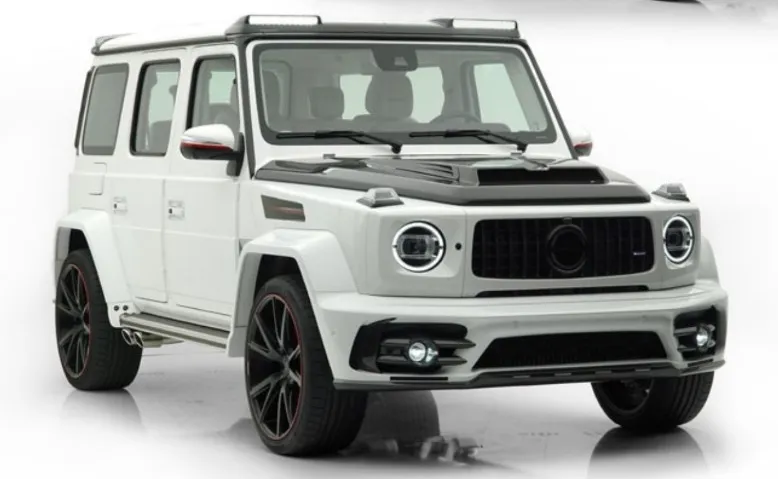
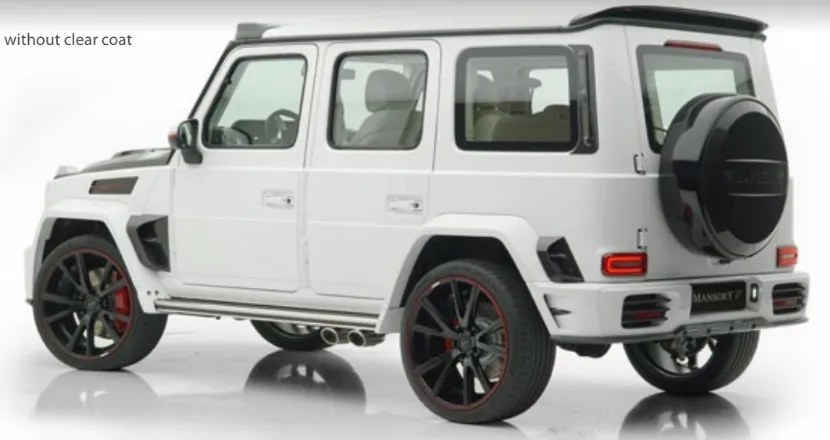
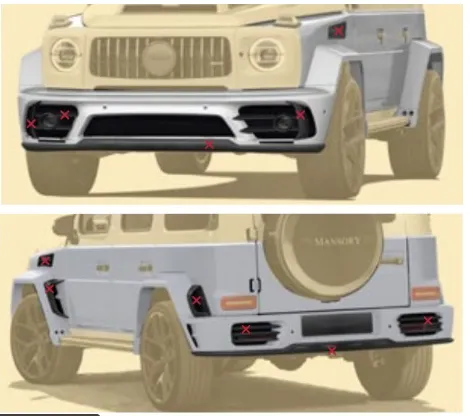
Widebody kit with panels Mansory Carbon for Mercedes G-class G500 / AMG G63 W463A


Widebody kit with panels Mansory Carbon for Mercedes G-class G500 / AMG G63 W463A
This is the dressed-up sibling of the base widebody — the same Mansory wheel-arch architecture, supplemented with carbon side door panels, lower-cladding inserts and a continuous visible-weave run from front fender to rear quarter. It is the catalogue choice for the customer who wants the Mansory program read instantly from twenty paces, where carbon flows along the full length of the cabin and down to the rocker. As part of the wider Mansory Carbon Body Kit for Mercedes G-class W463A G500/G63 programme, this multi-piece variant is what specialist garages, Mansory-program collectors and showcar builders specify when the brief is "every visible flat surface must be lacquered carbon". G500 and AMG G63 owners both order it; the panels are body-shape neutral, so AMG-specific considerations sit with adjacent components rather than the widebody itself.
The Multi-Piece Carbon Architecture
Where the simpler widebody variant in this catalogue stops at four arches and the bumper-side wing extensions, this version layers in eleven additional carbon pieces: four full-height door panels, four lower-door cladding inserts that tuck behind the running board, two long sill bridges connecting front and rear arches along the rocker, and a transitional carbon kick-panel between the rear arch and the spare-wheel cover. Each piece is moulded as a discrete part — a one-piece door skin would fight against door flex and amplify panel-gap drift over the first thermal cycle. The multi-piece logic exists for two reasons: shippability without core damage, and field-replaceable repair if a single panel suffers gravel chip or fuel-station rash.
The architecture also dictates who picks this kit. Drivers who park in tight underground bays and scuff cladding on bollards often choose the simpler widebody variant in this catalogue and accept the painted lower edge. Showcar builders, Mansory-program collectors and clients running matched-livery promo cars want the visible weave running unbroken across every horizontal axis of the truck, and they accept the longer install and tighter ownership protocol the extra panels demand.
Visible-Weave Continuity & Lacquer Layering
The headline of this kit is weave continuity. Mansory cuts the 3K twill at a consistent forty-five-degree bias on the arches, door panels and lower cladding so the diagonal lines of the weave run unbroken from front fender flare across the door, across the rocker and into the rear quarter. Each panel is laid up against an etched alignment grid on the mould, and the bias is verified twice before infusion. Dry-fit at the shop, the installer can stand three metres back, sight along the side of the truck and see the weave reading as a single continuous diagonal rather than eleven discrete blocks.
Lacquer is built up in eight coats — three base, three colour-clear, two top-clear with UV inhibitor — and flatted between the fifth and sixth coat to remove orange peel before the final two clears are flowed on. The wet-surface depth catches highlights at low sun angles, so the body sides read as carbon at golden hour rather than flat black. This depth drives ROI for showcar customers: a properly built lacquered carbon kit shows highlight variation from arch to door to cladding, which is exactly what promo and editorial photography wants. A satin-2K topcoat is available, but most kits in this configuration ship gloss because gloss is what makes the weave read in photographs.
Assembly Sequence (and why order matters)
Order of installation is not a suggestion; deviating from the prescribed sequence is the single largest cause of panel-gap drift on this kit. The correct order is: (1) dry-fit and bond the four wheel-arches first, using OEM-cut mounting points and Mansory clip-rails, and let them set for the full primer-cure window. (2) Then mount the door panels onto each door using 3M VHB at the perimeter and concealed M5 captive bolts at the upper rail. Door panels are aligned against the now-fixed arches as the reference datum. (3) Next install the lower-door cladding inserts, which key into the underside of the door panels and bolt to the existing rocker mounting points. (4) Last, fit the long sill bridges connecting front and rear arch — these are the visual finishing piece and they require both arches and both lower-cladding pieces to already be in their final position before the bridge geometry can be measured.
Why order matters: fit the sill bridges before the lower cladding and the bridge will set gaps off the running board rather than the cladding, leaving a 1–2 mm visible step at the join. Fit door panels before the arches and you lose the arch as reference datum — the door-to-fender vertical line will cant by half a degree, barely visible to the casual viewer, glaring under direct sun. A trained installer works on a level alignment table and uses shimmed blocks at the sill to hold the bridges in primary cure. Total install time, including primer prep, paint, lacquer cure between coats and final fit-and-finish, runs 9–13 hours, against 6–9 hours for the simpler widebody variant.
Material & Hardware Specification
- Cloth: 3K twill carbon, forty-five-degree bias, weight 200 g/m².
- Cure: autoclave at 6 bar, 120 °C, two-hour dwell with controlled ramp.
- Wall thickness: 2.4–2.8 mm at arches, 1.8–2.1 mm at door panels and cladding.
- Total kit dry weight: 27–31 kg across all fifteen-plus pieces, vs 14–17 kg for the simpler widebody variant.
- Hardware: factory-cut OEM mount points used wherever present; perimeter bond via 3M VHB GT-7108; concealed M5 stainless captive bolts at door-panel upper rails; Mansory-supplied clip rails on arches and sill bridges.
- Finish: eight-coat lacquer, gloss standard; satin-2K topcoat available on request.
- UV: aliphatic top-clear with HALS package, indexed for prolonged direct-sun exposure.
- Repair-friendly construction: each of the eleven additional panels is independently field-replaceable.
Compatibility, Trim Levels & Sunroof Variants
This kit fits Mercedes-Benz G-class W463A — Mercedes' internal designation for the 4th-generation platform launched in 2018. It fits G500, G550, G400d, G350d and AMG G63 (M177 4.0 V8 BT). It does not fit pre-2018 W463 — the older boxy G has a different bodyshell, door geometry and rocker line; panels will not key into the mounting points. W464 and W465 Gronos use a separate programme. RHD and LHD are both supported and require no panel changes — door panels are mirrored as standard, sill bridges symmetrical. Both glass-sunroof and solid-roof variants are accommodated; nothing in this kit touches the roof line. Electric-step provisions are preserved on the lower cladding. Customers with AMG-package factory wheel-arch flares should remove those flares before fitting — the Mansory arches replace rather than overlay.
Pairing within the Mansory G-class W463A programme
This kit is the visual spine of a full Mansory build, and three companion parts are commonly specified alongside it. The rear door panel closes the visible-weave run on the tailgate, completing the diagonal weave continuity that the side door panels established. The carbon trimbars sit along the rocker as a horizontal accent that catches highlights against the side panels. The mirror housing II is a style-variant mirror cap whose weave reads against the door panels at eye-line and brings the carbon up out of the body sides into the cabin glass area. Specifying these three together gives a build that resolves visually at every horizontal band of the truck, from rocker to roof-rail.
Maintenance, Repair & Long-Term Look
The lacquered carbon is no more delicate than premium painted bodywork, but the multi-piece architecture changes the protocol. Wash with pH-neutral shampoo using the two-bucket method — pre-rinse, foam-soak, contact wash with a long-pile microfibre mitt, second rinse, blow-dry rather than chamois. Avoid drive-through brush carwashes; brushes leave swirl marks specifically at door-panel and cladding edges where the lacquer profile is thinnest. Wax routine: a soft carnauba paste twice yearly on top of an annual ceramic seal works well. Stone chip on lower cladding is the most common repair; because each panel is independently replaceable, a chipped insert is swapped in 90 minutes without disturbing the door panel above it — the structural advantage of multi-piece over a one-piece skin. Avoid alkaline wheel cleaners, ammonia-based glass cleaners on adjacent surfaces and any abrasive sponge across visible-weave panels.
Lead Time & Warranty
Lead time is 4–6 weeks from order confirmation, slightly longer than the simpler widebody variant because of the additional panels in the cure schedule and the weave-continuity QC step. Warranty is 12 months against manufacturing defects — delamination, voids, fitment misalignment outside spec, lacquer cracking under normal thermal cycling. Stone chip, parking damage and abrasion are not covered, but the field-replaceable architecture means individual panel replacement is straightforward and quoted on request.
FAQ
Q: Is this kit only for showcars or can it be daily-driven?
A: It can be daily-driven, but the eleven extra panels add maintenance overhead and parking-damage exposure. If the truck spends most of its time in tight underground bays or on rough rural commutes, the simpler widebody variant in this catalogue is the more pragmatic spec. Showcars, weekend cars, livery cars and Mansory-program collector vehicles are the typical home for this multi-piece configuration.
Q: What is the repaint and refresh ROI compared to the panel-less version?
A: Higher refresh cost — eight-coat lacquer across fifteen-plus pieces vs. six-plus pieces — but higher resale and editorial value. Owners selling within five years generally recover the spec premium when the refresh is current; owners holding ten-plus years should plan for a mid-life lacquer flatting and refresh on the lower cladding specifically.
Q: How tight are panel gaps under thermal cycling?
A: Specified at 1.0–1.5 mm cold and verified at 50 °C ambient on the alignment table during install. Carbon expands less than steel, so gap drift across a hot-cold cycle is smaller than on equivalent painted-steel kits. The risk is not the carbon, it is the door-shell flex underneath — which is why door panels are bonded with VHB rather than rigidly bolted across their full perimeter.
Q: Can I retro-fit the door panels and lower cladding to a base widebody I already own?
A: Yes. The base widebody arches are the same part, so a clean upgrade path exists: remove the painted lower edge of the existing build, dry-fit the new door panels against the existing arches as datum, then proceed through cladding and sill bridges in the prescribed sequence. Allow a full week of shop time including paint refresh on adjoining areas.
Closing pair-with sentence: order the widebody-with-panels alongside the rear door panel, carbon trimbars and mirror housing II for a complete visible-weave envelope. CTA: WhatsApp +44 7488 818 747 or [email protected].