
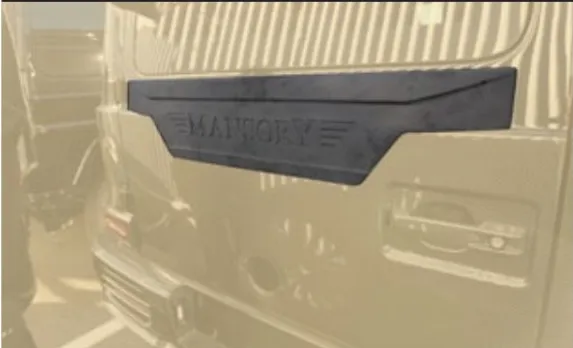
Rear door panel Mansory Carbon for Mercedes G-class G500 / AMG G63 W463A


Rear door panel Mansory Carbon for Mercedes G-class G500 / AMG G63 W463A
The rear door panel is the largest single carbon piece on the back of the W463A G-class — a flat-to-gently-bulged sheet that overlays the OEM tailgate skin, wraps around the spare-wheel mount and dictates how the rear reads from a distance. Within the Mansory Carbon Body Kit for Mercedes G-class W463A G500/G63 programme it does the heavy visual lifting at the back: the spare-wheel cover sits inside it, the frame surrounds it, brand presence is anchored against it. Without it the rear stays half-painted and the carbon story breaks down where the camera lingers.
The Rear Visual Mass
The rear of a G-class is unusual in modern SUV design: it is essentially a vertical wall, broken only by tail lights, the spare-wheel hub, the door handle and the wash-jet. Most rear surfaces in passenger cars curve away — glass, taper, tailgate spoiler. On the W463A there is none of that. The rear door is large, flat and visually loud, and whatever finish it carries becomes the dominant cue from twenty paces away. A painted rear with a carbon spare-wheel cover only treads carbon onto roughly fifteen percent of the rear silhouette; the rest is body colour. Adding the Mansory rear door panel reverses that ratio — the panel covers close to seventy percent of the rear visible field, leaving only the side gaps, the licence-plate well and the lower bumper section in paint. From across a forecourt the rear now reads as a carbon slab with a chrome-bordered spare wheel set into it.
This is why the panel is treated as the frame within which everything else hangs. The cover-II that caps the spare wheel, the surround frame, the brand badge, the carbon door handle — all of them sit in front of, or recessed into, this panel. Specifying the cover and frame without the panel leaves a visual island; specifying the panel without them leaves an oversized blank carbon plane. The three-piece set is what closes the composition.
Curvature, Reflection & Weave Flow
The OEM tailgate is not perfectly flat — it has a subtle inward draw on the upper edge for water shedding and a small radial bulge in the middle where the spare-wheel mounting bolts are sunk through the structure. Mansory's panel respects both. The curvature is matched to the OEM sheet within roughly half a millimetre across most of the surface, then deepened slightly along a band that surrounds the spare-wheel cut-out so the cover sits flush rather than proud. Under direct overhead light the panel throws a soft reflection cone rather than a hard line; walk past it and the reflected sky moves with you in a wide, slow arc instead of jumping across panel breaks.
This curvature also governs how the 3K twill weave reads. On a perfectly flat carbon panel the weave appears as a regular grid, which the eye interprets as crunchy or printed. By adding the slight radial bulge, Mansory makes the weave run through a continuous, slightly stretched diamond pattern from corner to centre, so each diagonal catches light at a slightly different angle and the weave appears to flow rather than tile. The lacquer is built up in three coats with a cross-hatched final flat-sand at 2000 grit before the polish, which preserves weave depth instead of filling it in.
Two-Piece Bonded Construction with Inner Frame
Internally, the rear door panel is not a single moulding. It is two carbon shells — an outer Class-A skin and an inner support shell — bonded around a concealed honeycomb-cored inner frame. The outer skin is 3K twill, prepreg, autoclave cured at roughly 2 bar and 125°C for around six hours, with a wall thickness of 1.6 mm. The inner shell is plain-weave carbon at 1.4 mm, and the honeycomb frame between them is aluminium-cored Nomex strips set along the load lines that run from the hinge edge across to the latch side. This sandwich gives the panel torsional stiffness over a span of roughly 1.2 metres without resorting to thick, heavy walls — important because the OEM tailgate hinges have to swing the panel out, and weight at the panel's outer edge multiplies into hinge torque.
- Outer shell: 3K twill prepreg, 1.6 mm, autoclave-cured (≈2 bar / 125°C / 6 h)
- Inner shell: 2K plain-weave prepreg, 1.4 mm, autoclave-cured
- Core: aluminium-Nomex honeycomb strips bonded along hinge-to-latch load lines
- Total panel weight: ≈3.4 kg vs. OEM tailgate-trim mass of ≈2.1 kg
- Mounting: OEM tailgate-trim clip locations (twelve points) + four stainless drilled inserts
- Finish: clear UV lacquer, three coats, 2000-grit cross-flat then machine-polish
- Optional finish: matte satin lacquer, single-coat hand-flatted
- Edge sealing: black flexible silicone bead on inner perimeter, water-tight against tailgate sheet
Compatibility (Camera, Sensor, Window-Wash Routing)
Designed for the Mercedes-Benz G-class W463A generation only — fourth-generation 2018+ platform, Mercedes internal model code W463A. Fits G500, G550, G400d, G350d and AMG G63 (M177 4.0 V8 BT) with factory spare-wheel-on-tailgate. Pre-2018 W463 (the original boxy generation) is not compatible — different tailgate dimensions, hinge offsets and spare-wheel mount geometry. W464/W465 Gronos cars use a separate panel from the GRONOS programme. The panel ships with cut-outs for the rear-view camera lens (offset upper-left of the spare-wheel cut-out, aligned to the OEM camera sleeve), the high-mount stop-light on AMG-package cars, and the heated-rear-window wash-jet. The lower parking-sensor positions are bumper-mounted, not panel-mounted, so they are unaffected. Wash routing stays internal via a supplied rubber-grommet sleeve. Body-colour repaint over the lacquer is supported for owners who want a painted rear with a carbon-cover-only look.
Installation, Hinge Re-Balance, Drilled Inserts
Fitment is shop-grade work. Most of the panel locates onto OEM tailgate-trim clip positions — twelve clips, with uprated replacements supplied — but four points along the hinge edge and the central spare-wheel surround are secured through stainless drilled inserts, meaning small holes are drilled through the OEM tailgate sheet and reinforced with bonded inserts before mounting. This is what makes the install non-reversible without paint correction; once the inserts are in, the OEM sheet has been modified. Bench time is four to six hours including hinge re-balance.
The hinge re-balance is the step amateurs miss. Adding 1.3 kg net to the trailing edge changes closing torque and can cause the door to drop on a worn hinge spring. Mansory supplies uprated gas struts (or torsion-spring shims, year-dependent) calibrated for panel-plus-cover-II combined mass; they go in before the panel, the door is cycled twenty times to seat the springs, and closing effort is checked against a spec card. Skip this step and the tailgate will sag within six months. The drilled inserts are sealed with marine-grade thread-lock and a flexible silicone collar so water cannot wick into the OEM sheet metal.
Pairing within the Mansory G-class W463A programme
The panel only completes its role when paired with the surrounding rear carbon set. The most direct partners are the spare wheel cover frame, which traces the carbon ring around the spare-wheel hub into this panel's central cut-out, and the carbon door handle with logo, the only piece of brand presence that sits proud of the panel surface. To close the rear story end-to-end, owners add the rear light protection cover across the tail-lamps so the entire rear plane reads as one carbon composition.
Care, Polish, Resealing the Drilled Inserts
The lacquered carbon surface is straightforward — pH-neutral shampoo, soft microfibre, no abrasive sponges, no ammonia-based glass cleaners drifting onto the lacquer. A carnauba paste twice a year suits the slight radial bulge because a flexible film follows the curve; ceramic coating is fine too and will outlast carnauba if applied over fully cured lacquer (minimum 30 days post-fit). Avoid drive-through brush washes — the rotating brushes can catch the inner perimeter silicone bead and lift it over time.
The point owners forget is the four drilled-insert seats. Once a year, trace a finger along the panel's inner edge near each insert and look for a silicone hairline crack. If you see one, a fresh bead of marine-grade flexible silicone is a five-minute job and stops water from reaching the OEM tailgate sheet. The sheet is galvanised, so a slow leak will not eat it overnight, but ten-year ownership is worth twenty minutes of resealing every spring.
Lead Time, Warranty & Replacement
Lead time is four to six weeks — longer than small clip-on parts because the two-piece bonded construction with honeycomb core requires individual layup, a long autoclave cycle, and bench inspection of the hidden core bond before quality release. Each panel ships with a serial number etched into the inner shell and a 12-month warranty against manufacturing defects (delamination, voids, fitment outside the supplied tolerance band). Stone-strike and accident damage are excluded but a replacement panel can be supplied at customer cost in the same window. For collision repairs that affect the OEM tailgate sheet, the four drilled inserts can be transferred to a new tailgate by a Mansory-trained body shop without re-buying the panel.
FAQ
Q: Are the rear-view camera and parking sensor cut-outs already in the panel?
A: The rear-view camera cut-out is pre-cut and aligned to the OEM camera sleeve. The high-mount stop-light cut-out is pre-cut for AMG-package cars and supplied as a closed blank for non-package cars (drilled out on fitment if needed). Lower parking sensors are bumper-mounted so no cut-outs are needed. The wash-jet passes through a supplied rubber grommet.
Q: How much does the panel add to tailgate hinge mass, and do the OEM hinges cope?
A: Net added mass is roughly 1.3 kg over the OEM tailgate trim, total panel mass about 3.4 kg. The supplied uprated hinge gas struts (or torsion-spring shims, year-dependent) are calibrated for this delta and must be fitted with the panel. Skip them and the tailgate sags within months.
Q: What is the weight delta versus the OEM tailgate-trim arrangement?
A: OEM tailgate trim and badging weigh about 2.1 kg combined; the Mansory carbon panel is about 3.4 kg. The rear gains roughly 1.3 kg — small enough to not affect handling, large enough at the trailing edge that hinge re-balance is non-optional.
Q: Can the panel be repainted to body colour for a cleaner monochrome look?
A: Yes. The lacquer accepts primer-and-paint once keyed with 600-grit. Some owners repaint the panel and keep only the spare-wheel cover and frame in raw carbon — a painted rear with a carbon medallion at the centre. Mansory will also supply a matte primer-ready finish on request, skipping the lacquer step.
Pair with the spare wheel cover frame, the carbon door handle with logo and the rear light protection cover to close out the W463A rear in a single carbon plane. To order, talk to us on WhatsApp +44 7488 818 747 or write to [email protected].