
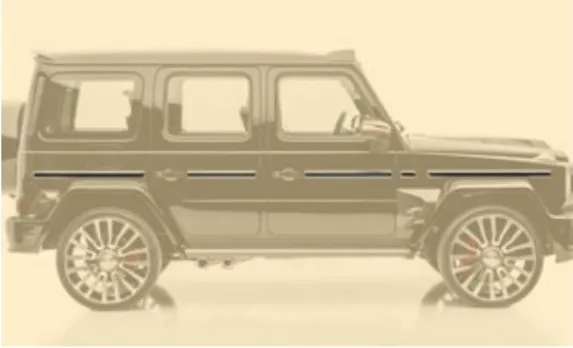
Carbon trimbars Mansory for Mercedes G-class G500 / AMG G63 W463A


Carbon trimbars Mansory for Mercedes G-class G500 / AMG G63 W463A
Stand a stock W463A in profile and the eye sees one continuous slab — door, door, door, rear quarter — broken only by a thin chrome belt. That slab is honest brutalist geometry, but it visually reads as heavy and short, especially on a widebody build where flares push the corners outward. Mansory's carbon trimbars sit along the lower body / rocker line and do one thing: introduce a long horizontal speed line that the eye follows from the front-bumper exit to the rear arch. Specified inside the wider Mansory Carbon Body Kit for Mercedes G-class W463A G500/G63 programme, the trimbars are a low-effort, high-impact graphic break that owners add when the rest of the kit is already loud and they want the silhouette to look longer rather than blockier.
The Side-Line Graphic Break
Industrial-design textbooks call it the "character line" — a continuous edge that gives a flat panel a direction. The W463A factory side has almost none. Two shut lines for two doors, one chrome belt, and a wheel-arch return; that is the whole composition. On a stock G500 or G63 it works because the silhouette is iconic. The moment you fit a widebody flare, however, the side becomes a tall billboard with no rhythm. The trimbars solve that. Each bar runs along the rocker, parallel to the belt line above, at roughly hip height for a person standing next to the truck. The eye locks onto the bar instead of the slab. Suddenly the car looks lower, longer, and more deliberately styled.
There is a subtle second job: the bars sit just above the side-step zone, so when the electric step is retracted the rocker stops looking empty. Owners who specify trimbars together with electric steps describe the area as "layered" rather than "blank." That is the visual function in one sentence — turn one slab into three horizontal bands.
- Weave: 3K twill on the show face, with a 2K plain understructure on the bond surface for stiffness.
- Cure: vacuum-bagged with autoclave post-cure for void-free outer skin.
- Wall thickness: 2.0–2.4 mm shell, plus internal foam core 8–12 mm depending on bar position.
- Weight: a single bar set (left + right pair, full length) lands around 2.6–3.4 kg total — negligible against a 2.5-tonne truck.
- Mounting: factory clip retainers re-used at original locations, plus 3M VHB acrylic foam tape on the long flat sections.
- Finish: clear UV-stable polyurethane lacquer (high-gloss standard, satin / matte on request).
- Pre-bonded mounting bosses: aluminium-threaded inserts laid into the foam core during lay-up — no post-drilling on the bodywork.
- Edge return: rolled, hand-finished, no exposed cut fibres.
Bar Taper, Shadow & Visual Weight
Look at a Mansory press shot of a finished build and you will notice the trimbars are not a constant rectangle. The front segment is slightly deeper top-to-bottom than the rear segment — a gentle taper that drops a few millimetres of section as the bar moves rearwards. The result, under direct sunlight, is a shadow line that thins as it travels rearward. The eye reads that as forward motion, the same trick used on aircraft wings and racing yacht hulls. On the variant pair fitted to the standard non-widebody body the section is more even, because the panel underneath does not need as much visual lifting; on the widebody-panel variant the taper is exaggerated to balance the deeper flare under the door.
Visual weight is the real game here. A bar that is too tall creates a heavy "skirt" — useful on a sports saloon, wrong on an off-road truck. A bar that is too short looks tacked on. Mansory's depth (around 35–55 mm at front, 28–40 mm at rear depending on car height and step option) is the sweet spot where the bar is unmissable in a static photo but disappears when you sit inside and look out the window — which is exactly what the buyer wants.
CFRP Laminate over Foam Core
Long thin carbon profiles have a structural problem: at this length-to-section ratio they want to twist. A pultruded carbon rod would be stiff but visually wrong — pultrusion gives unidirectional fibre with no twill weave on the outside. Mansory therefore lays each bar up by hand: outer 3K twill skin (the cosmetic surface), inner 2K plain skin, and a closed-cell PU/PIR foam core sandwiched between. The foam adds almost no weight but multiplies bending stiffness, so the bar holds its line along a 1.5-metre span without wobble or flex when you press on it. Aluminium threaded inserts are bonded into the foam at the mounting locations during lay-up, then the whole part is vacuum-bagged and post-cured. Cooled, demoulded, deflashed, sanded, primed on the bond face, and the show face goes through six coats of UV-stable clear lacquer with flat-block sanding between coats.
Compatibility (Widebody, Standard, with Side Step)
Mercedes-Benz G-class W463A — the 4th-generation 2018+ platform, internal Mercedes code "W463A." Fits G500, G550, G400d, G350d and AMG G63 (M177 4.0 V8 BT). Pre-2018 W463 (the original boxy G) is NOT compatible — different body, different rocker, different fastener positions. The trimbars come in three fitment variants: (1) standard body, no electric step; (2) standard body with factory or aftermarket electric side step; (3) widebody — used together with the Mansory widebody kit with panels where the lower panel changes geometry. Specify which variant when ordering. LHD and RHD use the same parts mirrored; AMG-package and base trim share the rocker, so no further sub-spec needed.
Installation, Adhesive, Clip Re-Use
Plan a bench day for this. A trained installer needs roughly 2.5–3.5 hours per side including masking, prep, and curing time for the adhesive. The original factory rocker trim (if your car has it) comes off first — release the clips with a trim tool, do not pry against paint. Inspect each clip; reuse the ones that come out clean, replace any that tore. The new Mansory bar drops onto the same factory clip pockets at the front and rear thirds, and the long centre run is bonded with 3M VHB 5952 acrylic foam tape at 21–25 °C surface temperature on freshly de-greased paint. Tape needs 72 hours to reach full bond strength; avoid pressure washing the rocker for the first three days. Reversibility: yes for the clipped sections, partially reversible for the VHB section (the tape can be removed with fishing line and adhesive remover, but there will be a thin residue line that needs polish). No drilling. No cutting. No paint damage when removed correctly.
Pairing within the Mansory G-class W463A programme
The trimbars are a connector — they tie front, side, and rear together — so they reward being specified with at least one front and one rear element. Most-ordered pairings: Widebody kit with panels for the full widebody graphic, Carbon door handle with logo to repeat the bar's twill weave at hand level, and Electric auto side steps short for the layered rocker described earlier. Add bonnet badge or grill logo if you want the same weave to bookend the silhouette front-to-back.
Care, Wax, Polish, Stone-Chip Repair
The bars sit in the worst zone for stone chips on any vehicle — the lower body, where rear-tyre spray throws grit forward against the rocker. Plan for it. A factory-fresh trimbar has a 6-coat UV-stable lacquer that takes light hits without reaching the carbon, but stone chips will eventually appear, especially in gravel use. Wax: carnauba is fine and gives the wettest gloss, but a ceramic coating (SiO₂ or Si–C hybrid, 9H rated) is the recommendation for owners who actually use the truck off-tarmac. Apply only to fully-cured lacquer (4+ weeks from delivery). Wash by hand, two-bucket method, pH-neutral shampoo only. Avoid: dishwasher detergent (alkaline, strips lacquer), ammonia-based glass cleaners on the bar, abrasive sponges, automatic brush washes. Stone-chip repair: small chips (<3 mm) fill with clear UV-cure lacquer pen, level with 2000-grit wet sand, polish with carbon-safe compound. Larger damage — return the bar for re-lacquer or replacement under warranty.
Lead Time & Warranty
Trimbar pairs are made in batches of 30–60 sets and stocked at intermediate level. Typical lead time 3–5 weeks from order confirmation if a stocked variant matches your fitment, 5–7 weeks for a custom finish (matte, satin, tinted lacquer, painted body-colour with carbon strip). Twelve-month manufacturing warranty against delamination, voids, lacquer failure not caused by impact, and fitment outside spec. Stone-chip damage and removal damage are explicitly outside warranty — those are use-case items, not manufacturing defects.
FAQ
Q: Will the bars come off cleanly if I want to remove them later?
A: The clipped sections at front and rear release cleanly with a trim tool — no damage. The centre VHB-bonded section comes off with fishing line and adhesive remover; expect a thin residue line that polishes out in one detail session. No drilling, no paint damage if removed correctly.
Q: Do the trimbars fit alongside Mansory electric side steps?
A: Yes. Specify the "with side step" variant on order — it has a slightly different lower edge geometry to clear the step rail when deployed. The short-step version is the most-paired option; the long-step version also fits.
Q: Painted body-colour or visible carbon weave?
A: Both available. Standard delivery is gloss-lacquered visible 3K twill carbon. On request: matte / satin lacquer, tinted lacquer (smoked / bronze tone), or full body-colour paint over the carbon — the carbon stays underneath and the show face is your car's colour.
Q: How much weight do the bars add?
A: A pair (left + right, full length) is around 2.6–3.4 kg complete, depending on variant. Negligible against a 2.5-tonne G-class. The factory trim they replace weighs almost the same, so net delta is essentially zero — this is a styling part, not a weight-saving part.
Q: How long does fitment take and can I DIY it?
A: 2.5–3.5 hours per side with proper prep and 72 hours of cure time for the VHB before pressure washing. DIY is technically possible but the bond surface temperature and cleanliness control are the two things owners get wrong — a trained installer or detail shop with experience in 3M VHB applications is strongly recommended.
Pair the trimbars with the widebody panels and matching door handles for a coherent side-graphic build, and the silhouette stops being a slab and starts being a sentence. To confirm fitment variant, lacquer choice, and lead time talk to us on WhatsApp +44 7488 818 747 or [email protected].