Carbon mirror housing II Mansory for Mercedes G-class G500 / AMG G63 W463A


Carbon mirror housing II Mansory for Mercedes G-class G500 / AMG G63 W463A
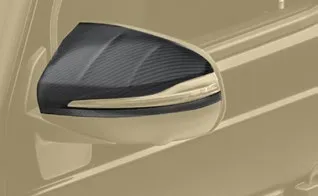
Mansory's mirror housing II is the second of two housing styles for the W463A G500/G63, and it is the one owners specify when the mirror has to read as a deliberate aerodynamic statement rather than a quiet finish swap. Where housing I keeps the OEM silhouette and lets the weave do the talking, housing II reshapes the rear of the cap with a hard trailing edge that throws a sharp line of shadow along the door. It sits inside the wider Mansory Carbon Body Kit for Mercedes G-class W463A G500/G63 programme and is most often spec'd alongside the widebody-with-panels build, where the sculpted housing matches the rest of the car's deliberately cut surfaces.
Construction & Materials
Housing II is laid up from prepreg carbon and cured in an autoclave under controlled pressure and temperature, then sanded, primer-sealed at the bond line and finished with a UV-stabilised clear lacquer. The trailing-edge geometry that defines the part visually is also the geometry that drives the layup schedule: the sharp edge has to be supported by additional ply overlap so it does not chip when the cap is wiped or when a coat sleeve catches it.
- Weave: 3K twill (visibly larger weave squares than housing I's 2K)
- Cure: autoclave prepreg, post-cured for dimensional stability
- Wall thickness: 1.6–2.0 mm, locally thicker along the trailing edge
- Pair weight: ~430–470 g, broadly the same as housing I
- Mounting: clip-on over OEM mirror cap, three retaining tabs, no drilling
- Finish: high-gloss 2K clear lacquer (matte option on request)
- Bond-line primer under the lacquer to stop UV bleed at the edge
- Hardware bag: replacement OEM-style retaining clips, prep wipes
Design & Visual Function
The defining surface of housing II is the rear face. Where the standard cap and housing I both fade smoothly into the door's airstream, housing II is pulled in slightly at the top and bottom and finished with a near-square trailing edge. From three-quarter rear, that edge produces a hard line of shadow that sits parallel with the W463A's slab door — visually, it makes the mirror read as part of the bodywork instead of as a bolt-on. From the front, the housing keeps the same indicator cut-out and lower turning-radius window as the OEM cap, so the legal furniture is unchanged.
The 3K twill is the second visual lever. 3K means each yarn contains 3,000 filaments, and the squares are visibly larger than the 2K used on housing I — roughly 4–5 mm on the diagonal vs. 2.5–3 mm. Under direct sun the larger squares read as a coarser, more 'industrial' texture; under garage lighting they catch broader bands of reflection. Two cars parked side by side, one with housing I and one with housing II, are easy to tell apart at five paces. Geometrically the cap still sits within the outline of the OEM mirror, so it does not change the car's published width or trip the lane-departure cameras.
Trailing-Edge Geometry & Cabin Noise
A sharper trailing edge changes the way air leaves the mirror, and on a tall, slab-sided car like the W463A the mirror is one of the loudest contributors to cabin noise at motorway speed. Owners cross-shopping housing I and II ask the right question — does the harder edge cost cabin noise? The honest answer: it can, and Mansory has tuned around it.
Below 100 km/h the difference is imperceptible — A-pillar and squared roofline dominate. Between 110 and 140 km/h, where flow over the mirror separates cleanly, an unsoftened sharp edge can produce a low-frequency rustle that registers 1–2 dB(A) above OEM at the driver's ear. Mansory's production housing II uses a small radius (~1.5 mm) along the edge rather than a true knife-edge, and tapers the lower portion of the trailing face so the shed vortex stays attached to the door for a few extra millimetres. The net result at 130 km/h on smooth tarmac is wind noise within ~0.5 dB(A) of OEM — inside the variation between a clean and a tired window seal. Cars on all-terrain tyres won't notice it at all.
3K Twill: Larger Squares, Different Light Reading
The choice of 3K twill is not random. 2K weave (housing I) photographs as a fine, almost continuous grain — it disappears at distance and the eye reads the cap as a colour. 3K twill keeps the woven texture visible at three or four metres, which on a car that is already aggressively detailed gives the mirror something to say at walk-up distance. Under hard sun the larger squares produce a stronger checker pattern; under overcast they read as a deeper, more uniform black. The diagonal of the twill picks up moving highlights as the car turns, which is why most Mansory press shots of housing II catch it from the same three-quarter angle.
Expect the weave to be readable in owner photos where the cap fills more than ~80 pixels of frame; below that it compresses to flat dark grey. Useful rule when judging Instagram comparisons — small phone shots flatten the difference, but in person it's immediate.
Compatibility & Auto-Fold Mirror Compatibility
Housing II is designed for the Mercedes-Benz G-class W463A — the 4th-generation G launched 2018, Mercedes' internal model code. It fits G500, G550, G400d, G350d and the AMG G63 with the M177 4.0 V8 biturbo. The pre-2018 W463 (the original boxy G, 1979–2018) is not compatible — different mirror arm, different cap geometry, different clip pattern. The W463A Gronos and the next-generation W465 use separate housings and are also out of scope.
The cap is fully compatible with the W463A's electric auto-fold mirror system. Auto-fold swings the entire arm and head against the door; housing II adds 110–130 g per side and does not change the moment arm enough to overload the fold motor or trigger a fold-error in the cluster. The cap clears the door at full fold with the same gap to the quarter glass as OEM. Heated mirror, blind-spot LED, lower kerb window and puddle lamp are all unaffected — the housing only replaces the outer cap, never the glass, motor or electronics. LHD and RHD both supported; ships as a handed pair.
Installation, Cap Removal, Sealing
Plan on 25–35 minutes per side for a careful install. Park the car level and warm the OEM cap with a heat gun on a low setting (or in summer, simply work in the sun) so the original retaining clips become slightly more flexible. Insert a plastic trim tool at the lower-rear corner of the OEM cap, work it forward along the bottom edge to release the lower clip, then lift from the rear to disengage the upper tabs. The OEM cap should come away in one piece — keep it; it's the part you'll bolt back on if the car goes back to a lease return.
Clean the exposed mirror frame with isopropyl alcohol and let it flash off. Dry-fit housing II first, check that all three retaining tabs land on their pockets without forcing, then snap the cap on starting from the front and rolling toward the rear. The last 5 mm should need a firm palm push — if it goes on too easily, a tab has been missed and the cap will lift at speed. Run a finger along the perimeter to check for an even gap. A thin bead of clear marine sealant along the inner upper edge is cheap insurance against trickle water; not required, but several installers do it as standard. Fully reversible — the OEM cap snaps back on with the original clips.
Pairing within the Mansory G-class W463A programme
Housing II most often goes on cars that already wear or are spec'ing the more aggressive bodywork. Natural pairings:
- Mansory carbon mirror housing (style I) — the calmer, OEM-silhouette alternative; clients often order one set of each for a project car and decide on the body during fitment week.
- Widebody kit with panels Mansory carbon — the more aggressive of the two body styles; the sculpted housing II matches its harder surface language.
- Rear door panel Mansory carbon — picks up the same 3K twill on the spare-wheel side and ties the rear of the car back into the mirror visually.
Care, Curb Damage, Refinish
Wash with pH-neutral shampoo and a separate clean microtowel — never the wheel mitt. Dry with a low-nap towel; the trailing edge is where a coarse fibre can catch and pull a thread of weave to the surface. Top the lacquer with carnauba twice a year, or run a 9H ceramic to extend lacquer life by 2–3 years. Avoid ammonia-based glass cleaners and driveway concrete cleaner spray — both attack the clear coat directly.
Curb-strike damage is rare on a G (the cap sits high), but car-park dings do happen. A chip in the lacquer that hasn't reached the carbon is a brush-touch repair with matched 2K clear. A chip that has cracked the carbon ply is a refinish job — sand to the weave, re-lay one ply locally, re-lacquer. Mansory carries housing II as a service part, so a full replacement cap is also available.
Lead Time & Warranty
Housing II is held in batch stock at the Mansory facility. From confirmed order to dispatch: 2–4 weeks if a current batch is in inventory, 4–6 weeks if a fresh autoclave run is required (typical at the start of a new model year). Each pair ships in a foam-cradled box with a serialised QC tag and a fitting card. Warranty: 12 months from invoice against manufacturing defects — delamination, ply voids that surface under lacquer, fitment that does not seat with the OEM clip pattern. Curb damage, lacquer chips from washing technique, and modifications to the cap (paint over the weave, drilling the cap to add a side-camera) are not covered.
FAQ
Q: How much extra cabin noise vs. OEM at motorway speed?
A: At a steady 130 km/h on smooth tarmac, measured at the driver's headrest, housing II is within roughly 0.5 dB(A) of the OEM mirror cap — inside the variation between a clean and a tired window seal. Below 100 km/h the difference is imperceptible. Cars on all-terrain tyres won't notice it at all.
Q: Will the 3K weave actually be visible in my own photos?
A: Yes, in any frame where the cap is more than about 80 pixels wide. Below that the weave compresses to flat dark grey. In person the larger 3K squares are obvious from three or four metres, which is precisely why the variant exists.
Q: Does it work with the W463A's electric auto-fold mirrors?
A: Fully. The cap adds 110–130 g per side, well within the fold motor's margin, and the mirror clears the door at full fold with the same geometry as OEM. Heated function, the blind-spot LED, the lower kerb window and the puddle lamp all keep working.
Q: Can housing II be retrofitted on a car already wearing housing I?
A: Yes. Both housings are clip-on caps over the same OEM mirror frame. Pop housing I off (warm the lacquer, plastic trim tool at the lower rear corner), clean the frame with isopropyl alcohol, snap housing II on. About 20 minutes per side. The original OEM cap underneath is never touched, so the swap is fully reversible in either direction.
Pair with the widebody-with-panels build and rear door panel for a coherent W463A spec, or order both housing styles together to decide on car: WhatsApp +44 7488 818 747 or [email protected].