
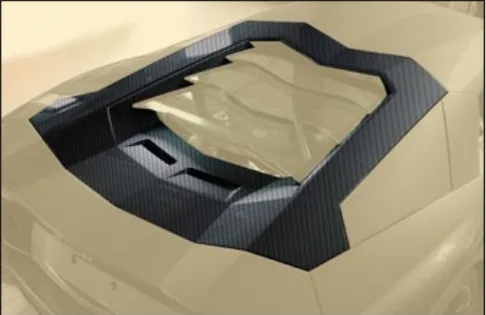
Engine bonnet Mansory Carbon for Lamborghini Aventador


Engine Bonnet Mansory Carbon for Lamborghini Aventador
If the front bonnet is the Lamborghini Aventador's first impression, the engine bonnet is its most technically demanding one. Positioned above the mid-rear V12, the engine bonnet must manage the thermal load from a 6.5-litre naturally aspirated engine producing approximately 700 horsepower in a mid-engine layout that concentrates exhaust heat directly against the lid's inner surface. It must also do so while contributing to the car's aerodynamic balance — the engine bonnet's vent geometry directly influences rear-bay air pressure and, consequently, the pressure available to the rear diffuser's Venturi zone below. Mansory's carbon engine bonnet for the Lamborghini Aventador coupé, part of the Mansory Carbon Fiber Body kit set for Lamborghini Aventador, addresses both demands with structural-grade autoclave-cured prepreg and a precision-louvred vent system calibrated for the LP 700-4's thermal output — the programme's most technically complex single panel.
Construction & Materials
The engine bonnet's thermal environment demands a resin system specification beyond that used for most exterior carbon panels. The LP 700-4's engine bay inner surface, immediately below the bonnet, reaches sustained temperatures of 90–120 °C in hard driving — conditions that would cause creep deformation in a standard structural epoxy over repeated thermal cycles. Mansory specifies a high-temperature toughened epoxy with a glass transition temperature of 155 °C for the engine bonnet laminate — the same class of resin used in motorsport body panels exposed to sustained engine bay radiant heat.
| Property | Engine Bonnet Specification |
|---|---|
| Outer skin weave | 3K twill, 45 ° diagonal orientation |
| Inner skin weave | 2K plain — stiffness and thermal isolation layer |
| Resin system | High-temperature toughened epoxy, Tg 155 °C |
| Cure | Autoclave 135 °C / 7 bar — higher pressure for HT resin compaction |
| Wall thickness | 3.0 mm main panel, 4.0 mm at hinge mounts |
| Vent apertures | 3 × louvred slots, 2K plain blades, 22 ° angle |
| Weight | approx. 12 kg (vs factory LP 700-4 engine lid ~20 kg) |
| Hinge inserts | Co-cured 7075 aluminium — pull-through rated to 3× operating load |
The 8 kg weight reduction relative to the factory engine lid is aerodynamically significant in addition to the obvious mass benefit: a lighter engine lid requires less spring force in the counterbalance mechanism, which reduces the panel's tendency to oscillate at high speed — an oscillation that degrades the louvre's extraction efficiency and creates an undesirable audible frequency inside the cabin at certain resonant speeds. Mansory's autoclave-stiffened panel is rigid enough to suppress this oscillation without supplementary damping hardware.
Design & Visual Function
The engine bonnet's louvred vent system is Mansory's primary visual signature at the rear of the Aventador — the three parallel louvre slots running across the panel's upper surface are the detail most frequently isolated in close-up photography of Mansory Aventador builds. Each slot is formed from 2K plain-weave blades angled at 22 ° from horizontal, directing hot air exhaust rearward and upward — away from the rear windscreen in the coupé configuration and away from the rear occupant zone in Roadster use. The blade geometry creates precise parallel shadow lines across the engine lid's surface in any lighting condition, adding a layer of visual complexity to what would otherwise be an unbroken upper surface.
The outer 3K twill skin provides the visual context for the louvre slots — the diagonal weave diamonds running continuously across the panel surface, interrupted only by the precise geometry of the louvre apertures, create a high-contrast visual composition that distinguishes the Mansory bonnet from any factory treatment at any viewing distance. In raking side light, the weave facets reflect at alternate angles, and the louvre shadows cut across them at 22 °, producing a surface that appears to shift its visual character continuously as the viewer moves around the car.
From a strictly aerodynamic perspective, the louvre slots serve a crucial function: at motorway cruise speed, the dynamic pressure at the engine lid surface drives hot bay air out through the louvres at a rate proportional to the square of vehicle speed. At 200 km/h the extraction rate is sufficient to reduce engine bay equilibrium temperature by 15–22 °C versus a sealed panel — measurable in oil temperature reduction and in the thermal response of the rear brake system that shares this air volume.
Compatibility & Fitment
This is the coupé engine bonnet, designed for the Lamborghini Aventador LP 700-4 (2011–2016) and LP 720-4 50° Anniversario coupé configuration. The Roadster uses a different engine lid geometry — the dedicated engine bonnet cabrio is the correct item for open-top cars. Aventador S (MY2017+) received a redesigned engine bay lid and vent geometry — the Mansory S programme covers that model. The panel is LHD/RHD symmetric — the engine bay lid geometry is identical for both steering configurations.
Installation & Reversibility
Engine bonnet replacement is a scheduled body-shop procedure, typically allocated 4–6 hours including removal of the factory lid, transfer of the hydraulic lid support strut to the Mansory panel, alignment verification at all four hinge points, and final torque. The factory lid can be reinstated in equivalent time — the installation is fully reversible. The hydraulic strut transfer is the most precision-sensitive step: the strut's mounting geometry must be verified against the Mansory panel's co-cured insert locations before final torque to ensure the lid opens fully without binding.
Pairing within the Mansory Aventador programme
The engine bonnet pairs fundamentally with the bonnet air outtake at the front — together they define the car's upper thermal management architecture: hot air enters the front bonnet cavity, is exhausted via the bonnet outtake at the trailing edge, and the engine bay hot air exits via the engine bonnet louvres at the rear. The trunk carbon cover continues the upper surface carbon theme from the engine bonnet to the very rearmost panel of the car, completing the upper deck specification in a continuous material narrative.
Maintenance & Durability
The engine bonnet's louvre slots are the most maintenance-intensive surface in the Mansory upper-body programme — the combination of airflow projection, engine bay particulate, and oil mist from the V12's breathing system can deposit a film of oil-and-carbon-dust on the internal louvre blade faces that accumulates quickly in hard-driven cars. A monthly inspection of the louvre blade inner faces and a degreaser application (non-caustic engine degreaser, applied with a soft brush and rinsed with water) is recommended for cars used on track or driven at sustained full-throttle. The external upper surface of the engine bonnet should receive PPF on the leading edge — the forward 100 mm that catches stone projection from the rear tyres — and a ceramic coating on the remaining surface for UV protection and hydrophobic self-cleaning performance.
Lead Time & Warranty
The engine bonnet's high-temperature resin specification and louvre blade co-curing require careful production scheduling. Mansory allocates 4–6 weeks lead time from order confirmation. The panel is covered by a 12-month warranty against manufacturing defects including delamination at the louvre blade roots, hinge insert pull-through under rated load, lacquer voids on the outer skin, and thermal creep deformation at the vent margins during continuous-service operation within the 155 °C glass-transition rating.
FAQ
Q: How does the Mansory engine bonnet compare to the factory lid on the LP 700-4?
A: The factory LP 700-4 engine lid is a glass-fibre-reinforced composite (not carbon) with a painted finish. Mansory's replacement is 3K twill carbon prepreg at a higher specific stiffness — approximately 8 kg lighter and substantially stiffer in bending, with louvres that replace the factory's passive vent slots with optimised blade geometry.
Q: Does the louvre geometry affect rear visibility from inside the car?
A: On the LP 700-4 coupé, the driver's rearward vision is via the small rear window above the engine lid — the louvre slots are positioned forward of the rear screen aperture and do not affect the visible rearward sightline. The impact on rear camera systems (where fitted) should be confirmed with your chassis-specific camera field of view.
Q: Is the engine bonnet compatible with the factory hydraulic strut system?
A: Yes. The co-cured hinge and strut inserts are dimensioned to accept the factory LP 700-4 hydraulic lid strut without modification. The strut is transferred from the original lid during installation.
Q: What visual finish is available — gloss or matte?
A: High-gloss UV-clear lacquer as standard. Matte lacquer is available on request. The louvre blades are supplied in the same finish as the outer skin for a unified appearance; a contrast finish (gloss outer/matte blades) is available on special order.
Enquire about the engine bonnet via WhatsApp +44 7488 818 747 or [email protected].