
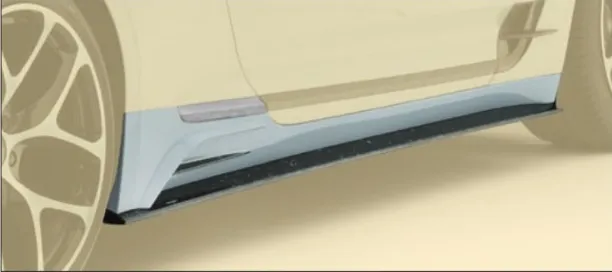
Side skirts Mansory Carbon for Bentley Continental GT GTC V8


Side skirts Mansory Carbon for Bentley Continental GT GTC V8
The Mansory side skirts are a full-length rocker panel replacement in visible carbon, not a sill cover overlay. They reach from the trailing edge of the front wheel arch to the leading edge of the rear arch, integrating with the OEM rocker channel rather than sitting on top of it. In the Mansory programme they are the part that ties the front bumper lip to the rear diffuser horizon line; without them, the lower chord of the car breaks visually at the door cuts and the kit looks unfinished. Programme context: Mansory Body Kit for Bentley Continental GT 2nd-Gen (D2A).
Construction & Materials
Each skirt is laminated as a single piece — no joints under the door cuts, no overlapping panels. The leading edge wraps under the OEM rocker pinch-weld and clips to the existing OEM channel; the trailing edge tucks behind the rear arch liner. Concealed M6 fixings into the existing rocker captive nuts mean no panel drilling and no visible hardware along the sill.
- 3K twill visible-carbon outer skin, 2x2 plain backing for torsional stiffness
- Autoclave epoxy cure at 120 °C / 6 bar, void content under 1.5 %
- Wall thickness 2.2–2.8 mm; locally 3.5 mm at the leading-edge underwrap
- Approximate weight 3.9 kg per side (~7.8 kg pair) vs. ~6.0 kg per OEM rocker assembly
- Stainless M6 captive nut plates on the inner face, mating to OEM rocker channel anchors
- EPDM acoustic foam strip along the inner upper edge to suppress wind drumming at speed
- Pre-machined cut-outs for OEM jacking points and underbody clip locations
- UV-stable 2K acrylic-urethane lacquer, hand-flatted, 60–80 µm
Design & Visual Function
Aerodynamically, the skirts perform a side-wash management role: by extending the lower body line outward by approximately 35 mm and downward by approximately 25 mm at the lower edge, they re-direct the airflow that would otherwise spill from beneath the door cuts back outboard, away from the underbody. The effect is most visible in a smoke-tunnel view — the skirt creates a continuous lower fence between front wheel exit wake and rear wheel inlet wake, reducing the cross-flow under the floor. This is not a downforce-generating feature in the way the front lip is; the gain is in flow conditioning, which is what allows the front lip and rear diffuser to actually do their jobs.
Visually, the skirt drops the apparent ride height of the car and stretches the side profile horizontally. The 3K twill weave runs longitudinally, which under raking sun produces a long, clean directional reflection along the sill rather than the busy patchwork that 2x2 plain weave gives in a long part. The lower edge is profiled with a thin negative chamfer that catches a shadow line — the trick that makes the carbon read as a sculpted feature rather than a flat appliqué.
Door swing clearance is preserved at the OEM angle. Door bottom kerb-strike clearance is reduced by approximately 12 mm, which is well within practical urban use but worth noting for owners who routinely park against high kerbs. The lower edge profile is deliberately under-angled — the skirt does not present a sharp leading edge at the rocker line — which means low-speed kerb contact glances rather than catches; the part is more forgiving of mistakes than its appearance suggests.
The skirt also conceals the OEM rocker pinch-weld, which on a Continental GT is a visually distracting horizontal line under the door cuts. Burying that line under the carbon underwrap restores a clean side profile and is one of the under-recognised reasons the Mansory programme reads as more sculptural than the OEM car despite using the same passenger cell.
A note on weave alignment: the longitudinal 3K twill is hand-aligned across the door cut shadow. Misalignment of even 5° across that cut is visible to the eye in raking sun and is one of the common defects of cheap aftermarket skirts. Mansory tooling indexes the layup against fixed datum points on the inner face so the visible weave runs as a single continuous direction across the entire side of the car when both skirts are paired.
Compatibility & Fitment
The skirts fit the Bentley Continental GT 2nd-generation (D2A) V8 4.0L coupé and GTC convertible. The convertible body has slightly different rocker reinforcement geometry inboard of the visible sill; the Mansory tooling accommodates both. The skirts are not interchangeable with the 1st-gen Continental GT or with the W12 cars whose factory body trim runs to a different sill profile — order strictly to V8 D2A specification. OEM jacking points and underbody clips are preserved; the part is invisible to a service workshop until they look closely at the weave.
Installation & Reversibility
Plan 3–4 hours per pair. Remove OEM rocker mouldings, clean the channel, transfer the OEM clip set into the new captive plates, mount, and shut-line. Body alignment is mostly self-jigging because the skirt registers off the OEM rocker channel; the only adjustment that matters is the door-bottom shadow gap, which should be 4–6 mm and consistent front to rear. The job is fully reversible — OEM rocker mouldings refit on the original clip pattern.
Pairing within the Mansory Continental GT programme
Skirts read best when sandwiched between the matching front and rear elements: the Mansory carbon front bumper with front lip at the front, the rear bumper with diffuser II at the rear, and the mirror housings as a mid-line carbon highlight to keep the eye travelling along the side profile.
Maintenance & Durability
The skirts live closer to the road than any other body panel — they will catch road salt, brake-dust spray, and the occasional kerb scuff. Hand-wash routine, pH-neutral shampoo, dry rather than air-evaporate to avoid water-mark drying on the lacquer. Apply a hard-shell carnauba or SiO2 sealant every six to eight weeks. Avoid the rotary brushes at automatic car-washes; the lower edge of the skirt sits exactly in the dirtiest part of the brush sweep and the lacquer will haze prematurely. Stone chip touch-in is straightforward; deeper damage from kerb strikes is repairable by any competent composite repair shop.
Lead Time & Warranty
Lead time is 2–3 weeks. The pair ships in a single foam-cradled wooden crate to keep the long visible-edge straight in transit. A 12-month warranty against manufacturing defects applies — voids, delamination, lacquer adhesion, hardware faults. Kerb damage and stone chips are wear items.
FAQ
Q: Will the skirts rub on a steep driveway?
A: Lower edge clearance is reduced by approximately 25 mm vs. OEM. Steep entries (1:6 or worse) should be taken at an angle. Air-suspension cars in lift mode have ample margin.
Q: Does the carbon weave run along the length or across?
A: Longitudinal 3K twill outer skin. The reflection runs along the car, which is the visual register Mansory is going for and is the harder lay-up to do well over a 2.2 m part.
Q: Are the fixings visible?
A: No. All hardware is on the inner face and uses OEM rocker captive points. Outer face is uninterrupted carbon.
Q: Will they buzz or drum at speed?
A: An EPDM foam strip along the inner upper edge suppresses the most common drumming frequency. Properly torqued fixings and the foam together make for a silent skirt at autobahn cruise.
Q: Can the skirts be repainted to body colour?
A: The visible-carbon variant is the default; a primed paint-ready variant is available on request with the same lead time.
Q: Do they affect the OEM side-impact rating?
A: No. The OEM rocker structure inside the body remains untouched. The skirt is a cosmetic-and-aerodynamic shell mounted onto the OEM rocker channel and does not load-bear in side impact.
Q: Can the skirts be fitted to a coupé and a GTC convertible interchangeably?
A: The convertible has slightly different inboard rocker reinforcement; the Mansory tooling accommodates both and the visible skirt geometry is common across the two body styles. Order strictly to V8 D2A spec.
Q: Will they conflict with paint protection film along the lower edge?
A: Paint protection film can be applied to the leading 30 cm of the skirt and to the lower edge if desired. The lacquer is film-friendly. Keep the film edge above the lower chamfer to preserve the shadow line.
Q: Do they require any wheel-arch liner modification?
A: No. The skirt registers off the OEM rocker channel and the wheel-arch liner clip pattern is preserved. Service workshops that disturb the front or rear arch liner can re-clip them on the OEM pattern without skirt removal.
Pair the skirts with the matching front and rear elements to lock in the lower chord line. CTA: WhatsApp +44 7488 818 747 or [email protected].