
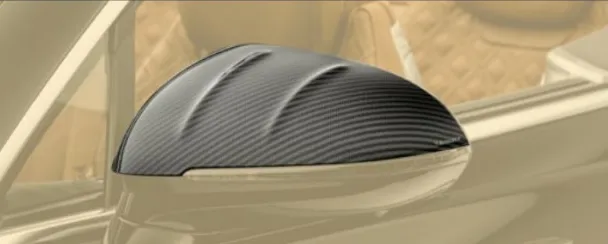
Mirror housing Mansory Carbon for Bentley Continental GT GTC V8


Mirror housing Mansory Carbon for Bentley Continental GT GTC V8
The original Mirror housing in the Mansory Continental GT carbon programme is a pure cosmetic replacement — a one-for-one carbon shell that sits exactly on the OEM mirror base and changes nothing electromechanical. It is the simplest, lowest-risk carbon swap on the car and the one most owners begin with before committing to bonnet, fenders or bumpers. Within the broader Mansory Body Kit for Bentley Continental GT 2nd-Gen (D2A), the housing pair acts as the visual signature at eye-level on either flank: the part most often seen up close, in valet traffic, and in product photography. Sold as a left/right matched pair so that weave alignment and lacquer batch are identical between the two sides — a non-trivial detail given how easily the eye spots tonal mismatch on bilateral parts of a car.
Construction & Materials
The housing is laminated as a single-piece female-tooled shell, not a two-half bonded clamshell. A female tool yields a smooth outer A-surface straight off the cure with no parting line down the middle, which is critical because any seam on a curved mirror catches light and reads as a defect. Layup is 3K twill outer with two structural cross-plies and a thin core gel-coat applied to the tool first to control surface finish. Female-tooled lay-up is also why the housing's curvature is so faithfully OEM — the tool itself was struck from a digitised scan of the original Bentley shell, so the carbon part inherits the original mirror designer's curvature intent rather than overlaying it with aftermarket guesswork.
The inner geometry is reproduced equally faithfully. Clip-engagement ribs sit at exactly the same standoff distance from the tool surface as on the OEM shell, which is why the carbon housing engages the OEM clip pattern with the same retention force the original shell delivered. On lower-grade reproduction housings, the clip ribs are often moulded slightly proud of OEM, which causes either over-tight engagement (and clip breakage on first removal) or under-tight engagement (leading to wind whistle and vibration at speed). Neither failure mode is acceptable on a part destined for a Bentley.
- Outer skin: 3K 2x2 twill prepreg, 200 gsm, weave aligned to part centreline
- Cure cycle: autoclave, 6 bar, 125 C dwell, controlled cool-down
- Wall thickness: 1.4–1.7 mm, kept thinner than Housing II for weight
- Mass per shell: approximately 280 g lacquered (vs OEM painted shell ~410 g)
- Mounting: factory clip pattern, no adhesive, no fasteners
- Finish: 2K automotive clear with UV inhibitor, machine polished to high gloss
- Internal ribs preserved for clip retention strength
- Optional matte finish on request
Design & Visual Function
Where Housing II is the aero-evolved revision, Housing I is the design-purist option. Geometry is held to the OEM external silhouette to a tolerance of roughly half a millimetre across the perimeter. The intent is identifying the car as carbon-spec instantly without departing from Bentley's original mirror line. On a 2nd-gen Continental GT, that mirror line is one of the cleaner, more confident pieces of the original W12 design language, and many owners do not want to alter it. The carbon swap is, in their hands, an upgrade in material rather than in form.
The interest, then, is in weave behaviour. The shell's compound curvature pulls the twill tighter at the upper shoulder than at the trailing edge, and the lay-up is hand-walked to avoid pattern distortion at the high-curvature region above the pivot. Done correctly, the diagonal weave reads as a continuous, slightly tightened lattice across the shoulder rather than a stretched fan — a small detail that separates a tooled Mansory part from a generic hydro-dipped or vinyl-wrapped imitation. The 0-degree weave registration along the centreline of the housing is the second visual cue: a wrap can never deliver that registration because vinyl shrinks and stretches non-isotropically across compound curves.
Lacquer depth is the second visual variable. The 2K clear is laid in two coats with a flat-sand step in between, then polished to a wet-look high gloss. Matte finish, when specified, runs the same UV-inhibitor base under a satin top-coat, and it ages more gracefully on a daily-driven car because hairline swirl marks are less visible. Owners running matte black exterior packs typically specify matte housings; gloss-paint cars typically specify gloss housings. Mixing matte parts on a gloss car is possible but reads as deliberately graphic rather than integrated.
Compatibility & Fitment
Designed for Bentley Continental GT 2nd-generation (D2A) chassis, V8 and W12 variants, model years 2011 through 2017 facelift inclusive. Both coupé and GTC convertible body styles share the same mirror assembly. Compatible with all OEM mirror options on that platform: power-fold, heated glass, memory function, side-camera (where fitted) and OEM blind-spot LED indicators. The housing covers, but does not interfere with, the indicator LED module — the lens lines up with the OEM cut-out automatically on fit. Vehicles upgraded with aftermarket puddle-light units in the mirror underside should verify the underside cut-out before fitting, since not every aftermarket puddle module honours OEM dimensions.
Installation & Reversibility
Each side is a 20–30 minute install for someone familiar with mirror trim work. The OEM cosmetic shell unclips from its three retention points by gentle outward pressure starting at the leading edge. The carbon housing then locates onto the same retention pattern and is hand-pressed home until the perimeter seats flush against the mirror base. No tools required if shells release cleanly; a soft trim-removal pry can help on cars where the OEM shell has been bonded by years of accumulated wax. A torque-free press-fit is the right method — if the housing does not seat with hand pressure, stop and inspect the clips rather than forcing engagement.
Pairing within the Mansory Continental GT programme
Most buyers pair the Mirror housing with 15 Lamels performance grill as a discreet first-stage carbon treatment, then progress to Engine bonnet and Front bumper with front lip as the next stage of build. The grill-and-housing pairing is popular because both parts are reversible without bodywork involvement — a low-commitment way to test the Mansory direction on a car before deeper investment.
Maintenance & Durability
Autoclave-cured prepreg is dimensionally stable across the operating envelope of a road car. The UV-inhibited 2K clear is rated for years of outdoor exposure before clear-yellowing becomes visible to a trained eye, and a ceramic coating extends that further by reducing direct UV-on-clear time. Avoid alkaline wheel cleaners and acidic bug-removers on the housing surface; both can soften lacquer over time. Gentle hand wash, two-bucket method, microfibre dry — standard high-end carbon care. Drying the housing immediately after a wash matters more on carbon than on paint because mineral spots etch into clear lacquer faster than they etch into properly painted steel.
Lead Time & Warranty
Lead time runs 2 to 3 weeks from order confirmation, with the matte finish option occasionally extending to 4 weeks during peak autoclave demand. Twelve-month warranty covers manufacturing defects in lay-up, bonding, and lacquer adhesion. Impact, kerb-strike or modification damage is not covered. The warranty is transferable with the vehicle on resale, which is occasionally relevant for collector-grade Continental GTs whose ownership chain is documented.
FAQ
Q: Should I pick Housing I or Housing II?
A: Housing I if the goal is a clean factory-silhouette carbon swap. Housing II if the goal is a slightly wider, aero-flavoured profile with turning vanes. Both share lacquer and weave specification. Housing I tends to suit purist-spec restorations and W12 GT Speed builds; Housing II suits broader Mansory-spec wide-body builds.
Q: Will it vibrate at autobahn speed?
A: No. The internal ribs that engage the OEM clips are preserved, and the laminate is structurally cross-plied. Vibration concerns generally trace to clip wear on cars over 100k km — fresh OEM clips solve any residual issue.
Q: Are the housings sold individually?
A: They ship as a matched left/right pair so weave alignment and lacquer batch are identical between the two sides. Single-side orders are possible but visually less consistent and usually not recommended.
Q: Does it work with the OEM side-camera mirror option?
A: Yes. The housing leaves the mirror base, glass, and any side-camera module untouched; it only swaps the cosmetic outer. Side-camera lens cut-outs are honoured.
Q: Can I clay-bar the housing?
A: A fine-grade clay used with proper lubricant is safe. Avoid medium or heavy clay grades — they can mar the clear under repeated passes. Synthetic clay mitts are gentler than legacy clay bars and are our preferred recommendation.
Begin a Mansory-spec Continental GT build at eye-level with the Mirror housing pair, then layer in bonnet, fenders, and bumper as the project develops. WhatsApp +44 7488 818 747 or [email protected].