
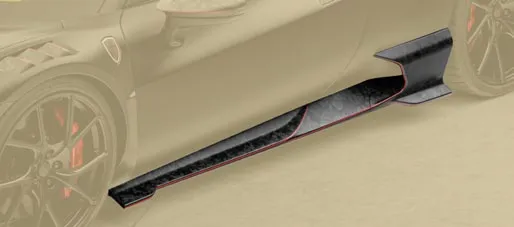
Side skirts II Mansory for Ferrari 296 GTB


Side Skirts II Mansory for Ferrari 296 GTB
The Mansory Side Skirts II redefine the lower longitudinal profile of the 296 GTB by introducing a deepened undercut blade that sharpens the rocker line, compresses the visual ride height, and participates actively in the car's underbody aerodynamics. As a component within the broader Mansory Carbon Fiber Body kit set for Ferrari 296 GTB, this second-generation skirt profile extends roughly 12 mm lower than the Side Skirts I, generating a more aggressive lateral shadow-line and a measurably tighter venturi channel beneath the sill. The Ferrari 296 GTB's short wheelbase — just 2600 mm — concentrates enormous visual weight between the wheel arches; a properly engineered side skirt exploits this geometry to anchor the car visually to the road while simultaneously contributing to the pressure differential that the underbody floor relies upon. The twin-turbo PHEV powertrain — 2.992 L hot-vee V6 producing 663 hp paired with a 165 hp axial-flux electric motor for 830 hp combined — generates sustained thermal load that migrates to the sill zone; the Side Skirts II's blade profile encourages lateral airflow that helps dissipate heat radiated from the central tunnel where the 7.45 kWh battery pack sits at operating temperature.
Construction & Materials
Every Side Skirts II panel is hand-layed in 3K twill-weave carbon fibre pre-preg over a precision CNC-machined aluminium mandrel and autoclave-cured at 120 °C under 6 bar for a 4-hour dwell cycle. This cure schedule drives full resin polymerisation and eliminates the microporosity visible in ambient-temperature vacuum-bag parts — critical for a panel that must tolerate stone impact, thermal cycling, and the mechanical vibration of a high-output PHEV drivetrain without developing surface crazing or subsurface delamination. The laminate builds to 2.8 mm at the primary vertical face, thinning gracefully to 1.6 mm at the lower trailing lip where the aerodynamic blade terminates, preserving stiffness-to-weight ratio across the span. Two 2 mm 6061-T6 aluminium stiffening inserts are bonded into the rear quarter of each panel to prevent panel flutter at motorway speeds — a phenomenon that produces audible resonance and contributes to long-term fatigue cracking at clip mounting positions. Pair weight is approximately 1.6 kg, against roughly 4.8 kg for the OEM painted composite rocker assembly.
- Fibre: 3K twill pre-preg, visual-grade A-face, symmetric [0/90/±45] cross-ply stack
- Cure: full autoclave 120 °C / 6 bar, 4 h dwell, 24 h cool under load before demould
- Wall thickness: 2.8 mm primary face; 1.6 mm trailing blade lip
- Weight per pair: ≈ 1.6 kg (saving ≈ 3.2 kg vs. OEM composite)
- Mounting: OEM rocker tab system (6 points per side) + 3M VHB HS tape on full flange contact face
- Finish: UV-stable 2-coat clear lacquer, 80 µm dry-film thickness; satin available on request
- Internal stiffeners: bonded 2 mm 6061-T6 strip, rear section only, structurally bonded with aerospace-grade two-part epoxy
- Substrate: exposed 3K weave; panel cannot be body-colour painted without abrading the lacquer finish
Design & Visual Function
The defining characteristic of the Side Skirts II versus the Side Skirts I is the secondary lower lip — a forward-swept blade that drops the effective sill height by approximately 12 mm at its lowest point before curving back up into the rear quarter panel. This geometry achieves two things simultaneously: it channels separated boundary-layer airflow that would otherwise tumble at the door-sill step back into an attached stream directed toward the rear underbody diffuser, and it creates a hard undercut shadow-line that makes the car appear wider and lower when viewed from a three-quarter standing angle. The 296 GTB's short wheelbase and high-mounted greenhouse mean that the lower body receives disproportionate visual attention from observers; a deep skirt line concentrates the car's identity in the zone that Ferrari's own design language — the "tea-tray" rear deck, the broad flanks, the pinched nose — sets up as the dominant visual corridor.
Aerodynamically, the Side Skirts II function as a lateral seal for the underbody pressure gradient established by the front splitter and front lip. By reducing the volume of high-pressure ambient air that leaks inward beneath the sill, they help sustain the low-pressure zone under the floor that generates downforce on the rear axle — particularly relevant given the rear-biased weight distribution of the PHEV platform. The battery pack and rear-mid engine mounting add roughly 150 kg compared to a comparable pure-ICE Ferrari V6 layout, shifting the weight balance rearward and increasing the importance of rear aerodynamic stability at track velocities. The secondary lip's inboard face also incorporates a small radial deflector that directs stone and water scatter away from the exposed sill weld seam, reducing the likelihood of paint damage under the carbon panel edge — a practical quality-of-life detail for cars that see regular road use.
Compatibility & Fitment
The Side Skirts II are engineered to the Ferrari 296 GTB coupé (2022+), 296 GTS spider (2023+), and 296 Assetto Fiorano specification. Rocker geometry is shared across all three variants, so the same panel fits without modification. No steering-side restriction applies — the skirt profile is symmetric about the car's longitudinal axis and suits both LHD and RHD drivetrains. At standard suspension ride height, the lower blade lip sits approximately 80 mm from a flat surface; owners who run lowered suspension settings or track-configuration ride heights should verify clearance before fitting. The Mansory side skirt replacement does not interact with the OEM front-nose lift system, which operates only in the front-subframe zone. The 296 Speciale shares the same basic rocker geometry as the GTB; owners of Speciale variants should confirm at order stage.
Installation & Reversibility
Begin by removing the OEM rocker moulding using a trim-removal tool to release the six clip-and-tab retainers per side — no cutting or drilling is required. Clean the sill contact face with isopropyl alcohol and allow to dry completely. Offer the Mansory panel dry to confirm consistent gap uniformity along the door sill and front/rear arch transitions before committing to adhesive. Apply 3M VHB HS tape in a continuous bead along the full inboard flange contact surface, then press the skirt firmly into position and re-engage the OEM clip positions. Apply light clamping pressure with soft-jaw panel clamps for 4 hours to allow the VHB bond to reach working strength before driving. Total installation time per side is 45–60 minutes for an experienced installer. The installation is fully reversible: the VHB bond can be cleanly separated using dental floss or a Sikaflex bond-cutter without marking the lacquered face or damaging the sill paint. A Ferrari-certified bodyshop or experienced detailer can complete both sides in a single morning.
Pairing within the Mansory 296 GTB programme
The Side Skirts II's rearward trailing lip aligns aerodynamically with the Rear Fender Air-Intake Splitter Mansory for Ferrari 296 GTB, which picks up the accelerated sill channel flow and routes it into the rear wheel arch ventilation circuit — specifying both parts produces a coherent lateral-to-rear aero strategy. The underbody aerodynamics initiated by the skirt's lower blade are completed by the Rear Diffuser with Brake Light Mansory for Ferrari 296 GTB, which extracts floor air at the trailing edge — the two parts together form the primary downforce-generating backbone of the programme. For owners building the full lower carbon story, the Side Skirts I Mansory for Ferrari 296 GTB represents an alternative profile with a slightly higher blade line, suited to owners who prefer a subtler underbody silhouette.
Maintenance & Durability
Lacquered carbon fibre requires a structured maintenance routine to preserve its optical quality over years of road and track use. Apply a carnauba wax or SiO₂ ceramic coating immediately after installation; SiO₂ coatings offer superior UV protection and hydrophobic performance but must be applied to a fully decontaminated surface. Reapply protection every six months for cars used on track, every twelve months for road-only use. Never use ammonia-based glass cleaners, strong alkaline degreasers, or dishwasher-style surfactant products on the carbon surface — these attack the polyurethane lacquer at a molecular level, producing micro-crazing that initially appears as a slight haze and progresses to complete topcoat failure within a season. Machine polishing with abrasive cutting compounds is incompatible with exposed weave panels — the abrasive cuts through the thin lacquer topcoat and into the resin, leaving dull patches that cannot be reversed without a full re-spray. Use a finishing glaze only, applied by hand with a clean, damp microfibre pad, to remove light water spots or surface contamination. For stone chip repairs, source a lacquer pen matched to the original cure chemistry — cold-applied single-part lacquers applied over a warm repair area will bloom and highlight rather than heal the damage. Inspect the panel underside annually for delamination at the VHB bond line, particularly on cars that regularly traverse speed humps, where repeated flex cycling at the OEM clip anchor points can initiate inter-laminar shear if the adhesive bond has softened due to thermal cycling.
Inspect annually for any signs of delamination or VHB bond degradation.Lead Time & Warranty
Side Skirts II panels are produced in batches at the Mansory composites facility, with a typical lead time of 3–4 weeks from order confirmation to despatch. Each pair ships with a 12-month manufacturer's warranty covering delamination, lacquer finish voids, and dimensional fitment tolerance failures at the OEM clip positions. Warranty claims for material or manufacturing defects are handled directly by Hodoor — contact the team with photographic documentation and your original order reference. Impact damage, abrasion from kerb contact, or lacquer degradation caused by incorrect cleaning chemistry falls outside the warranty scope.
FAQ
Q: Do these skirts fit the 296 GTS spider as well as the GTB coupé?
A: Yes. The 296 GTS shares the same rocker geometry as the GTB coupé, and the Side Skirts II fit both variants without any modification. The same panel covers LHD and RHD configurations since the profile is longitudinally symmetric.
Q: How do the Side Skirts II differ from the Side Skirts I aerodynamically?
A: The primary difference is the secondary lower lip on the Side Skirts II, which drops the effective blade height by approximately 12 mm. This deeper profile extends the undercar venturi channel width, increases the lateral boundary-layer seal against ambient pressure, and produces a more pronounced visual undercut — at the cost of slightly reduced ground clearance at the lowest point of the blade.
Q: Can I have the panels in a matte or raw-weave finish rather than glossy lacquer?
A: Mansory supplies the standard panels in a gloss UV-lacquer finish. A satin-finish lacquer is available on request and should be specified at order stage. True raw weave (no lacquer) is not available in the standard programme; raw panels require regular application of carbon-specific penetrating wax to prevent UV yellowing of the exposed resin.
To add the Side Skirts II to your 296 GTB Mansory specification or discuss finish and fitment details, contact us via WhatsApp +44 7488 818 747 or [email protected].