Rear diffuser with brake light Mansory for Ferrari 296 GTB


Rear Diffuser with Brake Light Mansory for Ferrari 296 GTB
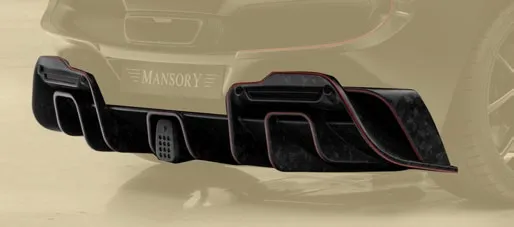
Among all the aero components in the Mansory 296 GTB programme, the rear diffuser occupies the most consequential aerodynamic position: it is the single largest contributor to underbody downforce, governing the pressure gradient that accelerates air beneath the floor and extracts it at the trailing edge of the car. The Mansory Rear Diffuser with integrated brake light replaces the OEM rear bumper lower section with a full-width, vertically finned carbon-fibre diffuser unit that expands the underbody flow path from the rear axle centreline to the bumper exit plane, creating a controlled Venturi diffusion zone that converts floor-level dynamic pressure into genuine downforce on the rear axle. As a cornerstone of the Mansory Carbon Fiber Body kit set for Ferrari 296 GTB, this diffuser is designed around the 296 GTB's specific underfloor geometry — including the clearance envelope of the 8-speed DCT gearbox housing and the battery cooling outlets that exit at the rear undertray edge. The integrated LED brake light replaces the OEM centre-high-mounted stop lamp that the standard 296 GTB carries in the same zone, maintaining legal lighting compliance without external appendages. The PHEV drivetrain's hybrid mass distribution — with the 7.45 kWh battery pack seated low and rearward in the central tunnel — shifts the 296 GTB's weight balance toward the rear axle; enhancing rear downforce through an optimised diffuser directly supports the handling balance that this weight distribution creates.
Construction & Materials
The diffuser housing and vertical fins are fabricated in 3K twill-weave pre-preg carbon, autoclave-cured at 120 °C under 6 bar. The primary horizontal floor plate — the surface closest to the road and most exposed to ground-strike risk — is constructed at 4 mm wall thickness, tapering to 2.5 mm at the fin leading edges to reduce aerodynamic interference drag at each fin junction. The fin array consists of seven vertical separators spaced at 65 mm pitch across the diffuser width; each fin is a double-curvature profile in plan view, angled to accelerate flow toward the diffuser exit plane while suppressing lateral oscillation of the separated underbody vortex cores. The integrated brake light module is housed in a carbon-faced aluminium extrusion that spans the full diffuser width, sealed to IP67 standard, and carries a 48-LED array powered through the OEM brake light wiring harness — no additional wiring is required. Total diffuser assembly weight is approximately 4.2 kg, including the light unit, versus approximately 5.8 kg for the OEM painted plastic assembly.
- Weave: 3K twill pre-preg, visual A-face on all exterior-visible surfaces
- Cure: autoclave 120 °C / 6 bar, 4 h dwell
- Floor-plate thickness: 4.0 mm; fin thickness: 2.5 mm at leading edge
- Fin count: 7 vertical separators at 65 mm pitch, double-curvature plan profile
- Brake light: 48-LED array, IP67, carbon-faced aluminium extrusion housing
- Wiring: plug-and-play into OEM brake light harness connector — no cutting
- Assembly weight: ≈ 4.2 kg (saving ≈ 1.6 kg vs. OEM)
- Finish: UV-stable gloss lacquer on all carbon faces; light housing sealed with UV-stable polycarbonate lens
Design & Visual Function
The Venturi diffuser operates on the principle of controlled flow expansion: air entering the diffuser throat at the rear axle is travelling at high velocity and low pressure, having been accelerated beneath the floor by the favourable pressure gradient sustained by the front splitter and side skirts. As the diffuser channels this flow rearward through the expanding fin array, the cross-sectional area increases progressively, converting dynamic pressure into static pressure and — critically — generating a suction force on the rear undertray that pulls the chassis toward the ground. The Mansory diffuser's fin geometry has been developed to maximise the pressure-recovery efficiency of this expansion zone while suppressing the turbulent separation at the fin trailing edges that would otherwise create an unsteady suction field with time-varying downforce magnitude. The result is rear axle downforce that increases consistently with speed, providing a stable handling characteristic that rewards committed track driving.
The seven-fin layout separates the full-width underbody flow into discrete channels, each channel exiting as an individual high-velocity jet into the lower rear wake. This structured exit prevents the chaotic cross-flow mixing that occurs behind a plain open diffuser, reduces wake drag, and concentrates the underbody suction over a wider spanwise footprint. At 200 km/h, the combined aerodynamic effect of the diffuser with the rear spoiler generates rear axle downforce that meaningfully supplements the 296 GTB's 830 hp mechanical grip — the PHEV platform's substantial rear mass ensures that the aerodynamic input is always working on a well-loaded rear axle, avoiding the rear-lift-at-speed sensitivity that affects lighter mid-engined cars with insufficient aerodynamic stability.
Compatibility & Fitment
The Rear Diffuser with Brake Light is engineered for the Ferrari 296 GTB coupé (2022+), 296 GTS spider (2023+), and 296 Assetto Fiorano. The diffuser interfaces with the OEM rear bumper structure at the same mounting geometry as the original lower bumper section; no modification to the rear bumper upper fascia is required. The integrated brake light plugs directly into the OEM centre stop-lamp wiring harness connector at the rear of the luggage bay — no wiring modification or relay addition is required. Ground clearance of the diffuser floor plate at standard ride height is approximately 95 mm — sufficient for normal road use but requiring care on severe speed humps or steep ramp entrances. For the 296 Speciale, several diffuser interface dimensions differ slightly; confirm compatibility at order stage. LHD and RHD configurations use the same panel — the brake light harness connector position is centrally mounted and independent of steering side.
Installation & Reversibility
Rear diffuser replacement begins with removing the OEM lower bumper section — retained by 6 M6 bolts and 4 push-pin clips at the bumper lower edge — and disconnecting the OEM brake light harness connector. The Mansory diffuser aligns to the same mounting geometry; offer the unit dry to confirm gap at the bumper upper rail and side skirt junction before committing to final fastening. Connect the brake light harness and torque the mounting bolts to 8 Nm. Full installation time is approximately 2–2.5 hours, including brake light function test before the car leaves the workshop. The installation is reversible — the OEM lower bumper section and its light unit are unmodified and can be reinstalled in approximately 45 minutes. A qualified auto electrician or Ferrari-certified bodyshop should carry out the work to ensure the OEM harness connector is not stressed during removal and reinstallation.
Pairing within the Mansory 296 GTB programme
The diffuser's aerodynamic contribution is greatest when paired with the Rear Wing Mansory for Ferrari 296 GTB, which adds high-mounted downforce that balances the diffuser's underbody suction — the two parts together define the 296 GTB's high-downforce aerodynamic balance. For a complete lower-body aero package, add the Rear Fender Air-Intake Splitter Mansory for Ferrari 296 GTB, which manages the wheel-arch exit flow that would otherwise disturb the diffuser's boundary layer. Owners specifying the low-profile rear aero variant should consider pairing with the Rear Spoiler Mansory for Ferrari 296 GTB in place of the full rear wing for a subtler combined downforce signature.
Maintenance & Durability
The diffuser floor plate is the most road-exposed exterior carbon surface on the car, subject to stone impact and occasional ground contact on severe ramp transitions. Inspect the floor plate and fin leading edges after each track session for impact damage; small chips in the lacquer should be touched up immediately to prevent moisture ingress into the laminate edge. The diffuser fins should be cleared of rubber debris — which accumulates rapidly on track cars — using a dedicated rubber-removal spray and a soft brush; hardened rubber deposits that are scraped off risk marking the lacquer. The LED brake light lens is polycarbonate-sealed; inspect the seal annually for UV yellowing that may reduce luminous output below regulatory thresholds. The aluminium extrusion housing of the light unit has a hard-anodised surface that is resistant to road salts and brake dust contamination; clean with a damp cloth and dry promptly. Do not use high-pressure washers directed into the fin channels — the water column can stress the fin-to-floor bond line at high hydrostatic pressure.
Inspect annually for any signs of delamination or VHB bond degradation.Lead Time & Warranty
The rear diffuser assembly, including the integrated brake light unit, carries a lead time of 4–5 weeks from order confirmation. The 12-month manufacturer's warranty covers delamination, fin-to-housing bond failures, LED array failure, and dimensional fitment tolerance failures at the bumper mounting interface. Electrical components carry a 12-month warranty against manufacturing defects — field replacement of the LED strip is possible without removing the diffuser from the car via the access panel in the boot floor. Contact Hodoor with order reference and photographic documentation for all warranty enquiries.
FAQ
Q: Does the integrated brake light meet legal road-use requirements?
A: The LED array is rated at 400 cd of red light at full activation and is designed to comply with EC Regulation 48 for rear stop-lamp luminous intensity and activation angle. The centre stop lamp position matches the OEM brake light location. Owners in markets with specific national type-approval requirements should confirm compliance with their registration authority before fitting.
Q: How much rear downforce does the diffuser add?
A: Precise downforce figures depend on ride height, approach angle, and the presence of other aero components. The Mansory diffuser is not wind-tunnel validated in the public domain; the fin geometry is developed from CFD modelling as part of the full 296 GTB kit. Owners seeking certified downforce data for competition homologation should enquire about Mansory's extended aerodynamic documentation service.
Q: Can the diffuser be fitted with a different finish for the fin faces — matte instead of gloss?
A: Yes, the standard programme offers a satin-lacquer option on request, which reduces the reflective glare from the fin array when the car is viewed from behind. Specify the desired finish at order stage; the LED housing is always supplied in a gloss-lacquer carbon face regardless of fin finish.
Q: Will this diffuser clear typical urban speed humps?
A: At standard suspension ride height the floor plate has approximately 95 mm clearance. Most urban speed humps are designed to 75–100 mm height; approach at a crawl and at a slight angle if the hump is higher than 80 mm. With lowered suspension the risk of ground contact is real — consider a front-lift-system equivalent for the rear if the car is run very low.
To configure your 296 GTB diffuser specification or discuss pairing options with the rear wing programme, reach us via WhatsApp +44 7488 818 747 or [email protected].